Senate Public Health Committee advances bill to allow Ibogaine trials
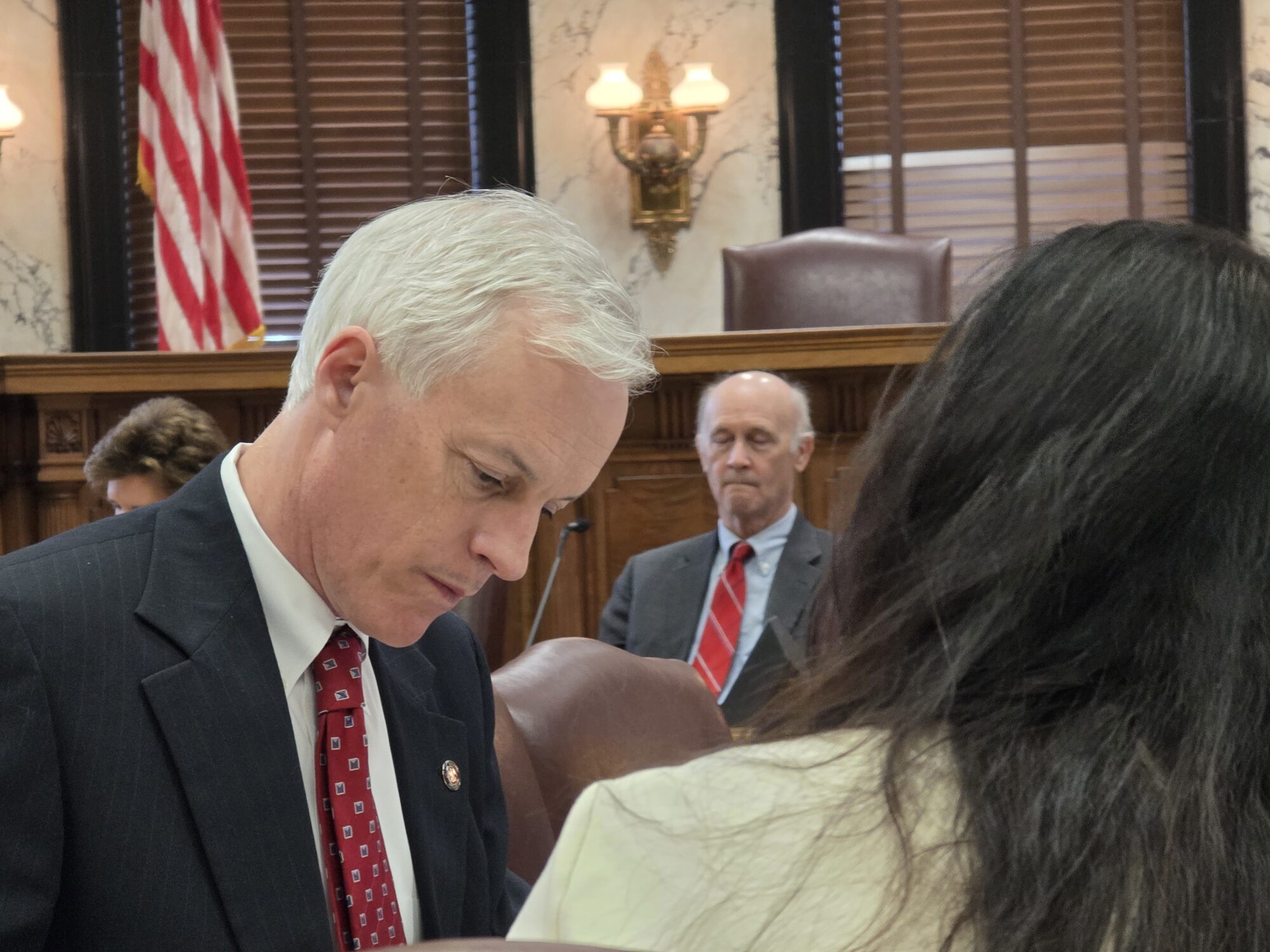
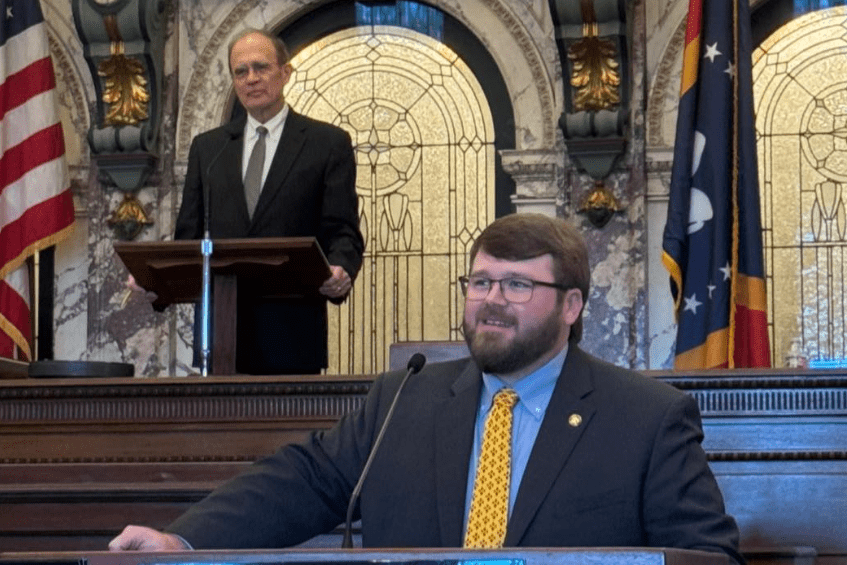
Senator David Blount looks over bills during a Senate Public Health Committee meeting held on Feb. 24, 2026. (Photo by Jeremy Pittari | Magnolia Tribune)
- Another bill that would have allowed terminally ill patients to use medical cannabis gummies while being treated in a hospital did not pass the Senate Public Health Committee this week.
The Senate passed a bill out of the Public Health Committee this week that could allow people suffering from neurological conditions or addiction to receive Ibogaine treatment, while killing another bill that would allow terminally ill patients to receive medical cannabis gummies while being treated in a hospital.
Ibogaine Trials
HB 314, authored by State Rep. Samuel Creekmore (R), would allow clinical trials of Ibogaine.
“If you’re asking what is Ibogaine, Ibogaine is a psychoactive alkaloid found in the root bark of the African Aboga plant,” State Senator Josh Harkins (R) explained to the committee on Wednesday. “Pharmacologically, Ibogaine interacts with multiple brain systems and is thought to contribute to prolonged effects on mood and craving.”
Data from studies conducted by Stanford University in 2024 as well as data from those traveling out of the country to places like Mexico to receive treatment demonstrate Ibogaine could help those suffering from PTSD as well as reduce the symptoms of persons suffering from substance use withdrawals.
“Abroad, Ibogaine is being used in supervised clinical settings with promising results,” Harkins explained.
Harkins added that the results are still considered preliminary and there are dangers and side effects with the treatment, such as risks to the heart. Medical screenings are required prior to treatment due to the potential side effects. However, Stanford’s research and the results coming from novel treatments abroad are promising.
“Of the treatments that are novel treatments for opiate use disorder, this is among the most promising and it’s why I’m in support of this bill,” Dr. Tom Recore, Medical Director of the Mississippi Department of Mental Health told the committee.
The legislation, which would allow clinical tests of the treatments in Mississippi, is needed since Ibogaine is currently a Schedule I controlled substance.
“To be a Schedule I in America, a substance must be highly addictive and have no medicinal value,” Harkins said. “We can argue that Ibogaine has neither of those characteristics.”
Under the bill, the state Department of Health would form a consortium of a drug developer, lead university, and hospital to conduct Ibogaine clinical trials, with the goal of obtaining FDA approval for the treatment of opioid use disorders and neurological conditions such as PTSD.
“It does not legalize general Ibogaine use. It confines activity to FDA regulated research and future FDA approved medical use,” Harkins explained.
Mississippi’s trials would be coordinated with those taking place in other states, such as Texas where that state has already committed to holding its own trials.
Recore said each treatment costs about $50,000, which is significantly less than the $250,000 typically paid for a standard substance abuse treatment at a medical facility.
The entire treatment, screening included, can last about 48 hours and has a high success rate. Recore said that of 30 patients treated for issues caused by traumatic brain injuries only one still showed signs of traumatic brain injury after the Ibogaine treatment.
While the treatment appears to have long-standing positive outcomes for treating addiction, Recore said there is the potential for relapse.
“I would also say that if folks return to the conditions that led to them being addicted to opiates in the first place, so they’re hanging out with folks that are using opiates regularly, and then they could possibly become convinced that since they don’t have an opiate problem any more they could take some opiates that the probably if a relapse would be high,” Recore explained.
The bill calls for $5 million from the Opioid Settlement Fund to be used to seed the program.
Medical Cannabis in Hospitals
Another bill that would have allowed terminally ill patients to use medical cannabis gummies while being treated in a hospital did not pass the Senate Public Health Committee this week. However, a motion to reconsider was entered, meaning the bill may be reconsidered.
“This seems to me to be a variation on where we are in this never never land of marijuana, where as best I can tell, one of the most longstanding and useful benefits from marijuana is either dealing with the effects of chemotherapy or dealing with people in the last stages of their life,” Public Health Committee Chair State Senator Hob Bryan (D) said while explaining HB 1034.
“We’re allowing a terminally ill patient to get marijuana gummies if he’s in the hospital. The dilemma is that doctors cannot prescribe, as you know, because of the federal regs,” Bryan added.
State Senator David Blount (D) pointed out that a terminally ill patient would already have received a prescription for medical cannabis since it is one of the state’s approved conditions.
State Rep. Kevin Felsher (R), the bill’s author, said the measure was drafted in response to a case where a terminally ill pancreatic cancer patient was provided medications in the hospital that diminished his quality of life.
“For the first two to three weeks they treated him with fentanyl and opioids, and he had no quality of life and could not communicate with his family,” Felsher described.
In response, the patient’s father sought out THC as an alternative treatment in a different facility.
“And with the THC, Ryan became lucid, and was able to communicate for five to six weeks of his life. He was able to interact with his family and have a little bit of quality of life,” Felsher added. “The initial facility would not allow that.”
He went on to say that the people who qualify under this bill have already been diagnosed as having less than a year to live by their treating physician.
State Senator Dennis DeBar (R) expressed concern about the potential for the hospital being responsible for securing and disposing of any remaining medication. Felsher said the law states that the caregiver has those responsibilities, but there could be isolated instances when the hospital would be on the hook.
The House bill does not mandate that hospitals allow the use of the gummies but provides protections. A provision in the legislation gives hospitals the option to opt out, stating that “the facility or caregivers of the facility are not responsible for providing medical cannabis for registered qualifying patients.”
State Senator Nicole Boyd (R) also expressed concerns that the bill would not protect the hospital from violation of federal regulations.
“Because as we know the federal government does like to act retroactively sometimes,” Boyd said. “So, I’ve got huge concerns given the language that we have right here.”
Uncertainty with the potential negative side effects of cannabis use were cited by State Senator Angela Hill (R).
An amendment submitted by State Senator Chad McMahan (R) to include the wording that a “medical facility with a hospice unit shall allow” the treatment aimed at addressing some of the concerns was not adopted by the Senate committee. State Senator Jeremy England also submitted an amendment to clarify and clean up some language. It was adopted.
In the end, the Senate committee voted against the bill in a close 8 to 9 show of hands.
State Senator Brice Wiggins (R) sought to keep the measure alive by entering a motion to reconsider. Bryan declined to entertain a motion to table to give members time to conduct more research, adding the committee may take it back up on Tuesday.
“I want to make clear, my intention was to at least keep the possibility alive that the committee might want to reach another decision on Tuesday, but I don’t know what, if anything, we’ll do about that Tuesday,” Bryan said.
The chairman also informed the committee that he also expects to bring up bills on PBM and certificate of need reforms during Tuesday’s meeting.

Jeremy Pittari