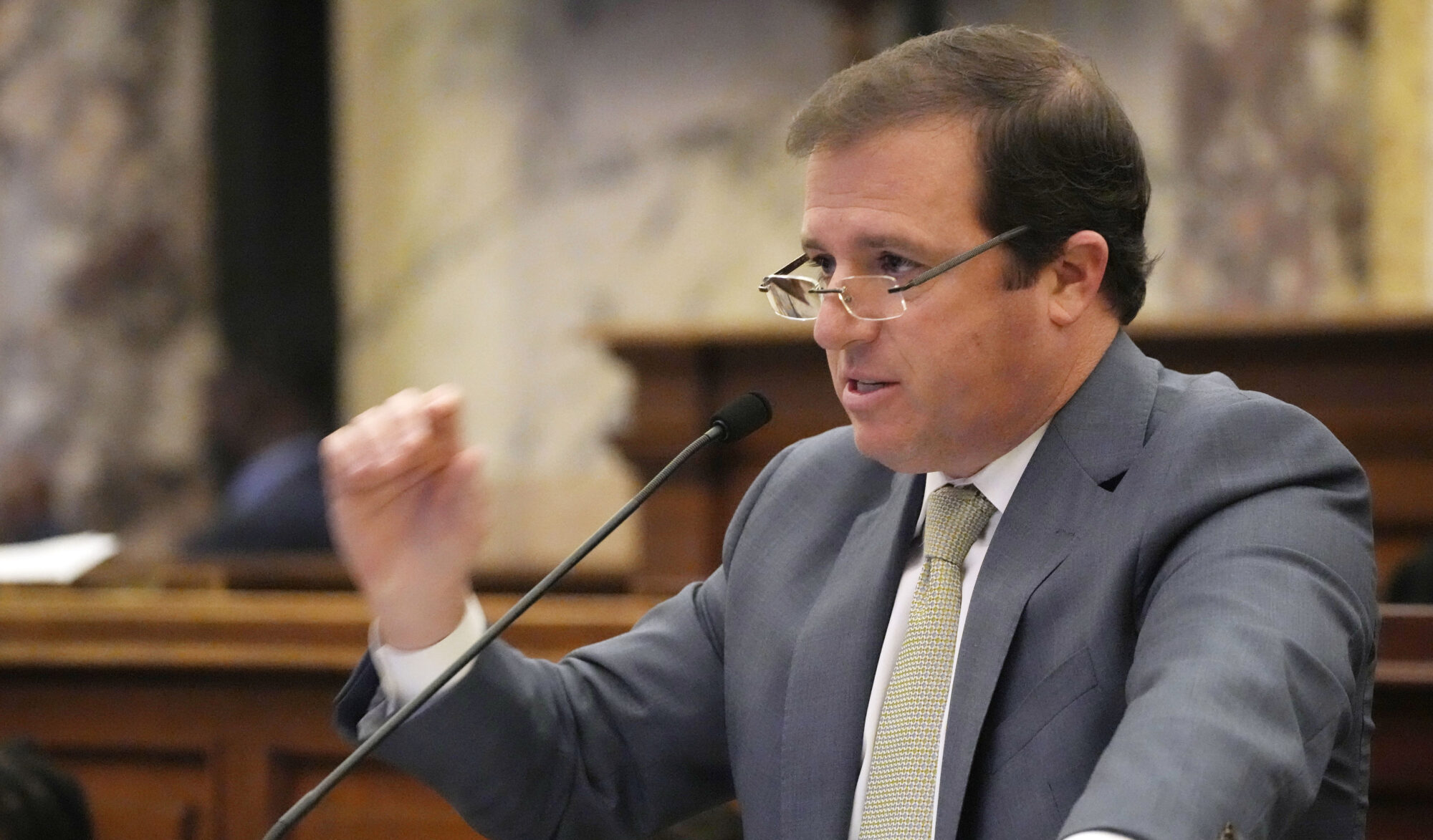
Mississippi State Finance Committee Chairman Josh Harkins, R-Flowood, in the Senate chamber at the Mississippi State Capitol in Jackson, Miss., Thursday, Jan. 25, 2024. (AP Photo/Rogelio V. Solis)
- State Senator Josh Harkins says when taxpayer dollars are invested, Mississippi has the right to define the terms of that partnership — including the expectation that workers’ choices about representation are made through a private ballot.
Mississippi is entering a new era of economic development. Major manufacturing projects, supply-chain expansions, and long-term capital investments are accelerating across our state. These projects can bring good jobs and sustained growth — and they are often supported by carefully structured incentive agreements intended to keep Mississippi competitive in a national and global marketplace.
When taxpayer dollars are part of an economic development package, the state has both the authority and the obligation to set clear, reasonable conditions for how those dollars are used. Those conditions protect the public’s investment, strengthen predictability, and ensure agreements are built on known expectations from the start.
That is why I introduced Senate Bill 2202.
SB 2202 is straightforward: for companies that choose to accept future state economic development incentives, any decision about union representation should be made through a private, secret-ballot election. The bill does not prohibit employees from organizing. It does not outlaw unions. It does not interfere with an employee’s right to choose union representation if a majority wants it. It simply sets an expectation that the decision is made in a way that protects privacy.
Under federal labor law, union representation is commonly determined through a secret-ballot election overseen by the National Labor Relations Board. Another path can occur when an employer voluntarily recognizes a union based on signed authorization cards — often called “card check.”
A private-ballot election is the gold standard for protecting an individual’s choice. It allows each worker to decide privately, without having to publicly disclose a position to coworkers, supervisors, union organizers, or anyone else. In any matter as consequential as workplace representation, confidentiality matters.
By contrast, a card-signing process is not a confidential vote. When support is shown through collected signatures rather than a private election, the process can invite pressure from any direction, and it can leave employees feeling exposed. A secret ballot removes that concern by ensuring each person’s vote is their own.
SB 2202 also addresses so-called “neutrality agreements” in the context of state incentives. In plain terms, these agreements can limit what an employer can say during an organizing campaign. My goal is not to tilt the playing field for either side — it is to ensure workers receive information and can hear perspectives before making a decision that could substantially affect their workplace.
Just as importantly, SB 2202 applies prospectively. It is limited to future incentive agreements and future organizing efforts tied to those incentives. Existing collective bargaining agreements, currently unionized workplaces, and subcontractors are not affected. The bill follows Mississippi’s long-standing practice of attaching performance and compliance standards to public incentive packages.
That’s not unusual. States regularly condition incentives on job creation thresholds, wage benchmarks, capital investment commitments, and regulatory compliance. These guardrails aren’t symbolic — they protect the integrity of the state’s return on investment and give policymakers and taxpayers a clear way to evaluate risk and accountability.
Mississippi is not alone in this approach. States including Georgia and Tennessee have enacted policies linking state economic incentives to secret-ballot protections, and Alabama has pursued similar legislation — all while continuing to compete successfully for major industrial investment.
And the issue is not hypothetical. According to the U.S. Bureau of Labor Statistics, about 5.2% of Mississippi wage and salary workers were union members in 2024. As our economy grows and new facilities open, organizing activity may increase. Establishing clear, consistent expectations now provides certainty for employers, employees, and taxpayers.
Economic development policy should balance competitiveness with accountability. Every incentive package is a fiscal decision: it uses limited public resources in pursuit of job growth and long-term investment. Mississippi should continue to compete aggressively — but we should do so with guardrails that reinforce transparency, stability, and public confidence.
SB 2202 reflects that principle. When taxpayer dollars are invested, Mississippi has the right to define the terms of that partnership — including the expectation that workers’ choices about representation are made through a private ballot. That protects employees, strengthens accountability, and supports a stable, predictable business climate.

Josh Harkins