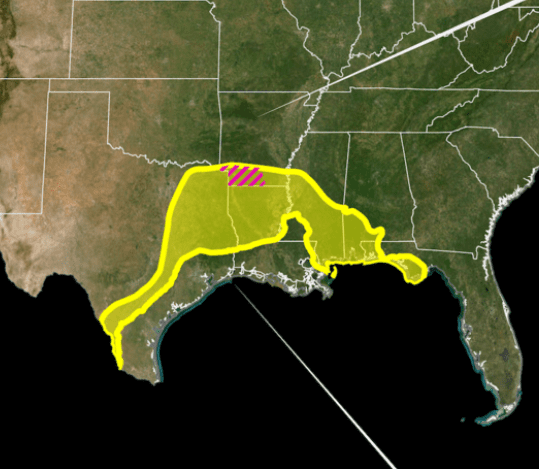
The Smackover Formation (from USGS)
- Mississippi sits on the Smackover Formation, which contains one of the nation’s highest-grade lithium brines. The element is viewed as a critical part of U.S. national energy security.
Could lithium brine be Mississippi’s next energy boon?
That was the question debated for nearly four hours on Wednesday at the Mississippi Natural Resources Summit in Jackson, where participants learned the Magnolia State could lead in the production of domestic lithium, which is critical in national energy security.
Mississippi sits on the Smackover Formation, which contains one of the nation’s highest-grade lithium brines, high-salinity waters associated with deep salt deposits, said Tim Palmer, a surface geologist at the Mississippi Department of Environmental Quality. The geological formation dating back to the Jurassic era extends across several states, from Texas to Florida.
“Mississippi holds one of the highest quality lithium brines in the world,” he said, challenging the much sought-after products of South America’s Lithium Triangle in Argentina, Bolivia, and Chile.
Lithium brine is used mainly in lithium-ion batteries, which are essential in electric vehicles, renewable energy storage systems, and energy-intensive industries. Data centers, of which Mississippi has seen major investments from over the last three years, are using lithium-ion batteries more due to efficiency, reliability, and sustainability benefits versus traditional batteries system, according to CloudCow, a comprehensive resource for cloud computing news, analysis and information.
Palmer noted that Mississippi’s brine has a concentration reaching 1,700 mg/L, which makes it economically sound for extraction. Decades of oil and gas operations produced—and reinjected—an estimated 12.5 million metric tons of unrecovered lithium, representing a major untapped resource, he told the audience of scientists, oil and gas executives, attorneys, and state employees.
Lithium brine production is part of Governor Tate Reeves’ Mississippi Power Play, an initiative to make the state an energy-producing powerhouse, said David Dockery, the state’s geologist.
Scientists from Oak Ridge National Laboratory in Tennessee, Edgar Lara-Curzio and Parans Paranthaman, part of the U.S. Department of Energy, said extraction of the brine is already done in the western U.S. and Texas. Dr. Paranthaman said that Direct Lithium Extraction (DLE) technologies have several advantages over other methods.
DLE decreases the footprint by eliminating the need for huge evaporation ponds, thus reducing land use and environmental impacts. Also, DLE technology speeds the production cycle from months to hours through adsorption rather than evaporation.
One participant predicted many bumps along the way to extraction. In Mississippi, said Steve Walkinshaw, an independent explorer, the state recognizes two owners of land, the surface owner and the mineral owner. Finding the rightful owners of both the land and the mineral rights is often difficult, as ownership often changes every generation. This will result in legal problems when it comes to paying royalties.
“You have challenges such as stepchildren, out-of-wedlock children, divorce, remarriages,” when searching for rightful owners, he said, adding that this can hurt exploration.
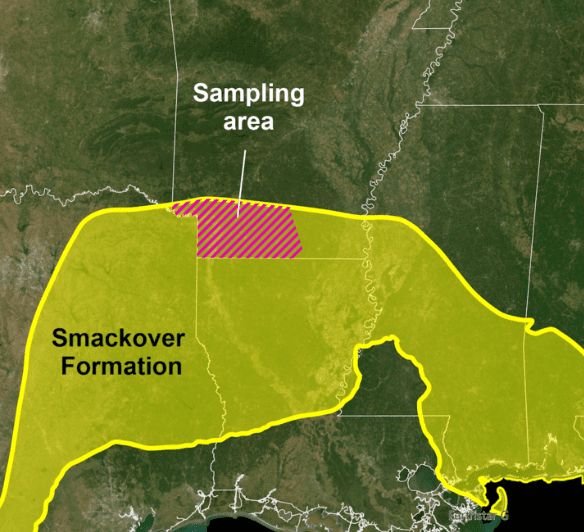
During a panel discussion on how to legislate and write laws on lithium brine extraction, a common response from the experts was “look at Arkansas.”
Mississippi and Arkansas share the Smackover Formation, but Arkansas is already accepting applications for brine units in the southern part of the state.
Arkansas law states royalties are paid to property owners who agree to lease their mineral rights to the extraction companies. A brine unit must be created for an extraction company to establish royalties.

Daniel Tyson