- Wilkinson County School District, Holmes Consolidated School District and the Noxubee County School District recently provided updates to the State Board of Education.
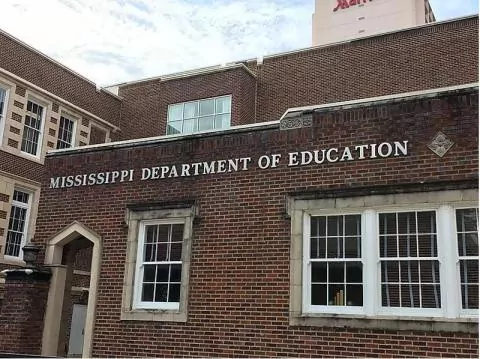
Interim leadership from three districts of transformation under the oversight of the Mississippi Department of Education shared the gains and challenges that remain on the path back to local control.
Last month, half of the superintendents in six school districts currently under state control shared their update. On Thursday, superintendents from the other three – Wilkinson County School District, Holmes Consolidated School District and the Noxubee County School District – updated the Board of Education on how they are working to bring their districts into compliance.
A district becomes a district of transformation if it cannot maintain sufficient academic performance, lacks fiscal viability, and/or show signs of other deficiencies in its operation over multiple years.
The three districts represented Thursday were moved under state control for deficiencies in meeting education standards as well as fiscal concerns.
Holmes County Consolidated School District Interim Superintendent Dr. John Jordan said his two priorities are addressing the accountability ratings and the district’s serious financial issues. Jordan told the Board that the financial issues were so bad that it was noted by the auditor that an audit could not be performed. The district became a district of transformation in August 2021. It most recently received an assessment score of a C.
Since 2021, efforts to increase the fund balance have brought it from a low of $8.1 million that year to about $10.7 million in the 2024-25 school year. Leases of 16th section land have also increased in revenue, from $601,811 to $1.2 million in the same period.
Low student proficiency ratings, which were all below 10% in the 2020-21 school year, also plagued the district. In that school year, proficiency in English was 8.3% and science was just behind at 8.2%. Proficiency in math was at 3.3%. However, the school has consistently held a high graduation rate, coming in at 98.1%.
The most recent proficiency rates Jordan presented demonstrated improvement, with English at 27.4%, math at 36.4%, and science at 43.6%.
Jordan also said an ongoing issue with chronic absenteeism and the difficulty in finding highly qualified educators. However, he did note that despite the challenges, graduation rates in the district have been seemingly unaffected. They have remained in the top 10 in the state, he told the Board.
“Something that is really strange to me that I’ve got to investigate is, is that we’re in the top 10 in graduation rate, we’re in the bottom 10 as far as chronic absenteeism,” Jordan explained. “It doesn’t go together in a way, but I will eventually figure out how we’re pulling that off. I’m sure it’s very legitimate.”
Safety was a concern noted by all three interim superintendents, though Holmes County has a larger issue.
“And Holmes County is going through a wave of violence among its young people, not school age, but still young.” Jordan added. “When you’re losing them to gunfire, it makes it a little harder.”
Noxubee County School District was taken into conservatorship in July 2018, also for academic and “extreme” fiscal deficiencies.
Interim Superintendent Dr. Washington Cole IV elaborated that the district failed to meet 26 of the 32 standards for accreditation at the time. In the years since, 22 of those 26 violations have been rectified, the district has been rated a C for the past three of four years, and has a fund balance of $6.2 million. In 2018, the fund balance was in the red by nearly $900,000.
Efforts are underway to address falling student enrollment, make upgrades to facilities, and ensure the safety of the schools.
Across the district, nearly 80% of all HVAC systems have been renovated while all roofs have been replaced and restrooms have been modernized.
Securing and ensuring high-quality instruction are priorities to help bring student proficiency higher. Cole said that in 2018, the district had proficiency rates in the single digits, with high school math showing only 2% proficiency. Today, that statistic is 59%.
ELA proficiency was at 30% district wide, but now it stands at 54%, and math has gone from a low of 16% to 24%.
Cole said chronic absenteeism is still being addressed, but has seen improvement. It was at 31.2% during the 2024-25 school year, but has declined to 25.6% this school year, just below the state average of 26.5%.
“We celebrate that it’s below the state average, but it’s nowhere near where it needs to be, because that’s roughly 25% of your population not in the classes at any given time and that’s unacceptable,” Cole said.
Just like the other districts, Cole described difficulty in recruiting and retaining quality teachers.
Wilkinson County School District became the most recent district of transformation when the state stepped in in January of this year for academic issues.
Interim Superintendent Walter Atkins Jr. said the district received an F assessment grade for two consecutive years and there was an issue with high school testing in 2023 that resulted in that school not receiving an assessment grade that year.
“We were placed in district of transformation due to serious academic deficiencies that demonstrated the district’s inability to provide students with adequate and stable education,” Atkins explained.
He said audits for fiscal years 2023 and 2024 are underway, some administrative positions were merged for cost savings, and new procedures for purchasing and procurement have been implemented.
Atkins added that the district saw a first in more than five years this school year.
“This is the first time since July of 2022 that Wilkinson County School District has started the school year with all of its administrators in place,” Atkins said.
The issues that remain, Atkins said, are the need to build teacher capacity, enact early intervention, set more uniform school practices to meet district goals, and monitor the use of federal funds.
To reconnect with the community, Atkins is holding town hall meetings every nine weeks and offering parents transportation to the schools during the days when report cards are issued. He said the path to building trust with parents is long, since many parents still demonstrate a level of distrust with the district.
Some facility improvements are also underway. Atkins said when he came on as the interim superintendent, the first thing he noticed was the “K” on the high school gym was upside down, and the “H” was missing. That issue along with improvements to landscaping and work to improve the district’s “optics” have been completed.
“Our security booth was degrading, it hadn’t been painted in years,” Atkins said. “I decided to paint it myself. That Monday morning when the children came on campus I wanted that to be the first thing that they saw.”
In other business, the Board of Education approved a motion to create a methodology to dispense the $350,000 in state funding the Legislature approved to help cover the cost of ACT prep materials and services to students.
Chief Operating Officer Wendy Clemmons explained that the amount of funding each district will receive in reimbursement funding will be based on the total number of applicants.
Since the appropriation did not have a legislative provision mandating a focus on low performing schools, the application process will be open to all districts.

Jeremy Pittari