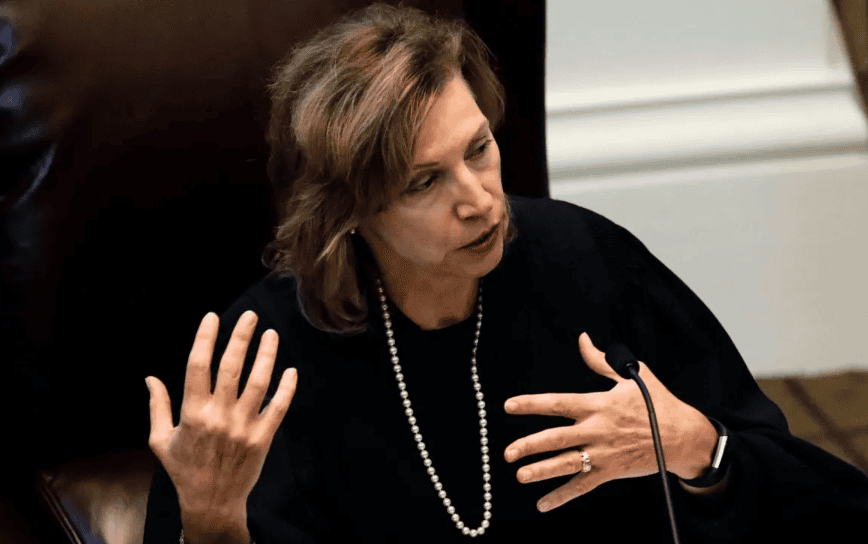
U.S. District Court Chief Judge Sharion Aycock of the Northern District of Mississippi (AP Photo/Rogelio V. Solis)
- U.S. District Court Judge Sharion Aycock said the group of DeSoto County residents challenging the new court districts “wholly failed to carry their burden” and “are entitled to no relief at this stage.”
U.S. District Court Judge Sharion Aycock denied a preliminary injunction on Thursday that was being sought by a group off DeSoto County residents to block the creation of new judicial subdistricts as approved by the Mississippi Legislature.
The plaintiffs in the case, which include Robert Foster, Katie Ligon, Kirby Cater, and John T. Williams, filed the challenge to the new subdistricts in the wake of the Callais v. Louisiana ruling by the U.S. Supreme Court. That ruling determined racial gerrymandering to be unconstitutional as it had been practiced under Section 2 of the Voting Rights Act.
The defendants in the matter are the State of Mississippi and the Board of Election Commissioners.
During the 2025 legislative session, lawmakers passed two bills as part of judicial redistricting based on the results of the 2020 Census. The lawsuit alleges the passage of HB 1544 and SB 2768 that year created racially segregated voting precincts within DeSoto County. An election to fill the newly created circuit and chancery court seats is set for November with the new judges taking office on January 1, 2027.
At issue, as outlined in the lawsuit, is that the law “specifically mandated that this new fourth circuit judge and new third chancellor, with authority and jurisdiction over the entire county, would only be elected from a racially-gerrymandered, majority-minority subdistrict within the County, made up of only nine (9) of DeSoto County’s forty-seven (47) precincts, encompassing just 22.6% of DeSoto County’s voting-age population (the “Majority-Minority Subdistrict”).” The judge elected from the subdistrict will have jurisdiction over the entire district.
On the chancery court side, the legislation moved DeSoto County into its own chancery district, creating one additional seat for the chancery court, for a total of three judges. Two of those judges will continue to be elected by all citizens in the county, but the new judge is to be chosen from voters living within those same nine districts.
“Stated more plainly, DeSoto Countians living within the majority-minority subdistrict have four votes for DeSoto County’s circuit judges, and three votes for DeSoto County’s chancellors, whereas DeSoto Countians living outside the majority minority subdistrict get only three votes for DeSoto County’s circuit judges and two votes for DeSoto County’s chancellors,” the lawsuit claimed.
Court filings show that two candidates have qualified for each position, with Lucius Edwards and John Hughes qualifying for the circuit court position and Gwendolyn Baptist and Malenda Harris Meacham qualifying for the chancery court position.
Judge Aycock’s order on Thursday stated that halting the creation of the new subdistricts now is too close to the election date, writing that “the Court finds that there is a significant risk of voter confusion if the subdistrict were struck down at this time.”
“The Plaintiffs’ proposal of striking down the subdistrict and reopening the qualifying window for a one-week period ahead of an election that is less than 90 days away is wholly impractical,” the judge wrote.
In addition, Aycock opined on the merits of the case as presented by the plaintiffs to date. She raised a number of concerns with their reasoning, focused largely on race considerations lawmakers used during the process of drawing the new subdistricts.
“Ultimately, disregarding the flaws with the manner in which the Plaintiffs have pled their claims, they have come nowhere near providing the requisite level of evidence to establish that the merits are clearcut in their favor. Again, their strategy of simply placing into evidence the debate from the Mississippi House floor where race was discussed, along with the conference report and a map of the subdistrict, is insufficient,” Judge Aycock wrote. “It ignores the presumption of legislative good faith and fails to take into account the portions of the debate where the Legislature discussed other principles that led to the creation of the map. And even to the extent the Legislature did consider race, the Plaintiffs have provided no argument or proof to rebut the reality that the Supreme Court made clear in Callais that ‘compliance with the Voting Rights Act can indeed provide a compelling reason for race-based districting.’”
Aycock also took issue with the plaintiffs waiting so long to file their complaint.
While Aycock did not grant the preliminary injunction, the case can proceed, writing in her order, “The Plaintiffs may very well eventually be able to prevail on their claims following discovery and a trial on the merits, but they must do far more than present minimal evidence and request that the Court make inferential leaps.”
You can read the full order from Judge Aycock below.