Screenshot
Listen to the audio version of this article (generated by AI).
- Calvin Coolidge slashed spending and the national debt. He cut taxes and championed American business. Coolidge ushered in the unbridled success of the Roaring 20s, and yet, he’s forgotten.
At a Washington dinner party, a socialite sidled up to President Calvin Coolidge with a mischievous smile. “Mr. President,” she said, “I’ve made a bet that I can get you to say more than three words.”
Coolidge looked at her, expression unchanged, and replied, “you lose.”
That was Calvin Coolidge in a nutshell. Few words. No theatrics. No appetite for spectacle. And, perhaps because of that, one of the most misunderstood — and under-appreciated — presidents in American history.
On Presidents’ Day, Americans tend to remember the loud ones — the generals, the orators, the reformers who promised sweeping change. But in the nation’s long history, there was one president whose greatness lay not in what he did, but in what he refused to do.
A Presidency of Restraint
Coolidge came to office in 1923 after the sudden death of Warren G. Harding, whose administration had been marred by scandal. Washington was weary, cynical, and in need of something honest.
Coolidge provided it.
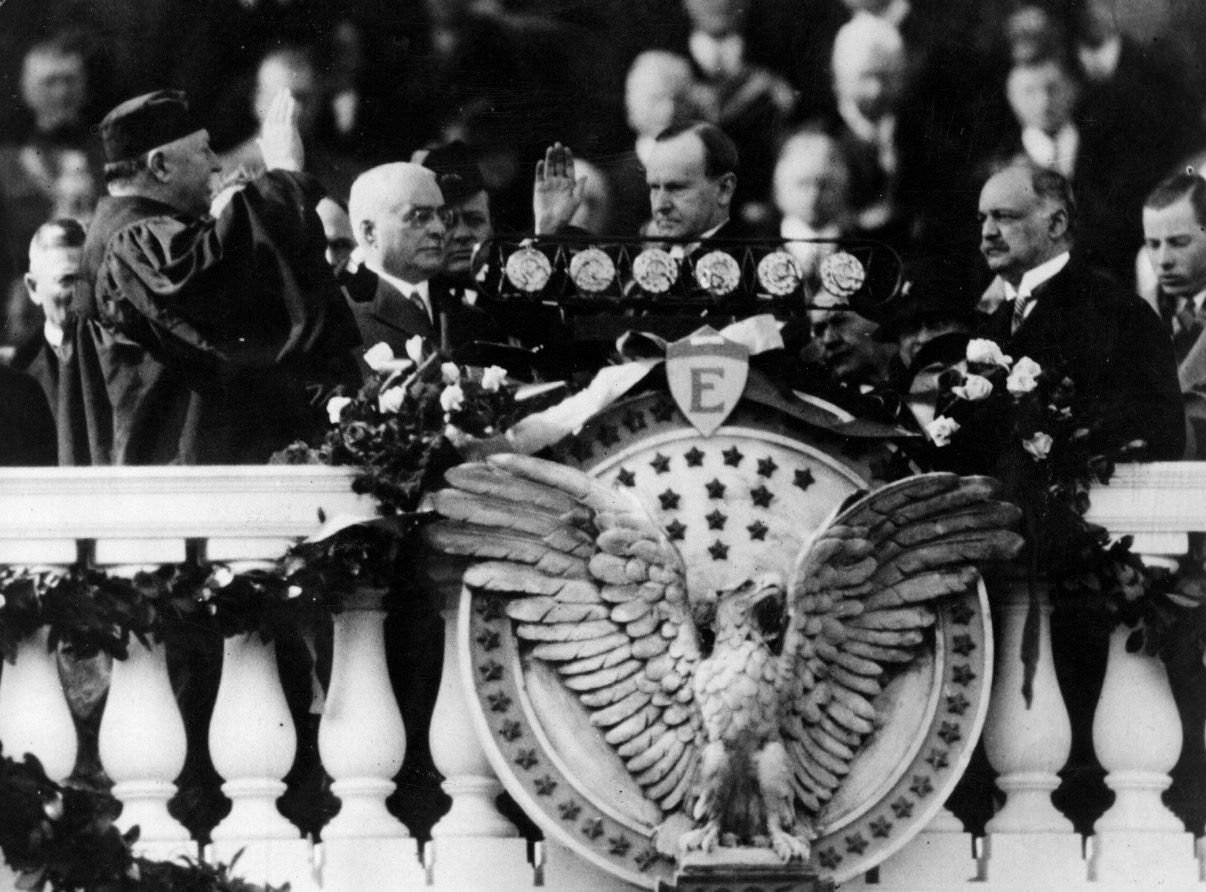
As the story goes, Coolidge was sworn in first by his dad, a notary public, on the family Bible before submitting himself to being sworn in by the Chief Justice.
He believed government was most effective when it was limited, disciplined, and respectful of the people’s freedom. To him, the presidency was not a pulpit for grand social engineering. It was a trust to be handled with care, humility, and restraint.
That philosophy produced one of the most remarkable fiscal records of any modern president.
When Coolidge took office, the national debt stood at $22.3 billion. By the time he left in 1929, it had fallen to $16.9 billion—a reduction of nearly 25 percent. He and Treasury Secretary Andrew Mellon cut taxes four separate times. They also cut spending, resisted new federal programs, and insisted on balanced budgets.
The result was not austerity-induced stagnation. It was growth.
The 1920s under Coolidge saw rising wages, expanding industry, technological breakthroughs, and low unemployment. Despite repeated tax cuts, the federal government ran consistent budget surpluses. Coolidge’s approach rested on a simple idea: prosperity grows when government leaves room for people to build, invest, and create.
Or, as he famously put it, “The business of America is business.”
A Champion of Limited Government
Coolidge’s governing philosophy was rooted in a deep respect for individual freedom. He believed that every expansion of federal power came at the expense of personal responsibility and local control.
He vetoed spending bills he considered excessive. He resisted federal subsidies for farmers. He rejected calls for government to manage prices, wages, or industry. His view was simple — a government that tries to do everything for everyone eventually does too much to everyone.
Coolidge believed the American people, left largely free, would outproduce and outthink any system of centralized control. Decades later, Ronald Reagan would look back at Coolidge’s presidency as a model — proof that tax cuts, regulatory restraint, and fiscal discipline could coincide with broad prosperity.
“Silent Cal” and Character Before His Time
Coolidge’s nickname, “Silent Cal,” was more than a joke about his reserved personality. It reflected a worldview.
He believed words were precious. He distrusted grand promises and political showmanship. In his mind, leaders should speak plainly, act honestly, and let results speak for themselves.
After the corruption scandals of the Harding years — most notably the Teapot Dome affair — Coolidge restored credibility to the White House.
He lived modestly. He avoided excess. He didn’t posture. He didn’t pretend to be something he wasn’t. Americans trusted him.
Coolidge believed freedom did not belong to a single group of people and was decades before his time in pushing Civil Rights protections for disadvantaged minorities.
In 1924, he signed the Indian Citizenship Act, granting U.S. citizenship to all Native Americans born within the country. He spoke out publicly against lynching at a time when doing so carried political risk. He supported civil rights for Black Americans and pressed for federal anti-lynching legislation.
A Legacy Worthy of Emulation
Coolidge was not a showman. He didn’t seek headlines. He didn’t cultivate a cult of personality. He simply did his job and went home.
He once said, “It is much more important to kill bad bills than to pass good ones.” It was a simple sentence, but it captured a deep truth about how he viewed leadership and the American experiment in democracy.
In an age when every problem is met with a demand for more spending, more regulation, and more federal control, Coolidge’s presidency stands as a reminder that sometimes the greatest service a leader can render is restraint.
He trusted the American people more than he trusted the machinery of government. He believed freedom, not bureaucracy, was the engine of prosperity. And he left the nation more solvent, more confident, and more prosperous than he found it.
That may not make for dramatic history books or cinematic biopics. But it might be the clearest definition of presidential success.
Which is why, a century later, Calvin Coolidge remains the greatest president the world has forgotten.

Russ Latino