- Seventeen Republicans joined Democrats in voting against the Speaker’s signature education package, with three others not casting a vote.
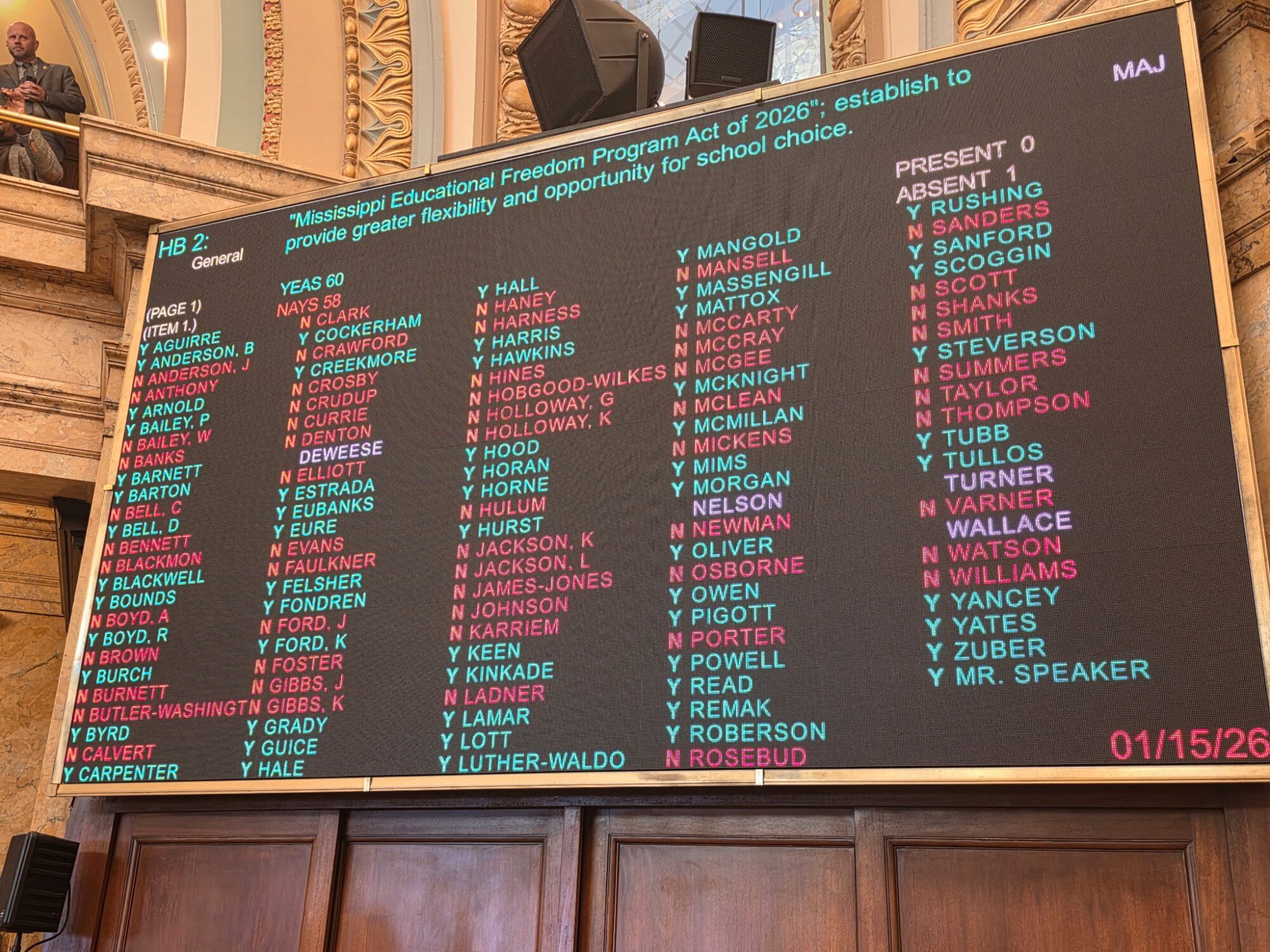
Speaker Jason White’s signature education freedom package narrowly passed the Mississippi House of Representatives Thursday afternoon by a narrow 60-58 vote after four hours of debate.
Seventeen Republicans joined Democrats in voting against the bill, with three others not casting a vote on the measure.
Concerns on the bill were focused on fears of how universal school choice could lead to public school closures while a lack of accountability for private schools that could receive state funds was also cited as an issue for some members.
State Rep. Celeste Hurst (R) attempted to alleviate fears on the bill before it was discussed.
“This is not a blank check,” Hurst said. “Or my personal favorite, a money grab for private schools. It’s a guided investment in the future of our kids.”
However, during the succeeding hours of debate on HB 2, also called the Mississippi Education Freedom Act, several representatives spoke on aspects of the bill that the argued could lead to a return to school segregation.
“I hope we are not moving towards modern day segregation,” State Rep. John Faulkner (D) said.
House Democrat Leader State Rep. Robert Johnson argued that the bill would create a system where accountability in education performance is moot, since it does not require private schools to meet the exact same standards as public schools.
“I would prefer that everybody have the same accountability and assessment standards,” Johnson said.
State Rep. Jeffery Harness (D) expressed a similar concern with the bill.
“How are we going to justify sending public money to private schools and not hold these people accountable. How are we going to justify that?” Harness asked.
Democrats also lodged concerns that the bill allowed non-accredited private schools to participate in the program, even though those schools would get less funding than accredited schools, up to $2,000 instead of the base student cost, which was nearly $7,000 this fiscal year.
State Rep. Bryant Clark (D) touched on the fact that the bill does not provide clear policing powers to the State Treasurer if the funds are found to be not used legally. State Rep. Rob Roberson (R), author o chair of the House’s Education Committee, admitted that is something to iron out.
Rep. Harness asked if the bill would violate the state’s constitution by sending public funds to private schools, since he said it specifically prohibits such a transfer. House Education Committee Vice Chair State Rep. Jansen Owen (R) contended the bill does not violate the state constitution because the funds are provided to the parents.
State Rep. Percy Watson (D) said his concern about the bill was the initial cost of the program, which Roberson said was estimated to be $162.5 million in the first year. Roberson added that at least half of the cost of the program would have been used by public school students anyway and pointed to the provision that establishes program caps.
Additionally, to address concerns that the measure would only help children in wealthy families, Rep. Roberson added that the program is structured to cater to families in the lowest median income brackets first. Only after all of the applications from those families were considered would families in the 200 and 300 percent of median income brackets be reviews for inclusion.
Concerns of the loss of funds resulting in school closures were also posed during the lengthy debate, especially in areas with already low enrollment numbers. Rep. Clark asked what will happen when those schools close, and if the state would pay to bus those children to districts outside county lines.
Rep. Owen countered that if the school was already failing, there are larger problems than allowing school choice.
“I would hope that those losing so many kids that they are in threat of closing, they would look at themselves and what they are doing because the parents are leaving for a reason,” Owen explained. “I don’t want schools to close, I personally don’t believe many if any will. There is a reason that many parents are leaving that school, that is the question I believe needs to be asked.”
In all, 17 Republicans crossed party lines to vote against the bill, including State Rep. Jill Ford (R).
Ford told Magnolia Tribune that her reservations focused on the lack of accountability requirements for private schools which prompted resounding calls from her constituency for her to vote against it.
“I had three people out of 25,000 constituents ask me to vote, yes, and I’ve had hundreds and hundreds of people to ask me to vote no,” Ford explained. “It was an easy ‘no’ vote for me.”
She said that if the bill was amended to include accountability she would give it more consideration.
“At this point I think the whole entire topic of school choice freaks my constituency out,” Ford added.
Of the 10 amendments submitted on the bill during its discussion, only two were approved – an amendment to clear up language concerning D- and F-rated schools being labeled incorrectly in connection with the Charter School aspect of the bill and another to correct reference language.
The failed amendments were submitted by Representatives Johnson and Omeria Scott (D). Those amendments included proposals to address the lack of accountability, selection of one specific verse in the Bible to be used in schools during the allowed time of reflection, student transportation issues, and who establishes the rules and regulations when a high school is established on the campus of a community college or university.
The measure was held on a motion to reconsider. Once it is dispensed, it will head to the Senate where the bill’s prospects appear dim given the expressed lack of appetite for school choice expansion by Senate leadership.
What Republicans Voted No or Didn’t Vote
Below are the 17 Republicans who joined Democrats in voting no on Speaker White’s Mississippi Education Freedom Act:
Richard Bennett (HD 120)
Andy Boyd (HD 37)
Billy Calvert (HD 83)
Carolyn Crawford (HD 121)
Becky Currie (HD 92)
Jill Ford (HD 73)
Greg Haney (HD 118)
Stacey Hobgood-Wilkes (HD 108)
Timmy Ladner (HD 93)
Clay Mansell (HD 56)
Kent McCarty (HD 101)
Missy McGee (HD 102)
Dana McLean (HD 39)
Gene Newman (HD 61)
Fred Shanks (HD 60)
Troy Smith (HD 84)
Lance Varner (HD 62)
Three other Republicans did not cast a vote:
Clay Deweese (HD12)
Jerry Turner (HD 18)
Price Wallace (HD 77)
The final vote was 60-58.

Jeremy Pittari