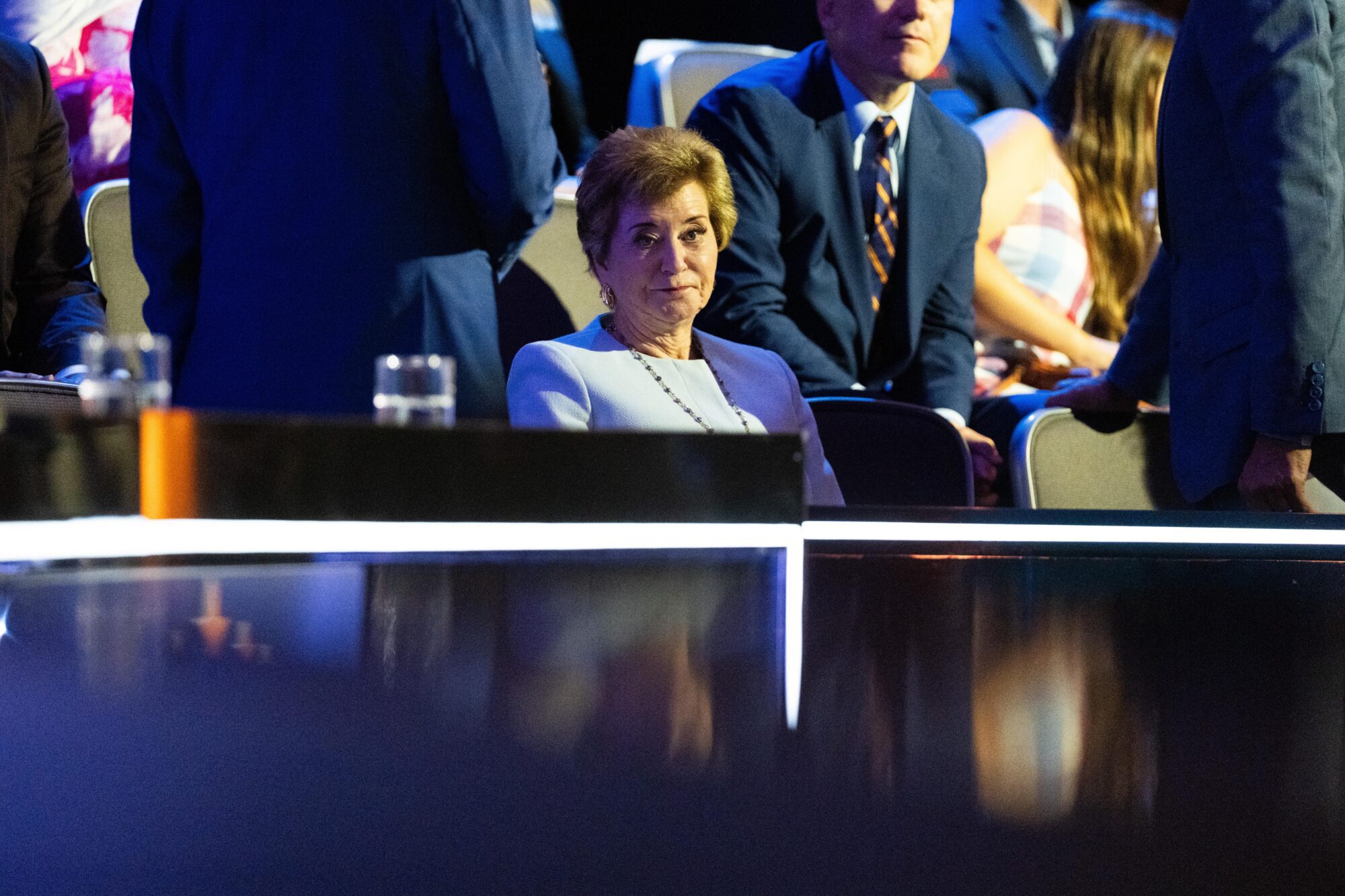
Secretary of Education Linda McMahon takes a seat ahead of the Small Business Administration's Million Dollar Pitch Competition, Friday, Sept. 18, 2026, in Washington. (AP Photo/Allison Robbert)
- Mississippi is among at least 30 states to opt into the program which aims to support school choice and is expected to benefit about 96% of children in participating states.
Nearly all schoolchildren in at least 30 states can apply for a new federal scholarship next year to help pay for private school, homeschooling and other educational expenses, according to regulations proposed Thursday by the Trump administration.
The first national school choice scholarship program, the Federal Scholarship Tax Credit, will launch Jan. 1, establishing a taxpayer-funded incentive for families to choose private or homeschooling in participating states. Taxpayers who donate to an organization passing out the scholarships will receive a federal tax credit, a perk expected to further fuel the conservative school choice movement.
About 96% of children in those states should be eligible, according to the department. Children attending public schools could use the scholarships for extra learning expenses.
“Education freedom is the key to unlocking opportunity and success for our next generation of students,” said U.S. Secretary of Education Linda McMahon in a statement issued Thursday. The federal scholarship program, she said, will ensure “every child has access to the education they need, not one limited by ZIP code, family income, or government‑imposed barriers.”
School choice scholarships have been available for decades in conservative-led states and throughout the South, giving individual students taxpayer-funded grants ranging from a couple thousand dollars to more than $30,000 a year. In places where they are available to all students regardless of income, such as Florida and Arizona, the majority of students using the money were already in private or home school or were from affluent neighborhoods, an analysis by The Associated Press showed.
The federal program departs from most state programs by not forcing students to leave public school to qualify for a scholarship. Public school students could use the money for tutoring or special education therapies, although the Republican administration has not provided specific criteria for eligible expenses yet.
Regulators say they have set up the program in a way that will make it easier for poor students to apply, proposing to let students use proof of participation in a government assistance program in lieu of providing income documentation. Foster children would not have to provide any income verification when they apply, officials said.
Experiences with school choice scholarships in other states have shown barriers to using the programs go beyond paperwork hurdles. Many families often do not know scholarship programs exist. Federal officials have not said how they would tell taxpayers and students about the scholarships.
How the scholarship and tax credit will work
Taxpayers will have the chance to donate to a scholarship program in a participating state, even if they do not live there, starting Jan. 1. Individuals can donate up to $1,700 and receive a federal tax credit for the same amount in exchange. Federal officials propose a couple filing jointly could give as much as double that amount.
Scholarship organizations in each state would decide how much to grant to each child who applies, depending on available funds and student need. Children could qualify if they are in elementary through high school and their families earn up to three times the area’s median income. For a family of four in Houston, for example, that equates to more than $300,000.
Scholarship recipients could use their funding to pay for religious or private school tuition, homeschooling costs, tutoring and special education therapies, books, computers and other expenses connected to enrollment or attendance, according to officials at the Treasury Department.
At least 30 states have opted in, and more may sign up
States could not turn to laws or regulations to narrow the uses for the scholarships or the type of organization that can grant them, federal officials said.
But states can choose whether to participate in the program.
According to the most recent Treasury Department list, as of mid-September these states are in for 2027: Alabama, Alaska, Arkansas, Colorado, Florida, Georgia, Idaho, Indiana, Iowa, Kansas, Kentucky, Louisiana, Mississippi, Missouri, Montana, Nebraska, Nevada, New Hampshire, North Carolina, North Dakota, Ohio, Oklahoma, South Carolina, South Dakota, Tennessee, Texas, Utah, Virginia, West Virginia and Wyoming.
Governors from Arizona, Minnesota, Wisconsin, and Oregon have said their states will not join, with some arguing these programs divert resources from public schools.
More than two dozen states have yet to say what they will do. In New York, Democratic Gov. Kathy Hochul has been supportive, and the state is expected to sign up.
Governors deciding whether to participate face many competing objectives and interests. There is the opportunity to bring significant new education money to students who need extra support, such as tutoring or extra speech therapy that their public school does not provide. At the same time, large scholarship programs in states such as Florida and Arizona have accelerated a growing enrollment crisis in public schools.
Even so, the federal program is expected to bring taxpayer money for private school tuition to several states that have yet to embrace vouchers or education savings accounts.
Education advocates disagree on whether states should participate
In Massachusetts — a state with historically robust public school funding, caps on charter school expansion and no taxpayer funding for private school tuition — education advocates on both sides are lobbying the governor to take a stand and pushing the public to register their opinion.
The state’s association of school superintendents opposes the idea that districts should take advantage of the program by creating their own nonprofits to accept donations and distribute scholarships. Many big city school districts around the country already have their own foundations. In Massachusetts, where every municipality has its own district, the majority of the more than 300 school systems have no such entity.
“Districts face a significant disadvantage compared to the private school networks that already have elaborate fundraising and scholarship infrastructure in place,” reads the Massachusetts Association of School Superintendents’ position paper. The group said requiring families to apply for scholarships and, in many cases, prove income eligibility were “bureaucratic hurdles that will certainly leave behind our most vulnerable families.”
On the other side, former Boston City Councilor and former public schoolteacher Annissa Essaibi George has argued Boston Public Schools faces severe budget shortfalls and needs new streams of income.
And besides, she argued in an op-ed published in a neighborhood newspaper: “Massachusetts taxpayers will be eligible to take advantage of this program whether the governor opts in or not. The only question is whether those dollars come back to Massachusetts children, or instead flow to students in states that moved faster.”
In just a few years, after donations from taxpayers pick up, the IRS and the Treasury Department predict the program will direct nearly $26 billion into as many 2.2 million scholarships each year.
The federal tax-credit scholarship program was signed into law last year by President Donald Trump as part of his signature tax breaks and spending cuts bill. The public has 60 days to comment on the Treasury Department’s proposed regulations.