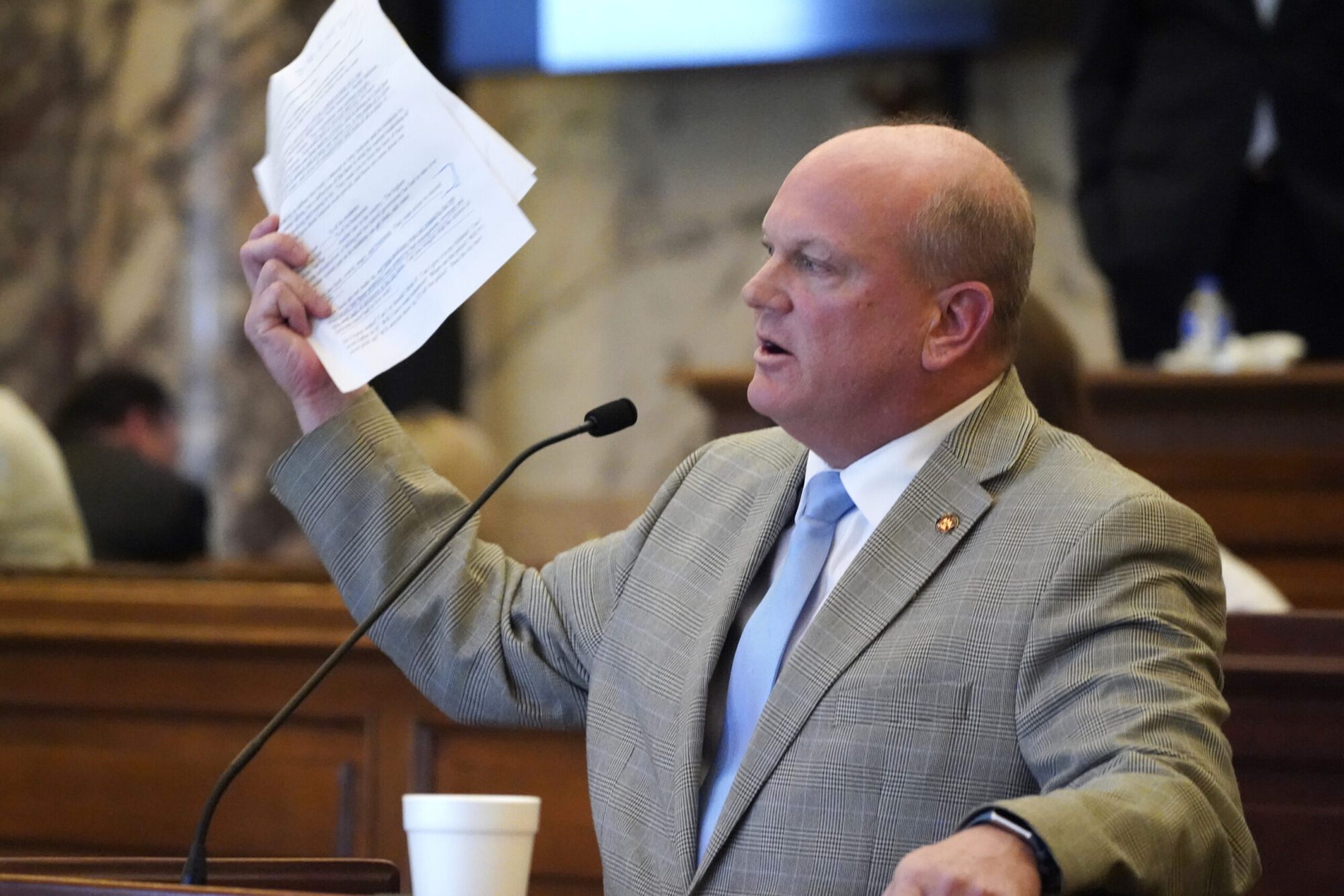
Senate Judiciary A Committee Chairman Brice Wiggins, R-Pascagoula, waves a letter asking for help to combat crime in Jackson, Miss., during his call for support for the controversial Jackson Capitol Complex Improvement District bill, Thursday, March 30, 2023, at the Capitol in Jackson, Miss. (AP Photo/Rogelio V. Solis - Copyright 2023 The Associated Press. All rights reserved.)
- Funding bills that provide nearly $30 million in funding for detention and diversion expansion remain to be finalized in special session.
Lawmakers are revamping Mississippi’s youth court system during the special session called this week by Governor Tate Reeves (R).
Both chambers passed the measure to enact the reforms, while the House also passed two appropriations bills adding $29.5 million to fund those revisions.
The main bill, SB 2001, proposes to establish nine state funded full-time chancellors in districts without county courts. It also provides increased transparency in the youth court system and places intake officers under the Administrative Office of Courts.
One of the major changes, elimination of the referee court system, will not take effect until July 1, 2027, with the other major changes going into effect in 2028.
To fill the chancellor seats in the nine districts, appointments will be made by Governor Reeves with an official election to be held in the 2030 cycle.
Counties with populations less than 50,000 that have County Courts, and subsequently associated youth courts, will have an opt out option. Those boards of supervisors will have until 2028 to alert the AOC of their decision to opt out. If they choose to do so, they will be responsible for covering the costs of those youth courts, Senator Brice Wiggins explained while on the floor of the Senate late Wednesday night.
“The state funding provided to them would no longer take place,” State Rep. Kevin Horan added on the House floor Thursday morning. “Because they’re getting a chancellor in those districts.”
It is estimated the new chancellors, associated staff and facilities will cost the state an additional $3.5 million annually.
County courts are mandated by state law in counties with populations above 50,000. They will continue operating as they have been but with state funding support, Rep. Horan told the House.
The bill also sets an open court standard as default for cases that do not involve juveniles but the judge will retain the power to close court proceedings when necessary.
In place of the current referee court system used in less populated areas, family masters will be appointed by the senior chancellor. Those officials will be tasked with duties outside of regular court proceedings as deemed necessary by the senior chancellor. That system is expected to expedite the hearing process.
To address complaints from Child Protective Services, a system of uniformity between all of the state’s youth courts will be established.
“Child protective services is complaining that they’re having issues with certain divisions, youth referees, youth court prosecutors, things of that nature,” Horan elaborated. “They want some uniformity, some access so they know what rules they’ll be playing by.”
Additionally, it is anticipated that $10 million will be provided to the Department of Public Safety to not only renovate the Oakley Youth Development Center to house more juveniles, but also conduct a study to identify locations in the north and south parts of the state to expand those diversion services.
Some of the concerns lodged by lawmakers centered on juvenile privacy when making the courts open by default as well as the notion that a larger swath of judges were not consulted in the drafting of the legislation. Certain lawmakers, particularly Democrats, also expressed concern that they had little to no time to review the legislation before being asked to support it.
In the end, the Senate passed the bill late Wednesday night with a vote of 25-10. The House then passed it with a 67-32 vote Thursday. The bill now heads to the governor’s desk.
Two appropriations bills were taken up by the House Thursday afternoon, HB 1 and HB 2.
HB 1 reallocates the $1.5 million the Legislature approved for the Department of Human Services during the regular session, which will be used for the state’s diversion program. That program aims to direct youth who have entered the youth court system outside of the justice system.
Funds from HB 1 will be combined with another $7.5 million outlined in HB 2 to expand that program, State Rep. Angela Cockerham (I) described.
Another $12 million is being appropriated to the Department of Public Safety as part of HB 2 for expansion and upgrade of the Oakley Youth Development Center. Cockerham said the aim is to expand bed capacity for the male only facility from 30 to 60 by utilizing currently empty facilities on site. Renovation work will ensure the facilities are livable and up to code, she added.
The Department of Public Safety is receiving another $10 million to locate and establish detention facilities in the north and south ends of the state.
State Rep. Robert Johnson (D), the House Minority Leader, introduced an amendment to HB 2 that would have tied the funding to the acceptance of federal funding for summer lunches to more than 300,000 children in the state during summer break. Johnson said Governor Reeves has rejected that federal funding for three years, totaling $114 million in assistance in that time. His amendment failed.
The House passed HB 1 by a vote of 94-8, while HB 2 passed by a 83-21 vote. A motion to reconsider both bills was entered after passage, but the bills were released later that same day.
The Senate then took up the two House funding bills, passing them unanimously before gaveling out.
“For years, we have worked on legislation to completely reform Mississippi’s youth court system to better serve our state’s children and standardize the judicial process. We passed a solution that fixes the system by adding full-time youth court chancellors, increases transparency and accountability, funds diversion programs and improves our detention centers,” Lt. Governor Delbert Hosemann (R) said. “I appreciate all of our Senators for returning to the Capitol on short notice for this special session and devoting thorough attention to reviewing and voting in the best interest of our state’s youth.”