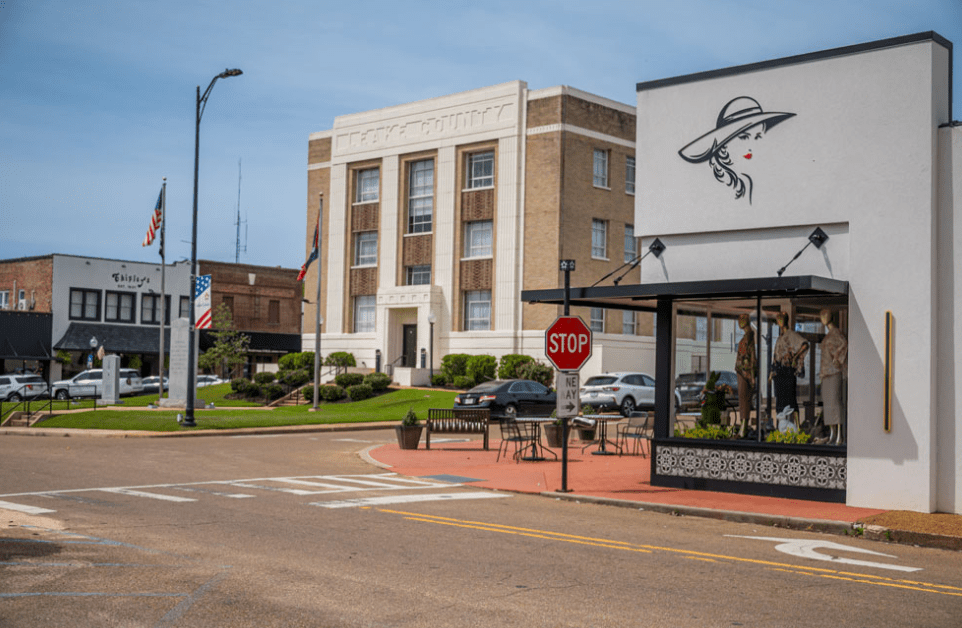
Leake County Courthouse in the Carthage downtown (Photo by Kevin Hudson)
- Aaron Akers, director of economic and community development for the Central Electric Power Association, says with new small businesses, there has been growth in employment and the tax base, and the services offered by these businesses are giving people hope.
When the Leake County Board of Supervisors set their sights on rejuvenating downtown Carthage, they initiated significant positive changes in a short time.
Carthage is a designated Mississippi Main Street community of about 5,000 people, with the overall Leake County population at about 22,000. In 2020, many downtown storefronts were empty, employment opportunities were few, and the economic outlook in the area was dim.
But supervisors, several of whom were newly elected, were determined to reduce local brain drain, make the community better, and increase the jobs available to young people.
“The supervisors started the ball rolling, and the folks affiliated with the Mississippi Main Street Association were also pushing the needle at the same time,” says Dr. Rachael Carter, an economist and community development specialist with the Mississippi State University Extension Service Center for Government and Community Development.

At the request of the Mississippi Development Authority, Extension helped gather data and develop attainable plans to address local challenges through the statewide Wake Up Downtown program.
“We found that many of the concerns the supervisors wanted to address were also concerns of the local community and those involved with Main Street,” Carter explains.
Carter’s office took the community members through a planning process that lasted more than six months and helped them identify the county’s assets, as well as what they wanted to preserve, improve, and change. Stakeholders also conducted a community survey, a retail trade study, and additional market analysis so that all groups had background information to make informed decisions as they created action steps.
Leake County officials united to accomplish their goals, and revitalization happened quickly.
“You just don’t often see the amount of change they had,” Carter emphasizes. “It normally takes three to five years to get that much done. They were serious about their community.
“The trick was taking what they wanted to see happen in their county, tying it into local resources, and making sure they were achieving the goals and responsibilities they were required by law to do as elected county officials,” she says.
The supervisors quickly identified a poor fire rating as a factor limiting development. Legislative funding allowed the city to purchase five new fire trucks and two used units, but these needed to be staffed.

Tommy Malone is the Leake County fire coordinator and the Emergency Management Authority director. He, along with the board of supervisors and local legislators, secured funding to purchase the trucks and assign them where needed. Leake County has nine paid firefighters and about 180 volunteers.
“One of our main problems county-wise was maintaining volunteers,” Malone states. “Many of these volunteers are elderly or retired, and on any given day, we may only have one or two who can respond from the local stations.”
Through a joint venture with Sheriff Randy Atkinson, they found a way to recruit, screen, and train young men who are non-violent offenders and short-term inmates at Leake County Corrections to become the firefighters needed.
“They have a separate area within the facility where they stay. They’re still inmates, still under security, and they have a captain or warden or law enforcement official who drives the truck and goes out with them,” Malone says.
“Their main purpose is support. They’re based in Carthage, so they’re not necessarily the first line of fire defense, but they support these other units,” he continues. “Having some younger people out there to assist our other volunteers helps.”
These men often remove downed trees on roads and handle brush fires in the county.
“The combined efforts of local officials, fire chiefs, and fire departments greatly improved the fire ratings of the municipalities and the county,” Malone emphasizes.
Carthage now has a class 6 rating, while Lena, Walnut Grove, and the area served by the Madden Volunteer Fire Department have a class 7 rating. Areas served by the county’s other volunteer firefighters have a class 8 rating.
Aaron Akers, director of economic and community development for the Central Electric Power Association, was a big force behind these economic development efforts.
“Dr. Carter did a phenomenal job in strategic planning,” Akers explains. “We would not be where we are without her leadership and guidance.”
Akers is also acting director of the Leake County Development Association in Carthage, a volunteer position that allowed him to pull the team together to tackle the work that needed to be done.
“We looked at every facet—from education to infrastructure, from small business to correctional facilities—as we drew up the plan,” Akers remembers. “The board of supervisors was absolutely the reason we were able to move forward.”

Today, the population has not changed much, but signs of revitalization are all around. The Carthage Coliseum got a facelift with legislative funds, a decaying motel was renovated into a trendy wayside inn, and diners and boutiques sprang up.
“Private business owners have revitalized the town square and the Highway 16 corridor,” Akers says. “There was a tremendous growth in private investment at the same time as public investment was happening.”
Akers says, with new small businesses, there has been growth in employment and the tax base, and the services offered by these businesses are giving people hope.
“Downtown Carthage now is not what it was a few years ago,” Akers emphasizes. “These improvements are having positive effects on the whole community.”
This article published in partnership with Mississippi State University Extension Service.

Bonnie Coblentz