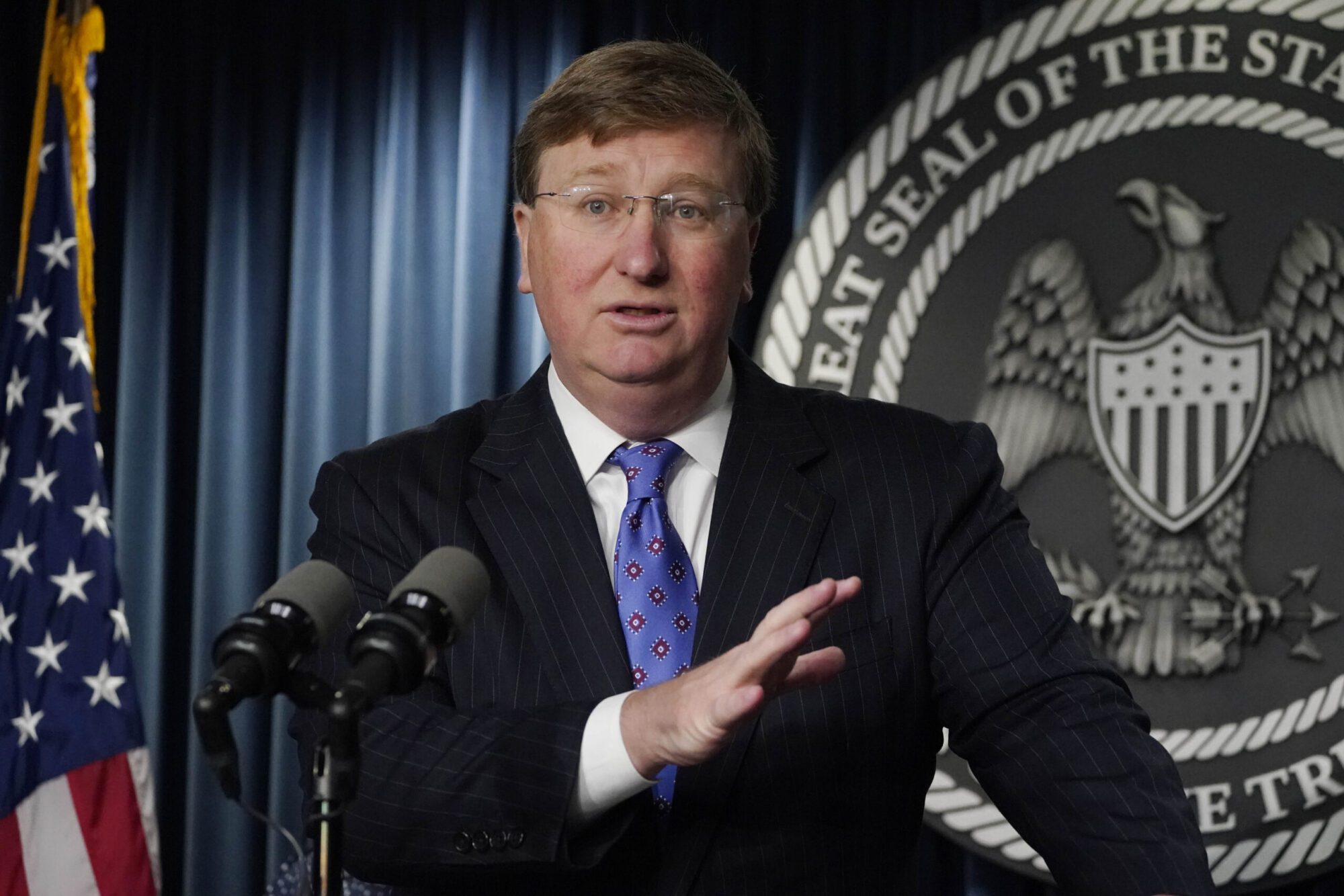
Mississippi Gov. Tate Reeves addresses business leaders at the Mississippi Economic Council's annual "Hobnob Mississippi" in Jackson, Miss., Oct. 27, 2022. (AP Photo/Rogelio V. Solis, File - Copyright 2022 The Associated Press. All rights reserved.)
- Reeves’ veto message of SB 2632 called out Senator Hob Bryan and Representative Clay Deweese for allegedly making material changes to the bill after it had already been sent to the Governor for his signature.
Governor Tate Reeves (R) vetoed Senate Bill 2632 on Monday, accusing leaders in both the Mississippi House and Senate of making material changes to the legislation after it had already been presented to his office, an act he said violates the state Constitution and may rise to criminal conduct.
“There is no provision contained in either the Constitution or any statute that authorizes the Senate Clerk’s Office (or any person or persons involved) to make a material change… NONE! The plainly unconstitutional (and possibly criminal) act of the person or persons that attempted to surreptitiously change a material… term of Senate Bill 2632 is unconscionable,” Reeves wrote in his veto message.
The Governor specifically called out State Representative Clay Deweese (R) and State Senator Hob Bryan (D) by name, alleging both men attempted to alter the bill under the guise of fixing a “clerical error” after it had already cleared the Legislature and been transmitted to his desk.
Editor’s Note: Members of the Mississippi Senate have pushed back on the characterization made in the veto message, arguing that the Governor confused a separate motion to correct brought by Bryan on March 17th with the Senate’s motion to correct SB 2632, which was made by Senator Tyler McCaughn on March 13th. The official report on SB 2632 does not show the Senate vote to alter the bill, but does show the House’s unanimous consent vote on March 17th. Video from March 13th does, however, show Senator McCaughn moving to correct what he referred to as a scrivener’s error in SB 2632’s interest rate language. (A scrivener’s error is just a lawyer’s way of saying typo).
Purpose of the Bill
SB 2632 would have created the “Local Governments Disaster Recovery Emergency Loan Program,” administered by the Mississippi Emergency Management Agency (MEMA), to provide loans to local governments recovering from federally declared disasters.
The program was designed to help cities and counties bridge financial gaps while awaiting federal reimbursement, particularly from FEMA, by allowing the state to issue loans backed by repayment mechanisms such as pledged local revenue streams.
Among its provisions, the bill required repayment if federal reimbursement was denied and allowed MEMA to oversee administration of the program, including contracting authority and fund management.
Material Change or Clerical Error?
At the center of the dispute is a key financial term — the interest rate applied to loans when federal reimbursement is not received.
Reeves said the version of the bill adopted by both chambers in the conference report set the interest rate at 1 percent per month. However, after the bill was signed by legislative leaders and presented to the Governor, lawmakers attempted to delete the word “monthly,” a change that would significantly alter the cost structure of the loans.
According to the veto message, Deweese first sought unanimous consent in the House on March 17 to remove the word “monthly,” characterizing it as a clerical fix. Later that same day, Bryan made a similar motion in the Senate to correct what he described as a “typo.”
Reeves noted that no objection was raised in either chamber, and both efforts were framed as minor corrections rather than substantive amendments.
The Timeline
The central allegation hinges on timing. Per the veto message, the bill was:
- Signed by the President of the Senate and Speaker of the House on March 16
- Presented to the Governor before 9:00 a.m. on March 17
- Subsequently “corrected” on the House and Senate floors later that same day
Yet Reeves said the version delivered to his office prior to those votes to fix the supposed error had already been altered, raising questions about when, and by whom, the change was actually made.
“Incredibly… the enrolled and signed Bill that my Office had received already contained the deletion of the word ‘monthly,’” Reeves wrote, questioning how the document reflected changes that were not formally adopted until hours later.
He further questioned whether staff in the Senate Clerk’s Office or House were involved in making unauthorized edits to the enrolled bill.
Alleged Constitutional Violation
Reeves grounded his veto in the Mississippi Constitution’s presentment requirements, which govern how a bill becomes law.
Under Article 4, Section 72, “Every Bill which shall pass both Houses shall be presented to the Governor of the state.”
Reeves argued that once a bill is passed, signed, and presented, it cannot be altered outside that constitutional process.
“The enrolled and signed version… is materially different from the conference report unanimously adopted by the Legislature… Thus… presentment to me represents an attempted departure from the law-making process enshrined in the Constitution rendering it null and void,” he wrote.
The governor emphasized that his staff had worked closely with lawmakers, including Deweese and the bill’s author, State Sen. Scott DeLano (R), to negotiate the 1% monthly interest rate prior to final passage.
He said that agreement was reflected in both drafts of the conference report and in the version adopted unanimously by the Legislature.
Frayed Trust, What Now?
Reeves warned that the alleged alteration calls into question not just SB 2632, but potentially other legislation.
“Have any other material changes been made to any other bill(s) after they have been enrolled and signed…?” he asked, urging an investigation.
Because of the disputed changes, Reeves declared the bill unconstitutional and vetoed it, despite supporting the underlying policy.
The measure had been intended to help communities recover from disasters such as Winter Storm Fern by providing a revolving loan program for emergency funding needs.
“Legislation that I was prepared to sign into law… unfortunately… contains a material change… Thus… I am compelled to veto it,” Reeves wrote.
The veto sets up a potential constitutional clash between the executive branch and legislative leadership, with lingering questions about how the enrolled bill was altered—and whether further action or investigation will follow.