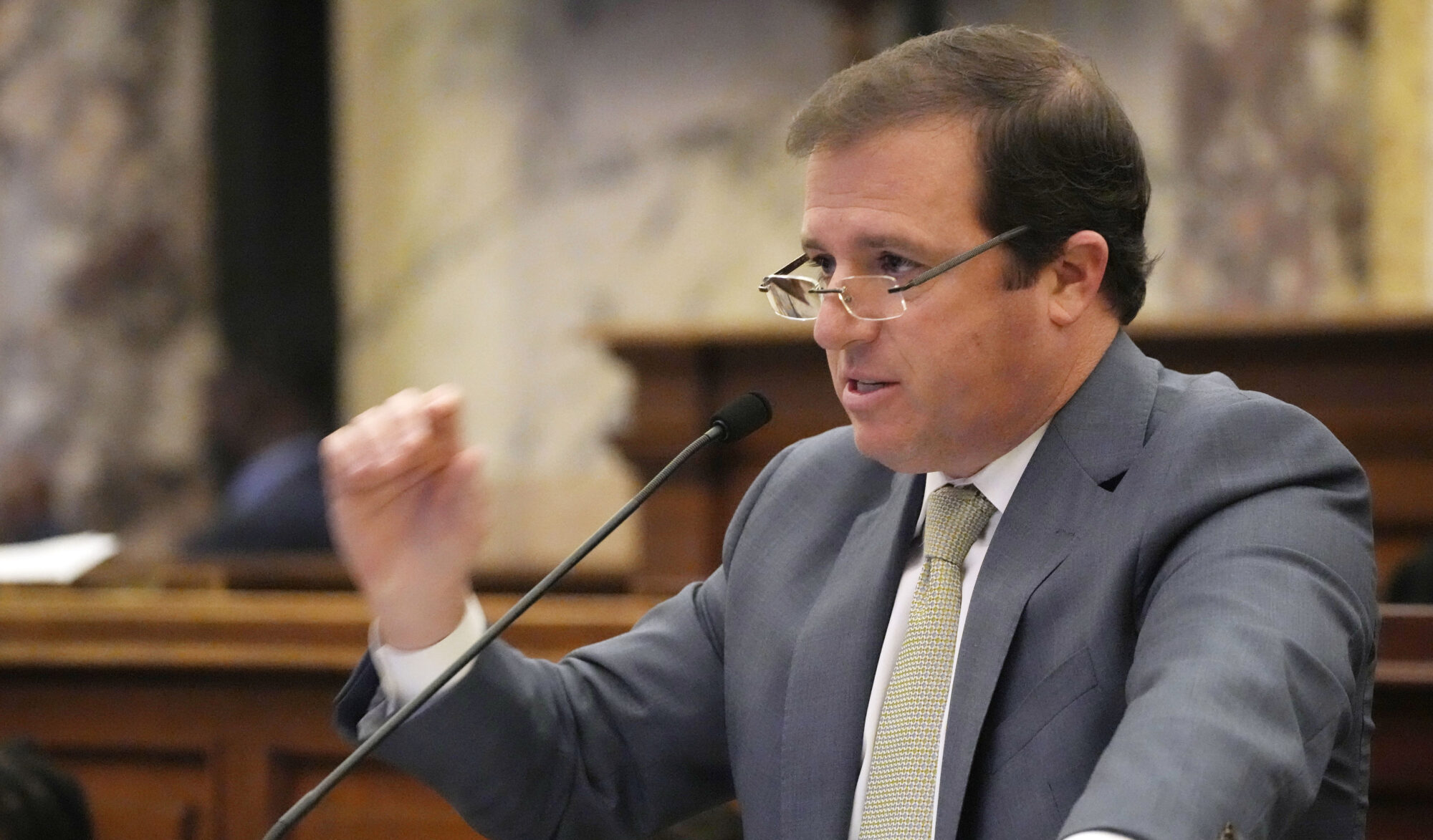
Mississippi State Finance Committee Chairman Josh Harkins, R-Flowood, in the Senate chamber at the Mississippi State Capitol in Jackson, Miss., Thursday, Jan. 25, 2024. (AP Photo/Rogelio V. Solis)
- The Magnolia State will be the first state to ban neutrality agreements in the workplace and just the fourth to enact the right to a private ballot in unionization efforts.
With the signature of Governor Tate Reeves (R), Mississippi will become the first state in the U.S. to ban so-called neutrality agreements in the workplace.
A “neutrality agreement” is a contract between a union and an employer under which the employer agrees to support a union’s attempt to organize its workforce.
The Magnolia State will also become the fourth state in the nation to enact the right to a private ballot in unionization efforts, joining Georgia, Tennessee and Alabama.
Authored by State Senator Josh Harkins (R), SB 2202 mandates that any decision about union representation should be made through a private, secret-ballot election for companies that choose to accept state economic development incentives.
“Employees should be able to communicate with everyone involved in their workplace—including their employer and fellow employees—not just union organizers,” said Senator Harkins. “This legislation protects the First Amendment rights of everyone involved in the unionization process and guarantees workers the right to a private ballot. Every employee deserves the freedom to make that decision privately, without intimidation or pressure—just like Mississippians do when they vote.”
In an op-ed published by Magnolia Tribune, Harkins noted that the bill does not prohibit employees from organizing nor does it outlaw unions.
“It does not interfere with an employee’s right to choose union representation if a majority wants it,” Harkins added. “It simply sets an expectation that the decision is made in a way that protects privacy.”
The measure narrowly passed the Senate with a 27 to 25 vote in early February. The House took the legislation up on Wednesday, passing it on to the governor with a wider margin of 78 to 39.
Workers for Opportunity, a national organization focused on advancing workplace freedom for employees across the country, applauded the Mississippi legislature for passing what they termed as “landmark worker freedom legislation.”
“The First Amendment and right to free speech applies to all Americans, including a business’ right to communicate freely and honestly with their employees,” said David Guenthner, Executive Director of Workers for Opportunity. “Thanks to legislative leadership, Mississippi becomes the first state in the country to defend the free flow of communication and ideas in the workplace. Neutrality agreements are anything but neutral and can force employers into gag orders which prevent them from communicating with employees.”
Guenthner went on to say that the right to a private or secret ballot vote also ensures that taxpayers’ dollars are not used to promote card check, which often includes intimidation tactics, coercion and other questionable practices. Card check is when an employer voluntarily recognizes a union based on signed authorization cards.
Harkins also noted in his recent op-ed that the bill follows Mississippi’s long-standing practice of attaching performance and compliance standards to public incentive packages.
“That’s not unusual. States regularly condition incentives on job creation thresholds, wage benchmarks, capital investment commitments, and regulatory compliance,” Harkins wrote. “These guardrails aren’t symbolic — they protect the integrity of the state’s return on investment and give policymakers and taxpayers a clear way to evaluate risk and accountability.”
Harkins said when taxpayer dollars are invested, Mississippi has the right to define the terms of that partnership.

Frank Corder