House seeks to allow proton radiation therapy in Rankin County, addresses other CON provisions
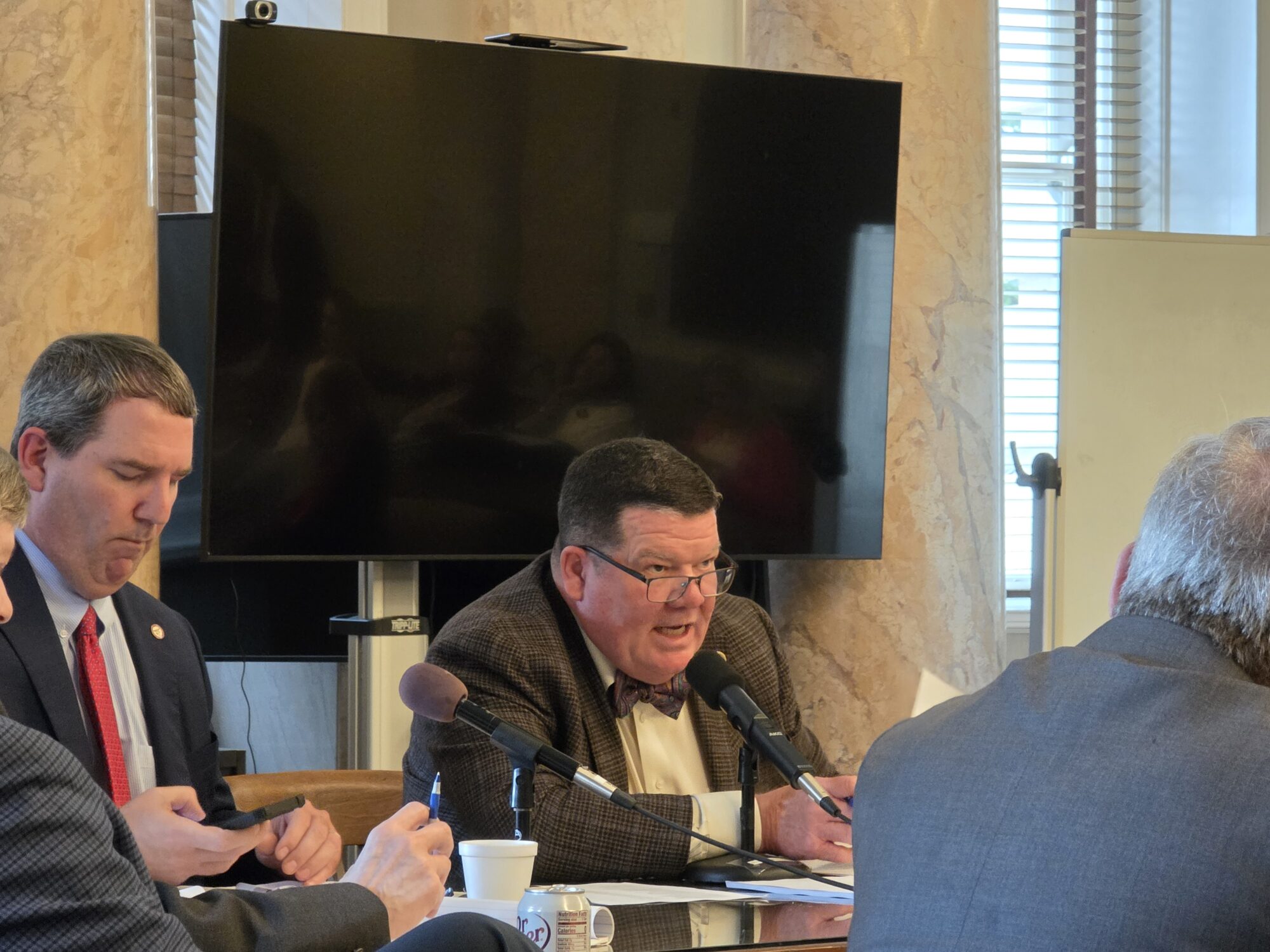
Rep. Samuel Creekmore (R), chair of the House's Public Health and Human Services Committee, describes a certificate of need bill during Thursday's meeting. (Photo by Jeremy Pittari | Magnolia Tribune)
- If the amended Senate bill becomes law, it would allow the creation of the state’s first proton treatment facility. The closest facilities offering such treatment are in Texas, Tennessee and Arkansas.
Two Senate bills made it out of the House Public Health and Human Services Committee on Thursday. One aims to adjust the state’s certificate of need laws, while the second would make it easier for practicing dentists and dental hygienists to relocate to Mississippi.
SB 2474 focuses on certificate of need regulations for rural hospitals. The committee approved a motion to adopt a strike-all amendment to the Senate’s bill during Thursday’s meeting.
“We’re taking out their language and adding most of our bill back to it,” House Committee Chair State Rep. Samuel Creekmore (R) told his colleagues.
Creekmore said he has been working with the Senate to develop language both sides can agree on.
The strike-all amendment to the bill did include a major change, allowing CON for proton radiation therapy at a facility to be located only within Rankin County.
“That is a fairly new treatment for cancer that uses protons instead of x-rays,” Creekmore explained.
By using protons, doctors can deliver high doses to tumors while sparing healthy tissue and organs.
“It’s especially useful for tumors near critical structures such as the brain, spine and heart,” Creekmore added, noting that the treatment has also shown promise in treating children and those who have already undergone radiation treatment.
No proton therapy centers are currently located in Mississippi. The closest facilities are in Texas, Tennessee and Arkansas.
Creekmore explained that Rankin County was chosen as the site due to “someone who’s ready to invest in Rankin County.” He estimates the private investment in the project to be between $50 million to $100 million.
Other provisions in the bill exempt rural hospitals, defined as those in municipalities with a population of 15,000 or less, from having to obtain a certificate of need to build or provide services within a five-mile radius of that hospital.
“Any service that was subject to the general moratorium remains in the moratorium; the CON bill does not affect that,” Creekmore explained.
The amended bill also prohibits any new hospital from attempting to locate within 35 miles of another hospital when it could jeopardize the existing facility’s critical access hospital designation.
Applicants seeking to establish an acute care general hospital located within 35 miles of another licensed hospital in the state “and located in Benton, Carroll, Humphreys, Isaquena, Itawamba and Tunica counties” will still have to abide by certificate of need laws, but they will not have to pay application fees.
The House’s version of the bill also closes loopholes for “single-specialty ambulatory surgical services,” subjecting all new centers to CON laws, Creekmore added.
The strike-all amendment also kept dialysis under the CON process.
“This was a sticking point for CON. I know we were able to pass it out for us to get something,” Creekmore added. “In this bill dialysis would remain subject to certificate of need.”
In other business, the committee also passed SB 2543.
State Rep. Tamara Butler-Washington (D described the bill as providing a faster way for dentists and dental hygienists to utilize existing compacts in other states to bring their skills to Mississippi.
The Senate bill outlines that the purpose of the “”This compact shall be known as the ‘”Interstate Dental and Dental Hygiene Licensure Compact” is to expedite licensure and increase access to dental health care through licensure boards acting in cooperation.
“The compact adopts the existing structures most utilized by dental boards across the United States, while ensuring the safety of the public through the sharing of documents and information,” the bill reads. “This compact ensures that each state retains the right to impose an adverse action on a licensee as a home state or as a practicing state. Each state has an opportunity to share investigations and information with the home state of licensure. The compact is operated by state dental board members, administrators and other staff, thus allowing for each state to maintain its sovereignty.”
Both bills now head to the House floor for consideration.

Jeremy Pittari