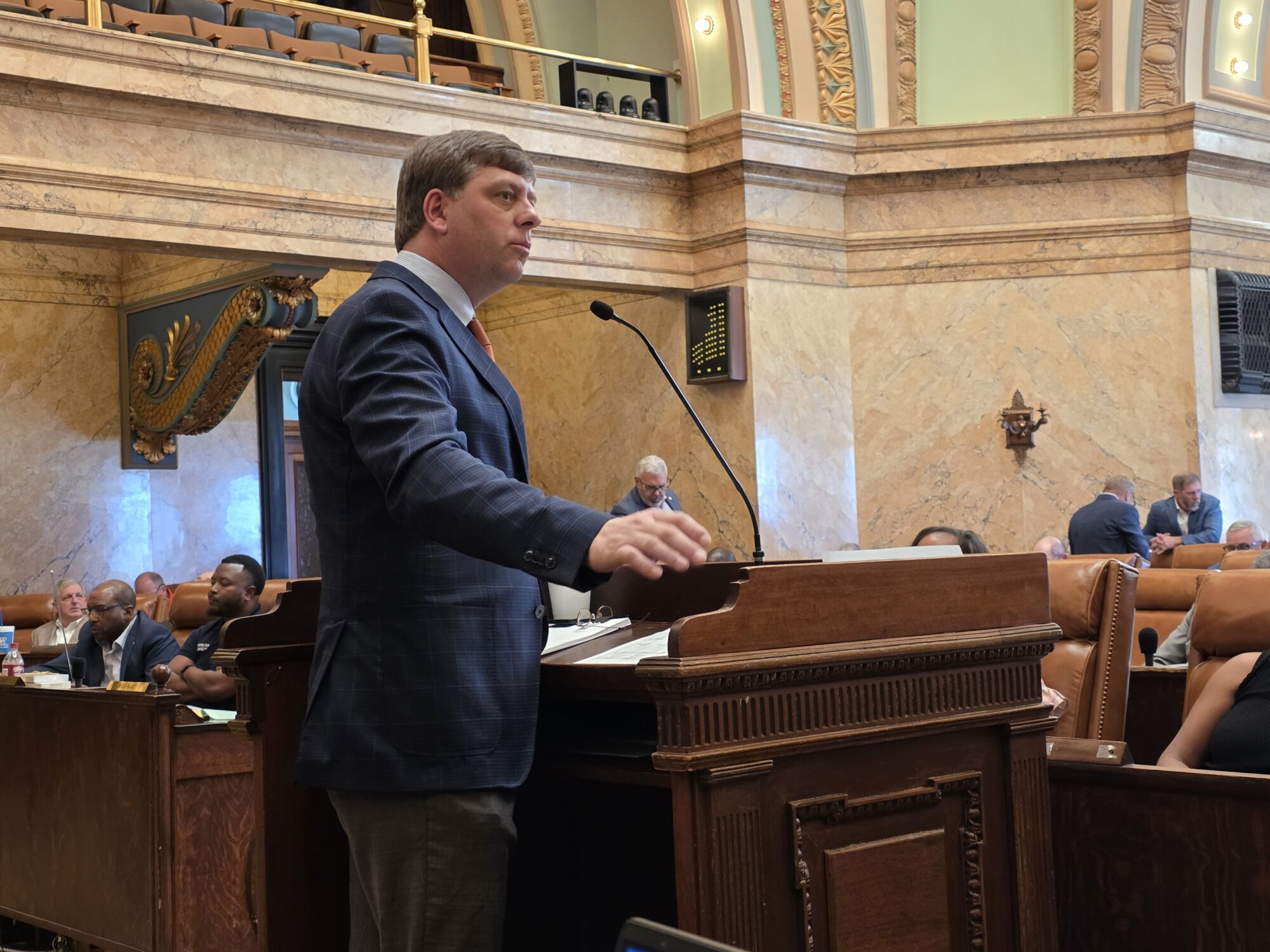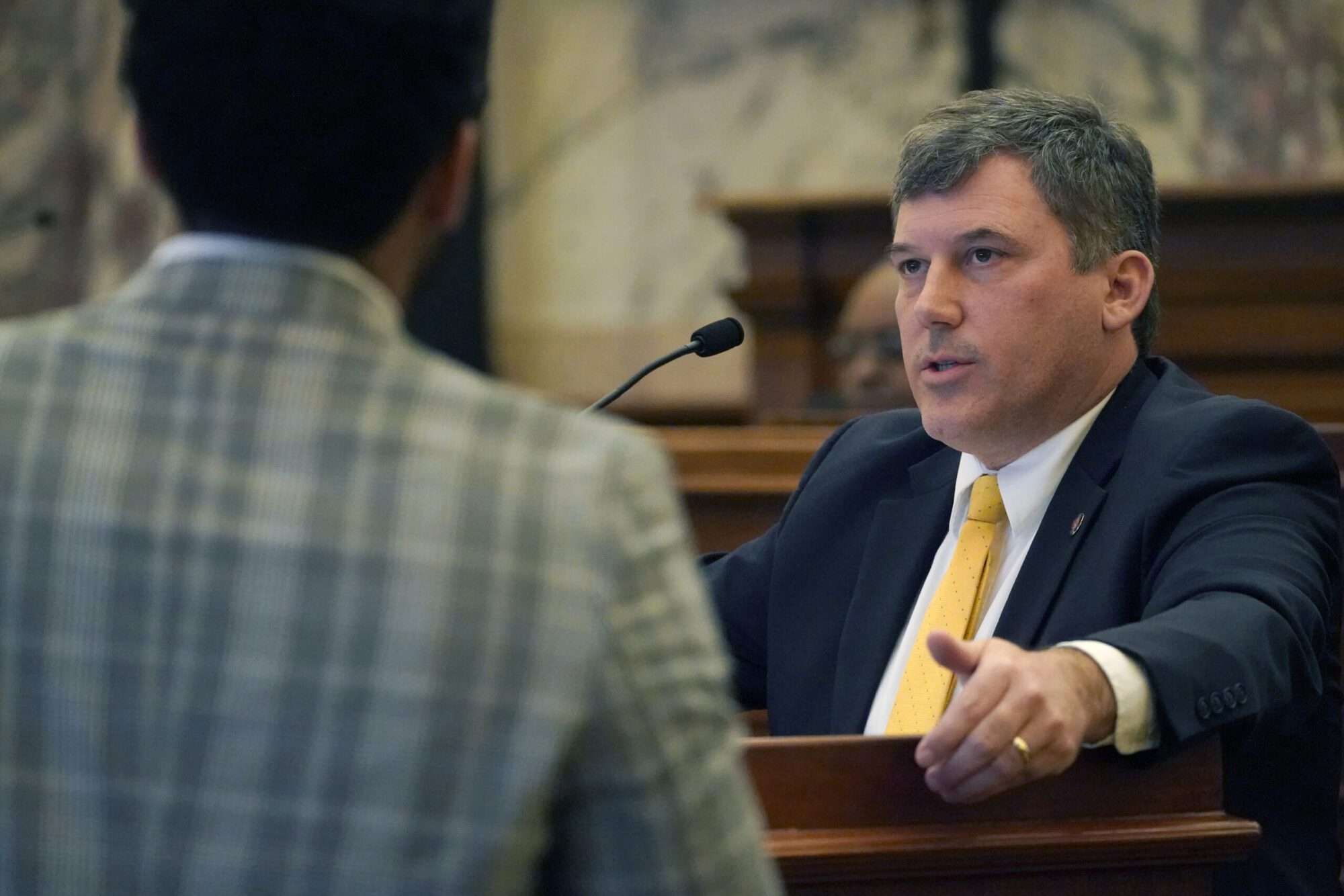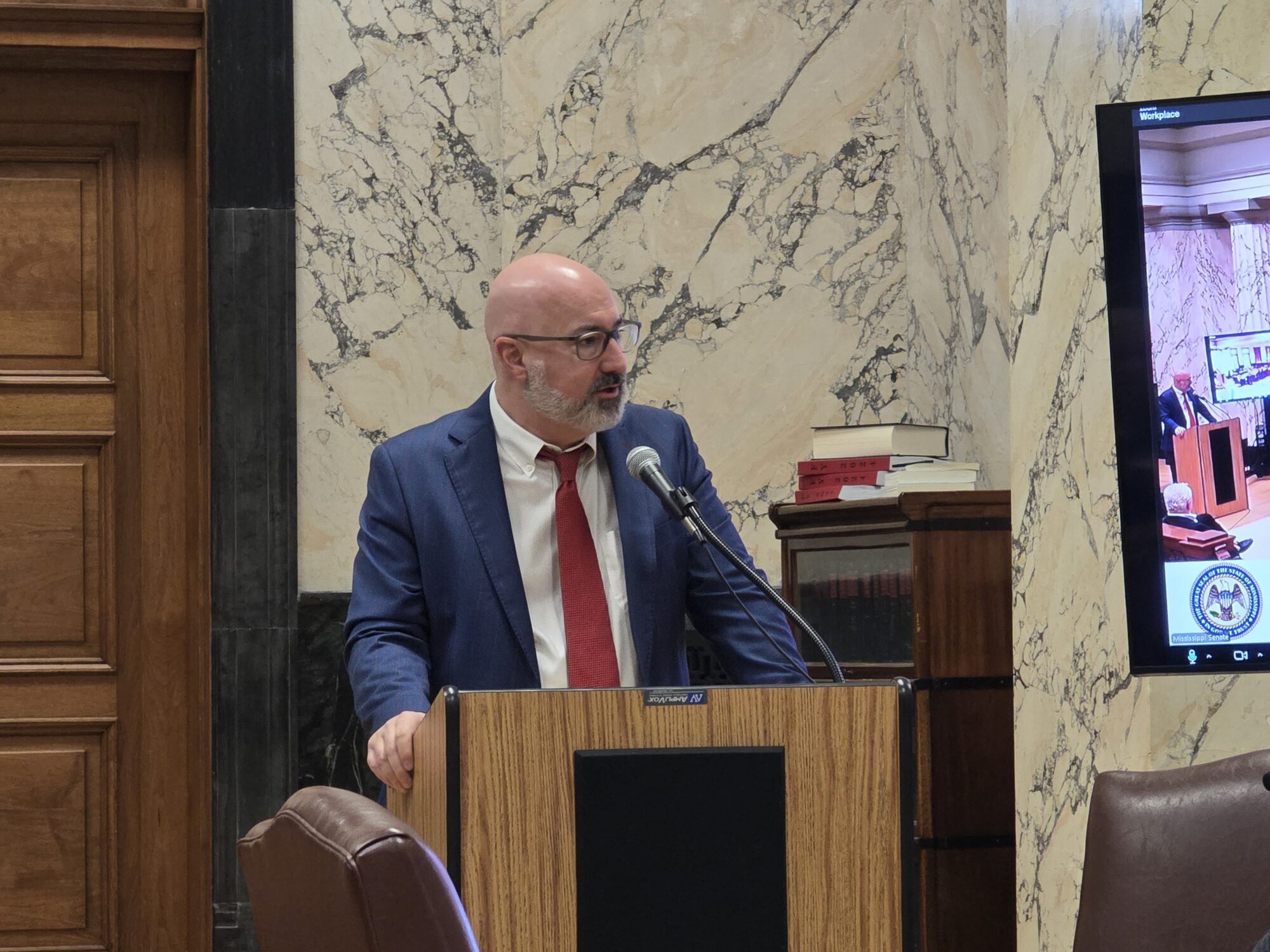
Mississippi Department of Transportation Executive Director Brad White addresses the Senate's Highway and Transportation Committee during meeting held Wednesday morning to decide if he should be reappointed to the role. Photo by Jeremy Pittari | Magnolia Tribune
- During the committee meeting, White was asked about MDOT’s response to the recent ice storm in North Mississippi.
Lawmakers on the Senate Highway and Transportation Committee approved the reappointment of Mississippi Department of Transportation Executive Director Brad White on Wednesday.
Prior to receiving the vote of confidence from the Senate committee, White was asked about MDOT’s response to the January winter storm and what could be done to improve the department’s response in the future.
White began by thanking the Legislature for its financial support in the department’s effort to maintain and improve the state’s interstates and highways.
“We have stopped the bleeding of our employees thanks to SEC Squared in cooperation with the personnel board,” he explained. “We’ve been able to begin the process of rebuilding our workforce, both on the maintenance side as well as the engineering staff.”
Close to $1 billion in additional supplemental funding from the Legislature has also allowed the state’s capacity program to restart construction projects, he added.
Federal ARPA funding and an increase to the fuel tax passed last year were contributing factors in allowing MDOT to rehabilitate the existing highway system.
In response to a query from State Senator Neil Whaley (R) on how district lines may have affected the agency’s work in the wake of the recent ice storm, White explained that MDOT uses them because the geography of the state dictates how crews can easily maneuver equipment as well as in terms of available assets and fuel availability.
“So I think we’re always going to have a situation where we have a maintenance crew that is going to be confined in some area,” White added.
As such, the loss of power in so many of those affected areas left crews limited in its ability to fuel equipment and vehicles.
“In regard to this storm, I would just mention that this was something the state has not seen in a generation,” White said.
Not only did the storm bring freezing rain, precipitation from days prior remained on roads as sub-optimal conditions rolled in, causing what White called a “flash freeze.”
“Our ability to respond to that was inhibited just because it’s something that the state of Mississippi just doesn’t get and something that we are not necessarily fully equipped to deal with immediately,” White said.
More than 15,000 miles of highway were impacted and 180,000 people were without electricity due to trees falling on lines among other factors, such as the fact that roads were frozen over.
“You can’t plow ice. You have to have temperatures right and you have to have the ability to shave off that residue from the interstate or highway,” White said.
In light of the negative press MDOT received following the storm, which White said falsely claimed employees with his agency abandoned their districts during the emergency situation, the executive director said the reality was much different. What White said actually happened was that nearly 400 MDOT employees who work and live in the affected areas left their homes after the storm, many of which were also without power, to remove trees from roadways and conduct other work that allowed emergency personnel and linemen to respond.
“We had another 500 people from central and south Mississippi that relocated to come to the aid of their colleagues and their fellow Mississippians.” White added. “I’m very proud of the work that our folks did under the conditions that they were working.”
Removal of trees from roads by MDOT crews allowed residents with medical needs to be rescued from homes without electricity, which was especially beneficial for those who need power to run oxygen or other medical equipment.
“To say that our folks were spread thin would be an understatement,” White added.
All told, those employees racked up 26,000 man hours in the emergency response.
While some asked why Mississippi’s response to the storm was not as effective as Tennessee’s, White said the neighboring state regularly deals with those conditions. As such, Tennessee sets aside $30 million just to respond to winter storms.
Like when the Mississippi Coast made adjustments after Hurricane Katrina, White made a commitment to the Senate committee that MDOT would continue to look at ways to better respond to future ice storms.
There are also other challenges at the forefront for the department, such as providing competitive wages to attract in-house engineers. Currently, the below market pay has forced the agency to be completely dependent on the private sector for those services. There are also fewer maintenance personnel than when White started with MDOT.
“Being able to move our salaries is critical,” White said. “We compete with municipalities and counties who are not limited in what they can pay people.”
Unlike the state agency, which has to abide by pay restrictions under the state Personnel Board, counties and cities can offer salaries based on the available funding generated from their respective tax bases.
“And so the ability to have the flexibility within our budget to continue moving salaries is critical for us to be able to not just hold on to what staff we have but to build it back,” White explained.
These staffing shortfalls mean less staff are now covering larger areas.
Following discussion with White, State Senator Andy Berry (R) moved to send the executive director’s reappointment to the full Senate. The motion was unanimously approved by the committee.