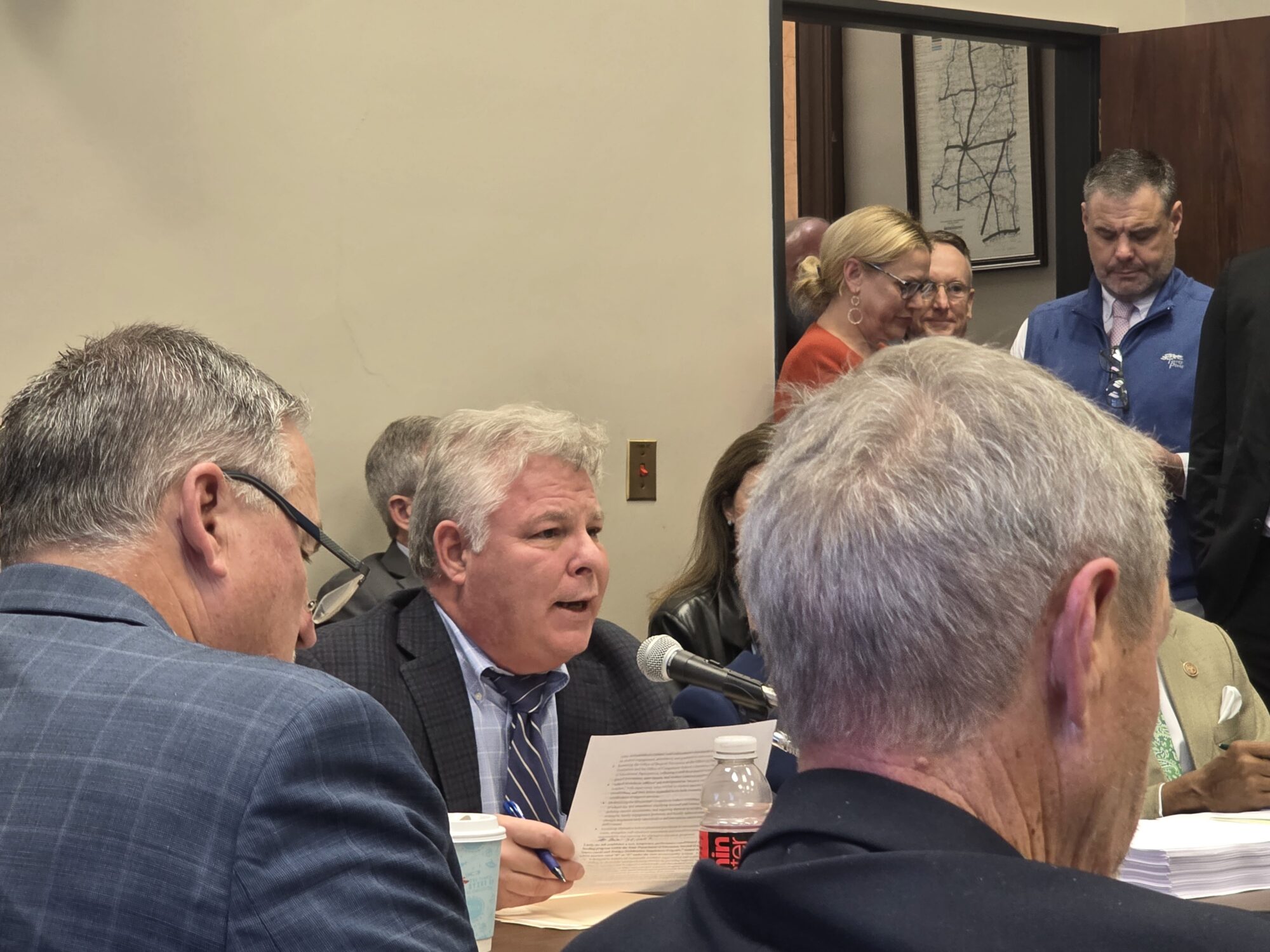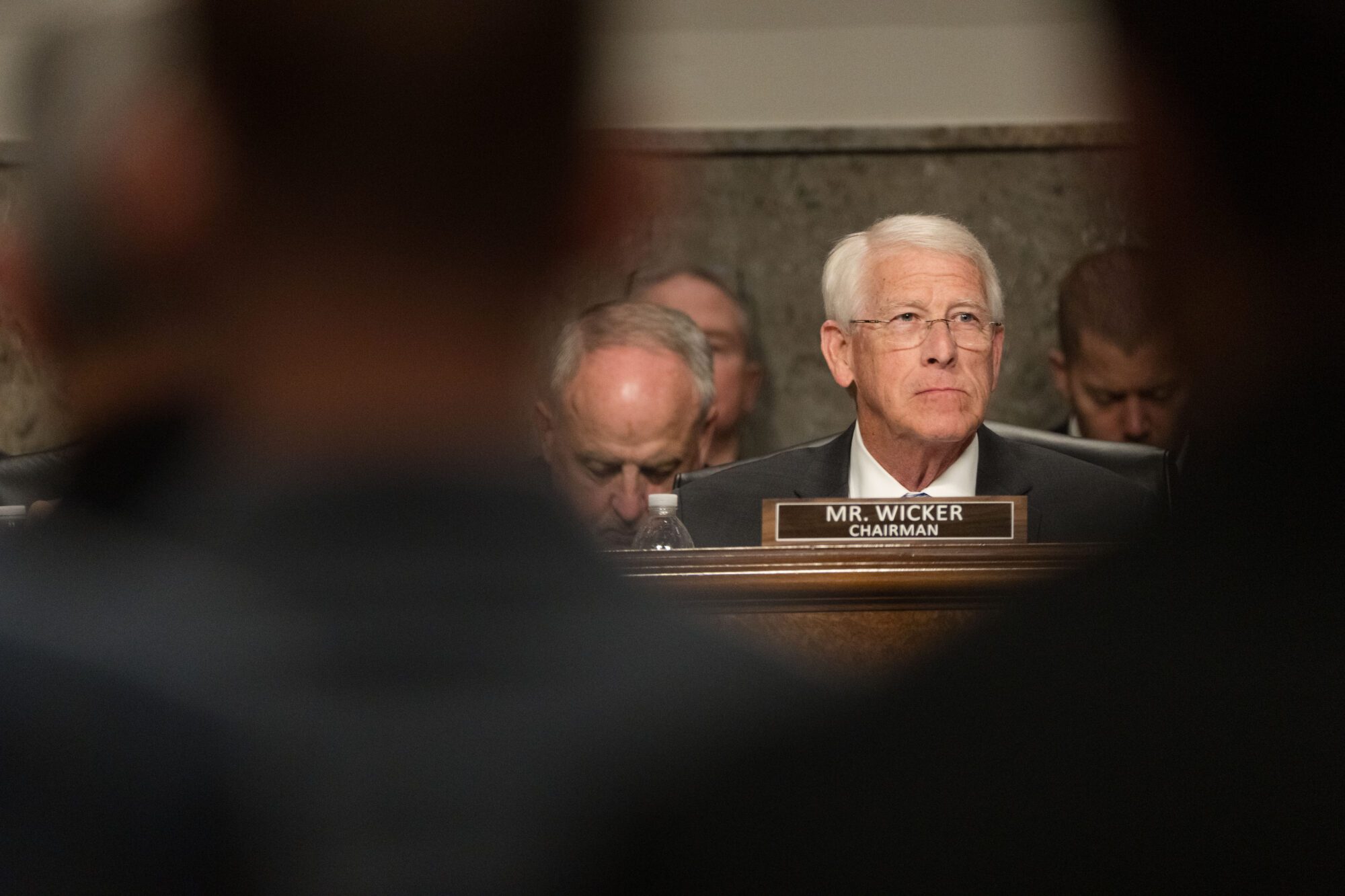
Senator Roger Wicker chairs the Armed Services Committee Hearings to examine the nominations of Bradley Hansell, of Virginia, to be Under Secretary for Intelligence and Security, Earl Matthews, of Virginia, to be General Counsel, and Dale Marks, of Florida, to be an Assistant Secretary, all of the Department of Defense, and Brandon Williams, of New York, to be Under Secretary of Energy for Nuclear Security, in Washington, DC on April 8, 2025. (Official U.S. Senate photo by David Rogowski)
- U.S. Senator Roger Wicker told Homeland Security Secretary Kristi Noem in a letter that the existing medical and human services infrastructure in Byhalia is insufficient to support an ICE facility.
Mississippi U.S. Senator Roger Wicker (R) is raising the red flag, expressing his opposition to a proposed Homeland Security plan to purchase a warehouse in Byhalia to convert into an Immigration and Customs Enforcement (ICE) detention center.
Since documents leaked online of the proposed facility, area residents have held protests outside of the warehouse, which is located on private property, urging local and state officials to oppose the federal government’s use of the facility.
In a letter to Homeland Security Secretary Kristi Noem, Senator Wicker contends that the warehouse in questions is designed as an industrial site to attract economic investment in Mississippi. Converting this site into an ICE detention facility, he said, would strain the existing local infrastructure and foreclose on economic opportunities better suited for this site.
“While I support the enforcement of immigration law, I write to express my opposition to this acquisition and the proposed detention center,” Wicker wrote.
Senator Wicker, the chairman of the Senate Armed Services Committee, told Noem that the warehouse “represents an opportunity for job creation, private investment, and long-term economic growth in Marshall County.”
“The county is already experiencing meaningful growth and increased interest from employers seeking to locate or expand in North Mississippi,” Wicker said. “Preserving limited, development-ready industrial sites is essential to sustaining this growth.”
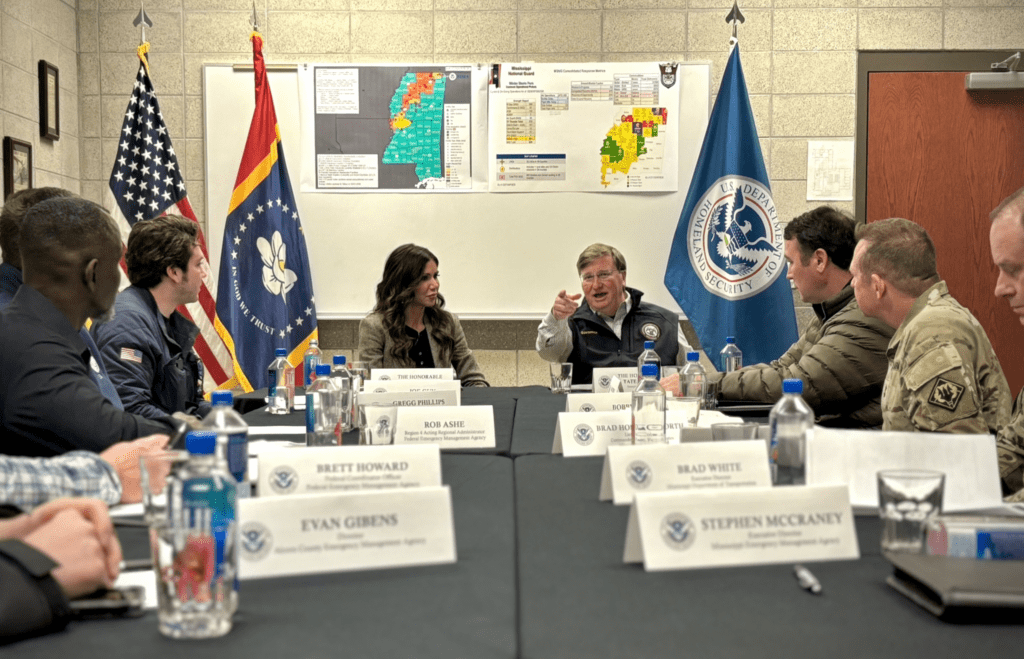
The Senator goes on to say the proposed conversion to an ICE detention center “also raises serious feasibility concerns.”
“Detention facilities impose substantial and specialized infrastructure demands—including transportation access, water, sewer and energy costs, staffing, medical care, and emergency services,” Wicker wrote. “From my understanding, the ICE detention facility would have a capacity exceeding 8,500 beds. Existing medical and human services infrastructure in Byhalia is insufficient to support such a large detainee population. Establishing a detention center at this site would place significant strain on local resources.”
Wicker added that “many of my constituents have voiced concerns regarding the public safety, medical capacity, and economic impacts this center would impose on their communities.”
“Proceeding with this acquisition without adequately addressing these issues disregards community input,” he tells Noem, urging her to reconsider the site for ICE use.
UPDATE:
Senator Wicker posted the following on social media on Friday, February 6:
“I just spoke with DHS Secretary Noem about the proposed ICE detention facility in Marshall County. I relayed to her the opposition of local elected and zoning officials and as well as economic development concerns. I appreciate her for agreeing to look elsewhere.”

Frank Corder