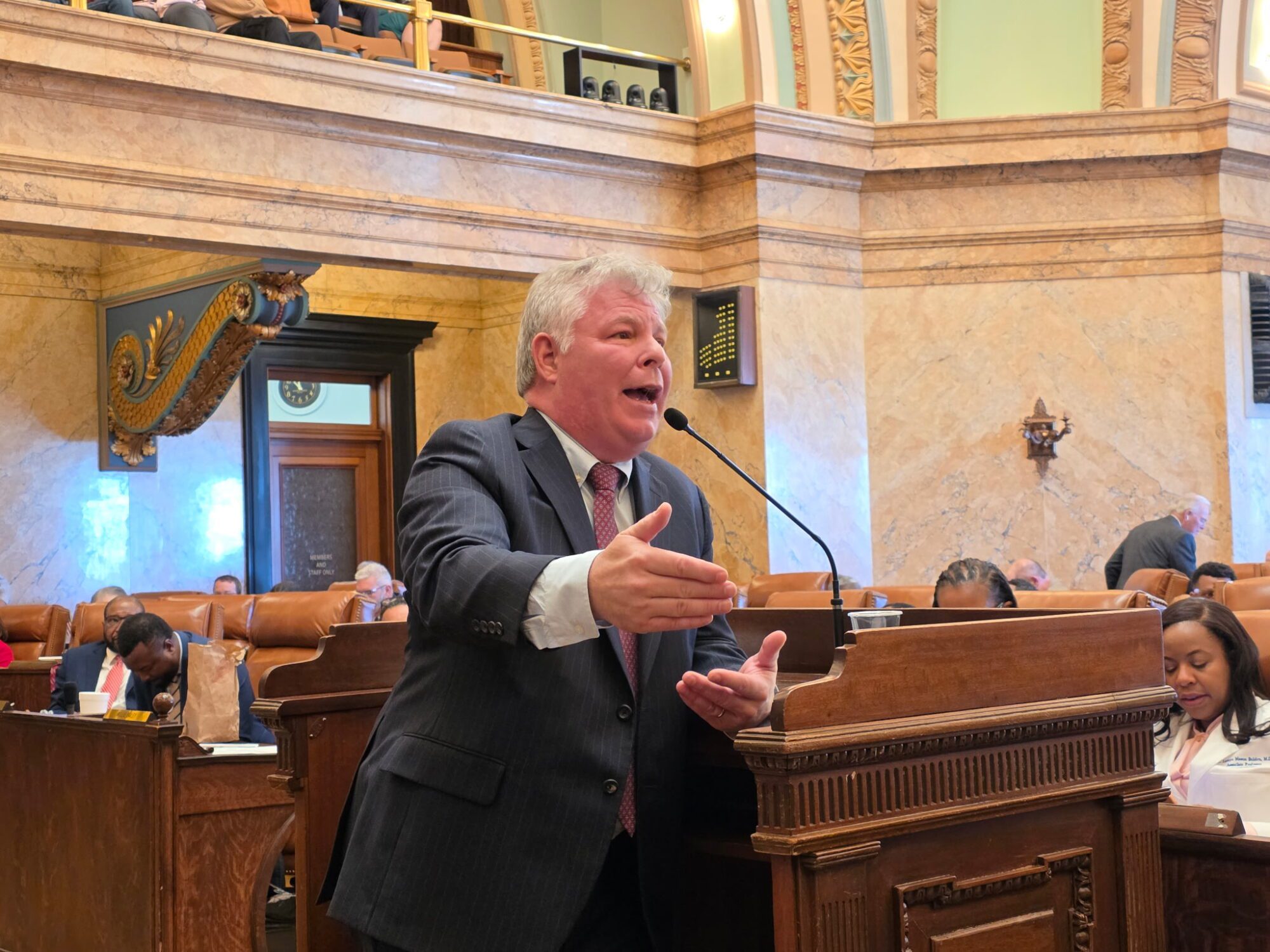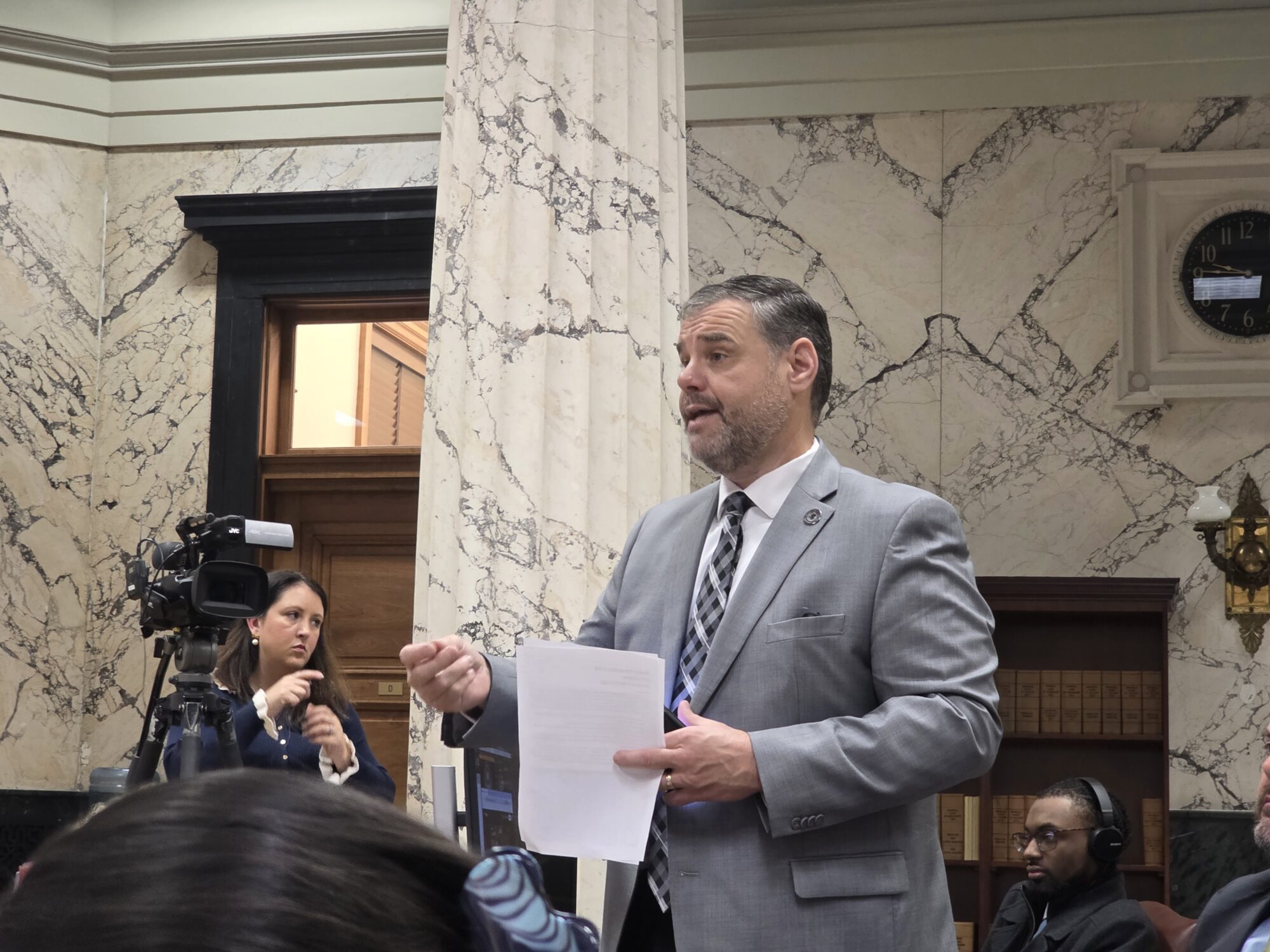
State Superintendent Dr. Lance Evans describes to the Senate's Education Committee how many Carnegie units a student needs to graduate during Thursday's committee meeting. (Photo by Jeremy Pittari | Magnolia Tribune)
- The committee also passed measures to explore future school district consolidations, restrict the use of cellphones in schools, and have civics taught in the classroom, among other bills.
Several bills passed out of the Mississippi Senate Education Committee late last week, including one that could lead to the consolidation of some school districts within the state. Other bills seek to set cellphone use policies in schools, improve math outcomes, provide financial literacy, and ensure funding for gifted education reaches students.
Consolidation
Committee Chair State Senator Dennis DeBar (R) clarified that SB 2486 does not call for the immediate consolidation of districts, which total about 140 including the two state-run special schools, but would direct the Mississippi Department of Education to conduct a study to determine if there is a need to consolidate.
Under the bill, MDE’s Commission on School District Efficiency would review each district based on student population, accountability rating, fiscal impacts, and other factors before presenting that information to the Legislature for review next session.
If the Legislature decides to consolidate any districts based on the findings, that process would begin in July 2028.
Consolidations could be voluntary and could merely entail tightening administration staff, DeBar added.
State Senator Angela Hill (R) made an amendment to have the report also include reviews of the savings, if any, seen from previous consolidations. Hill said her intent is to confirm findings noted in previous PEER reports indicating savings are typically only seen in the first year or two after a consolidation before budgets increase once again.
The bill passed out of committee with that amendment.
Math Act
Two of the bills that came out of the Senate Education Committee focused on ensuring better academic outcomes that can be carried over past graduation.
The Mississippi Math Act, SB 2242, builds on the successes from surrounding states and focuses on instructional improvement in mathematics using evidence-based intervention practices. The emphasis would be on upper elementary grades with a goal to identify gaps in math skills and ensure children are Algebra ready.
“We know that Algebra readiness has a lot to do with their workforce success,” State Senator Nicole Boyd (R) said.
The bill would set aside about $3.5 million for the effort, Senator DeBar noted.
Stat Senator David Blount (D) expressed concern that the bill does not mandate all school districts utilize a standardized math curriculum, as is done in reading. He believes each school in the state should be required to select from MDE’s list of approved high-quality instructional materials.
Senator Boyd said that the state’s home rule allows districts to choose their own instructional material, but if gaps are seen, the bill gives MDE the authority to suggest future changes.
“So, I would ask this body let’s do this, let’s look and if the data comes back to us that we’re not moving the needle, then we need to do more,” Boyd told members. “But right now let’s give these districts their home rule to be able to do this.”
Blount contended that the bill needed to go “all in” and use MDE’s approved curriculum so coaching would be more universal.
“We don’t make exceptions in the teaching of reading in K-3, and it works,” Blount said. “I don’t know why in the world we have 140 different districts choosing their own curriculums.”
After more discussion on the matter, State Senator Brice Wiggins (R) submitted an amendment requiring all districts in the state to use high-quality instructional material from MDE’s list. He said everyone values home rule, but the implementation of high-quality instructional materials in other programs, such as the Third Grade Reading Gate, have proven successful.
“When our children are challenged, they will rise to the occasion,” Wiggins said.
Prior to passing out of committee with that amendment, Senator Hill suggested the Senate consider adding an accountability measure similar to the one outlined in the Reading Gate measure before the bill hits the Senate floor.
Financial Literacy
A financial literacy bill, SB 2483, that passed out of committee looks to set standards for children attending the state’s public schools, with courses to begin in grades 6-8 in preparation for the completion of a half-Carnegie unit high school course.
State Senator Daniel Sparks (R) said the instruction should focus on tax obligations, how to earn income, cash management, how credit and its reporting works, and how capitalization of interest on savings and loans work, to name a few area of emphasis.
“The last one is becoming more and more important, consumer rights and fraud avoidance. So much of our financial transactions take place today in a digital world,” Sparks said. “I get these messages all the time from my banks that say, ‘We will never call you and ask you for personal information.’ That’s something that we need to learn in the sixth grade, the seventh grade and eight grade.”
There was concern the bill would add to the current total units needed for graduation. When asked how many Carnegie units a student needs to graduate from high school, State Superintendent Dr. Lance Evans said it can vary, but a traditional diploma requires at least 26, while specific courses can add endorsements if the student chooses those courses.
To avoid adding more units to the graduation requirement, Dr. Evans said the necessary instruction could be covered in conjunction with existing courses or through the state’s college and career readiness effort.
School Attendance Officers
Similar to a bill that passed out of the House Education Committee last week, SB 2286 would increase the pay of school attendance officers to a base salary of $34,000, an increase from the current base pay of $24,500.
Senator DeBar said the state’s current absenteeism rate is far too high at an average of 27 percent, with some areas of the state seeing rates as high as 45 percent.
Unlike the House bill, which leaves control of SAOs with MDE, the Senate bill would turn control of those officers over to the local districts. Smaller districts could be required to share one officer. It also aims to increase the number of officers by 76 to bring the total to 190 by reducing the requirements for the job.
A new absentee reporting system would also be created by MDE and the Superintendent’s Association, with the first report to be presented to the Legislature by December of next year.
Other changes include defining a student as present if they attend 66 percent of the instructional day, advising schools not to count participation in school athletics or activities as an absence, and moving truancy cases to the youth court.
Gifted Education Funding
The Senate committee also passed SB 2293, which would increase funding allocated for gifted education programs. It was passed with amendments that ensure those funds are only used on those programs. The bill increases the weighting under the Mississippi Student Funding Formula for gifted students from 5 percent to 14.5 percent.
Senator Wiggins introduced two amendments, one of which addressed an ongoing issue.
“What has been found is that those districts, even though they have gotten a portion of the gifted education [funding] had not spent it on gifted education, which is a problem in my opinion,” Wiggins said.
As such, his amendment seeks to ensure gifted funding goes directly to gifted instruction, especially since that category makes up a smaller portion than other funding categories.
“We have overlooked the gifted students in our state,” Wiggins said. “The gifted students need just as much or more encouragement and help as any other student.”
His second amendment moved 7th and 8th grade gifted programs under the Career and Technical Education weight. DeBar said that the Legislative Budget Office estimates the changes will add $21 million to the education funding formula.
Other Bills that Passed the Senate Education Committee
SB 2099 tasks school boards with adopting policies restricting or banning the use of cellphones by students while on campus and during class.
SB 2243 creates an ombudsman office within the Mississippi Department of Education to help parents find the resources they need for their child’s education.
SB 2292 mandates that all students receive instruction on Civics by 2027, which is to be incorporated into a course called “United States Government and Civics” to be offered between the 8th and 12th grades. Senator Wiggins said the bill is meant to increase critical thinking skills on the various branches of government.
SB 2236 revises the state’s Cardiac Emergency Response Plan to include airway clearance devices. The goal is to put at least one such device in every school, State Senator Philman Ladner (R) said. He added that these devices use disposable masks, making them reusable. The devices can also be used on wheelchair-bound individuals without the need to remove them from the chair. The cost of one device is roughly $70, but a company manufacturing the devices pledged to provide at least one for every school free of charge if the bill becomes law, Ladner explained.

Jeremy Pittari