- At its recent meeting, the Mississippi State Board of Education also heard an update on how early education programs are faring in the state.
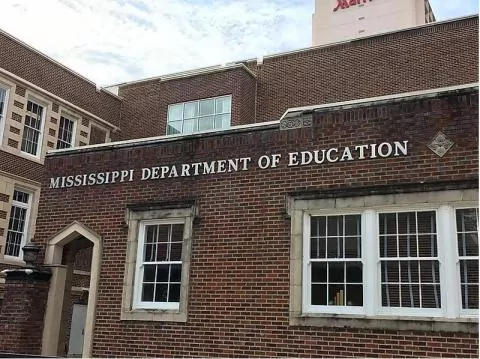
In response to the growing number of districts falling behind on their annual audits, the Mississippi State Board of Education approved a request for a temporary ruling under the Administrative Procedures Act to amend school district financial standards during last Thursday’s meeting.
Chief Operations Officer Dr. Paula Vanderford said the financial standards in the state have been a topic of discussion for some time but have ramped up recently.
“They’ve been a topic of discussion over the last couple of years, but more robust over the last six months,” Vanderford said. “As you know, the conversation intensified after the placement of the Okolona School District in a district of transformation for their serious financial findings.”
In November, the Mississippi Department of Education placed the district under state control, designating it as a district of transformation after the district notified MDE that it did not have enough funds to make payroll.
Vanderford explained to the State Board of Education that prior to 2011 only two violations of the financial standards relating to financial accountability were allowed before sanctions were imposed. In that same year, the threshold was increased to four violations.
“Because the State Auditor’s office was behind on receiving and reviewing and issuing the responses to MDE so that we could take the appropriate action,” Vanderford said as the justification for the increased threshold.
In 2016, MDE made a request to bring the standard back to two violations but did not receive approval. Then in 2023, the agency asked for relief from the state and federal sanctions due to a shortage of firms willing and able to perform the audits.
Samantha Atkinson, Director of MDE’s Bureau of Internal Audit, noted that the shortage of available firms to conduct audits is in part due to their willingness to audit school districts, and the rates requested by firms often exceed what districts are comfortable paying.
Today, the State Auditor’s Office works with MDE to address the firm shortages through MDE’s Bureau of Internal Audit.
During Thursday’s presentation, Vanderford said the goal is to take the threshold back to two violations and focus on the timely audit submissions.
“The recommendation is to take the four consecutive findings back to two consecutive despite the known circumstances and the impact that the shortage of audit firms is currently having on school districts,” Vanderford told the Board. “The revisions attempt to provide clear guidance related to the difference between minor violations and serious financial violations of the financial accountability standards.”
Four of the most severe standards violations that could result in sanctions include having a negative fund balance, maintaining a district maintenance fund balance below 7 percent, receiving an adverse or disclaimer opinion on an audit, and having one or more outstanding audits, Vanderford said.
Atkinson explained that a school district typically has 9 months after the end of a fiscal year to complete an audit.
“So, an outstanding audit, one that misses that year mark, is actually missing 21 months out,” she said.
Currently, there are 17 school districts that have not submitted audits from the past two fiscal years.
The Board went on to approve the request.
Update on Early Childhood Education
In other business, the State Board of Education heard updates on MDE’s strategic plan. Some of those updates focused on how early childhood learning efforts are faring.
Efforts are underway to increase the number of children with disabilities in general education early childhood classrooms. After reaching highs in the 2015-2016 school year, declines were noted after the COVID-19 pandemic, State Superintendent Dr. Lance Evans said.
“The goal here being everyone being educated with their peers,” Evans continued. “We know that works best. We know that is the way the world really works, is everyone is among their peers. And so, what we do is we incentivize that.”
A blended grant program helps incentivize these classroom settings, Evans added. He went on to describe how those percentages have varied over the years.
According to a slide presented to the Board, the percent of children with disabilities in general education early childhood programs was at 75.5 percent in the 2015-16 school year. Each year after that it varied slightly, averaging about 74 percent. The rate dropped to 59.4 percent in 2020-21 school year.
“The percentage drop that we’ve seen has been since the pandemic. We think a lot of that is attributed to the decreased number of students that were ruled eligible for special services during that time of the pandemic. That’s really the only logical reason that we saw those declines,” Evans explained.
Another statistic presented showed Mississippi has seen an increase in the percentage of 4-year-olds attending publicly funded Pre-K programs. Those include programs that are state and federally funded. During the 2015-16 school year, 36 percent of four-year olds were enrolled in those programs, that percentage is now reportedly more than 60 percent.
“We are at an all-time high at 61 percent in ’23-’24,” Evans said.
A dip in the percentage was noted for the 2022-23 school year, falling to 52 percent. Dr. Evans attributed that decrease to a decline in Head Start enrollment, and potentially, to the lower birth rates and outward migration seen in the state. He added that 20 percent of those 4-year-olds within Mississippi are enrolled in the state-funded program.
“Which is up five percent from the previous year,” Evans said.
There has also been an increase in early learning collaborative sites across the state, from 11 in 2015 to 40 in the 2024-25 school year. In that period, the percentage of sites that meet the required rate of readiness has declined from 94.4 percent in the 2021-22 school year to 63 percent in the 2024-25 school year. Dr. Evans explained that time is needed to get new sites up to the standard through training and coaching.
“Now the required rate of readiness has declined over the past two years and what I would tell you is we do know for a fact that as these new collabs come online it takes a couple of years to get them where they need to be,” Evans said.