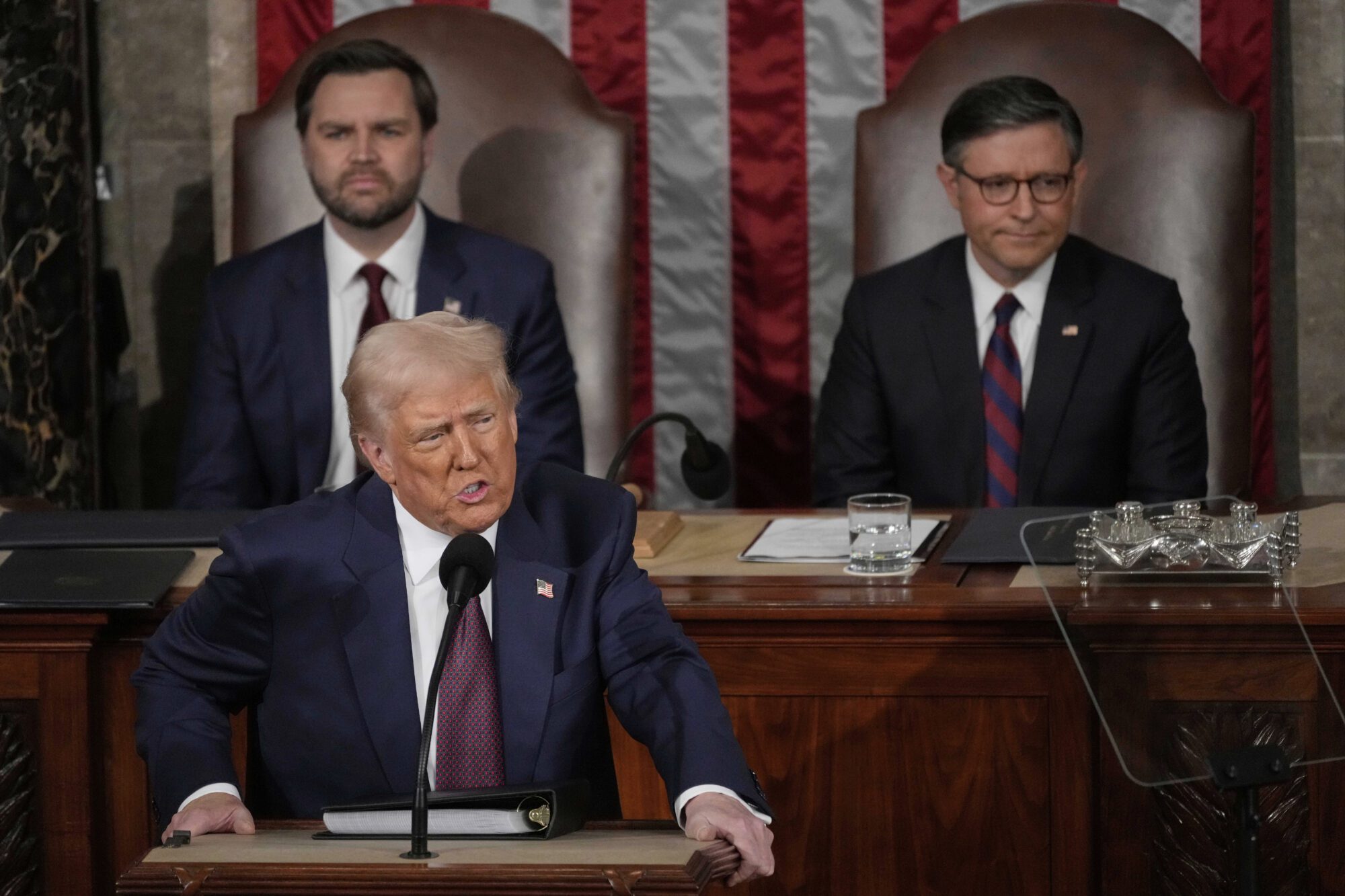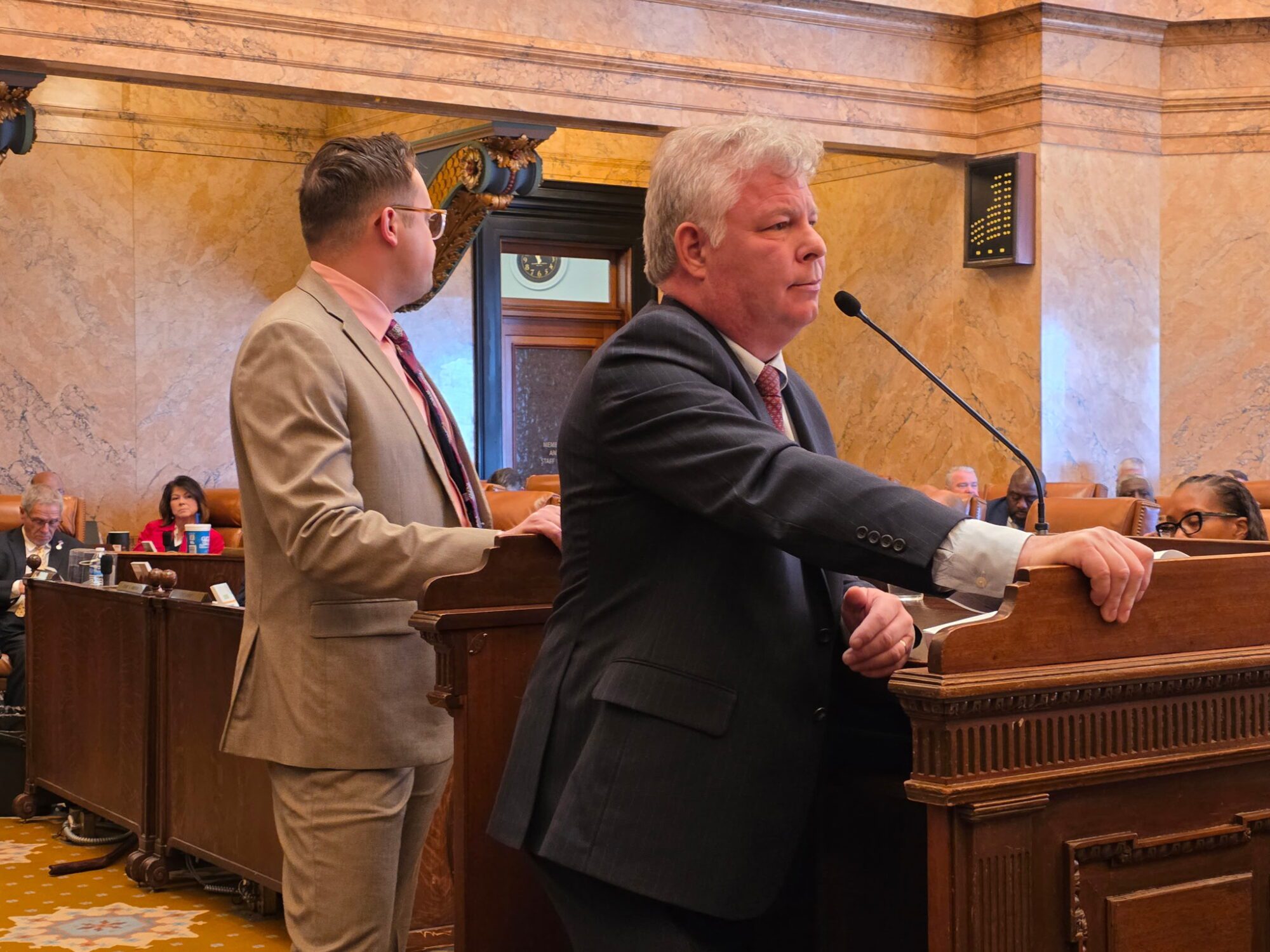
State Rep. Jansen Owen and State Rep. Rob Roberson present the House Education Freedom Act, January 16, 2026 (Photo by Jeremy Pittari | Magnolia Tribune)
- It is rooted in a very old conservative belief that parents, not the government, are responsible for raising and educating their children. They do not belong to the state.
Social media in Mississippi is abuzz with misinformation and scare tactics over school choice after the Mississippi House of Representatives passed a Trump-backed plan to deliver meaningful options to families in the Magnolia State.
Let’s take a step back. What is school choice? Why do supporters, including President Donald Trump, Governor Tate Reeves, the Mississippi Republican Party, every Republican governor of every surrounding state, and over 70 percent of Mississippians favor giving families education options through ESA programs that let the money follow the student?
Why do conservatives support the idea of giving families school choice?
Fundamentally, it is rooted in a very old conservative belief that parents, not the government, are responsible for raising and educating their children. They do not belong to the state. Parents know their children and have the most vested interest in their child’s success.
It’s also rooted in an understanding that the whole point of “public investment” (your money) in education is to prepare kids for life. Only a fool — or an absolute charlatan — would say that 100% of the time, every single kid, is miraculously best served at the school that happens to be closest to where a kid lives.
The point of public investment in education is not to fund teachers’ unions that push transgenderism, fight gun rights or donate hundreds of millions of dollars to far left causes and politicians.
The point of public investment is not to shut down conservative organizations, like Charlie Kirk’s Turning Point USA at Clinton or Gulfport High. The point is not to circle the wagons around convicted child predators in DeSoto County. That’s not why you pay the taxes that fund education.
What exactly is school choice?
So, what is “school choice”? There are different forms that people are confusing. There’s public-to-public school choice — sometimes called open enrollment or portability.
It allows a kid attending the public school closest to where he lives to move to a nearby public school. Mississippi already has this. Under the current law, both the school the child is currently attending and the school he wants to attend have to agree to the transfer.
The proposed change would just remove the sending school’s veto power. That’s it. The receiving school would still have to agree to accept the child. It’s a nothing burger that has people in an absolute tizzy.
There are public charter schools that are designed to allow for a little innovation within Mississippi’s public system. We have very few because the law was originally written to be so restrictive as to be largely pointless. The proposed law would open up charter school eligibility to any school district containing a D or F-rated school.
There are tax credit scholarships, that allow individuals or companies to fund private school scholarships in exchange for a tax credit.
And then there’s the “holy grail” that impacts the most kids — the creation of Educating Savings Accounts (ESAs) that allow money already allotted by the state to follow the student.
Mississippi already has these for children with special needs and scholarships for dyslexic students and people with speech therapy needs. These are not “vouchers” or coupons to attend a specific school. They give families flexibility on things other than tuition as well. Universal ESA programs are what Trump has supported in surrounding states.
It’s important to realize that under the current proposal in HB 2 there are 6,250 scholarships allotted to current public school enrollees in Year 1. Put into context, that’s less than 1.5 percent of the current K-12 public enrollment.
Who is supplying the talking points against school choice?
Who is fighting this? The same people who fought the 2013 package of public education reforms that have been credited with the change in direction/improvement in our test scores.
The same exact people who, mad about conservative reforms, loudly lied to Mississippians in 2015 in an attempt to rob you of your elected representation and turn our schools over to Hinds County judges. (They failed despite outspending conservatives 10-to-1.)
Shockingly, it’s the same people who opposed funding formula changes that have pumped hundreds of millions into our public schools. The same people who fought returning to school during COVID.
They are using far left market-tested talking points and money from the Southern Poverty Law Center and the ACLU to push it. They go by Orwellian names like “The Parents Campaign,” despite being primarily motivated by denying parents’ options and doing the bidding of superintendents. Despicably, they use segregationist-era talking points about “culture” and “property values,” hoping to stir a fringe of conservative voters against their own interests out of fear a Black kid might end up in class.
It’s a “Bootleggers and Baptist” scenario. And it might work. Some conservative legislators might just be silly enough to stand against Trump in favor of the ACLU and Southern Poverty Law Center. They might cozy up to the very people that have fought them tooth and nail, up to and including trying to take away their authority to make education policy.
But it will be another example of Mississippi leaders putting the easy path, the loudest voices, above the interest of the next generation.
Make no mistake, teachers unions and even some administrators in Mississippi, see your child as a dollar sign and nothing more. Both NEA and AFT, the two largest teachers’ unions in America have affiliates in Mississippi. Both funnel nearly 100 percent of their giving to candidates in a single party. It’s about power and control, not your kid.
And no, this isn’t a shot at teachers. There are wonderful teachers in both public and private schools. And no, this isn’t a public versus private school message. There are good versions of both and there are bad versions of both.
This is about what is in the long-term best interest of kids as the national trend is skyrocketing expenditures for diminished returns.

Russ Latino