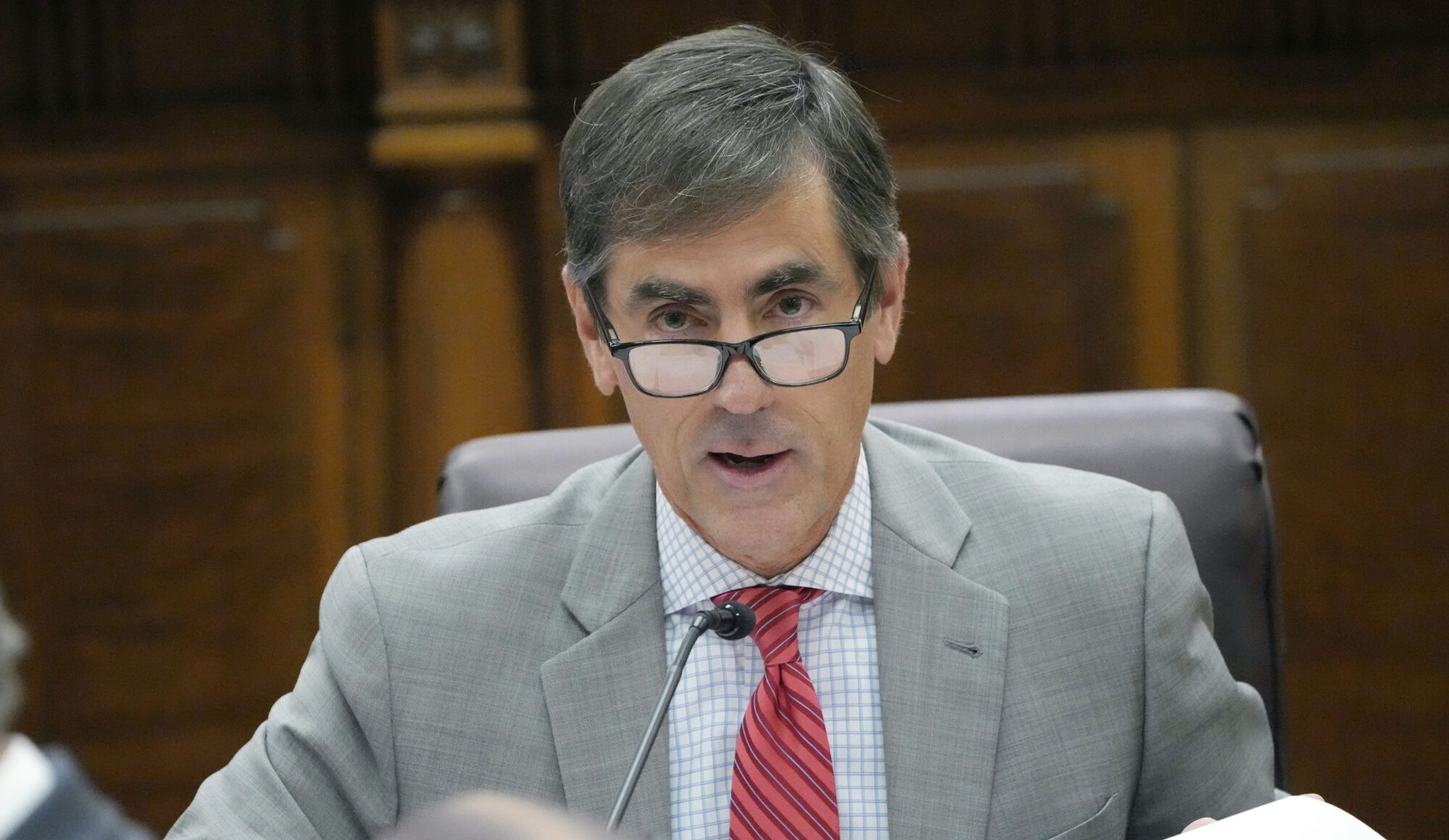
Mississippi State Appropriations Committee Chairman Briggs Hopson, R-Vicksburg, chairman of the Senate Appropriations Committee, Thursday, Jan. 25, 2024. (AP Photo/Rogelio V. Solis)
- Lawmakers in both chambers continue to hold budget hearings with state agencies as they work to compile appropriations bills and set a Fiscal Year 2027 state budget.
The Mississippi Department of Employment Security, AccelerateMS and the Community College Board presented their budget proposals to the Senate Appropriations Committee earlier this week.
MDES kicked off the meeting by asking for level spending as well as the ability to keep 22 positions.
Bill Ashley, Executive Director of MDES, informed the committee that the agency currently has 28 positions in active recruitment. When filled, that will give the agency a total workforce of 440, down from last year’s total headcount, if the Legislature decides to allow the agency to retain some positions.
Guy Martin, Chief Financial Officer for MDES, added that the agency is asking for 22 positions above the Legislative Budget Office’s suggestion of 418 total employees.
“Please note, that MDES will reduce its workforce by 13 positions compared to last fiscal year’s headcount of 453,” Ashley explained.
The agency is requesting $139 million to keep the workforce at the 440 total. The request includes $1.4 million for a state longitudinal data system (SLDS) along with $400,000 of fiscal support for AccelerateMS.
“This funding is not just a request but a needed proactive step to capitalize on economic momentum and address workforce challenges head-on,” Ashley described.
The SLDS is the keeper of the state’s education and employment information. That information is compiled by a third-party vendor.
Dr. Courtney Taylor, Executive Director of AccelerateMS, asked the committee for level funding for the 204 career coaches, which is about $75,000 per coach, and informed the members that her agency is preparing for the decline in federal ARPA funding. The agency has $84 million allocated in ARPA funds, with $16 million remaining.
“We do have the final reimbursement date set for September 30 so that it can be closed out on December 31. And we do not anticipate any big non-use, so we don’t think any money is going to come back,” Taylor explained. “We are conducting monthly check-ins on this money to make sure they are using it and that they are spending it.”
In Workforce Enhancement Training funds, there are $36 million allocated, $18 million of which is in open enrollment and training programs. Another $18 million is set aside for basic skills and special projects along with another $18 million allocated to Mississippi Works, with $13 million of that remaining to be spent this year.
Taylor did ask the committee for salary increases due to increases in healthcare, retirement, and worker’s compensation, along with funding for two new positions. The new positions would be in systems administrations and talent solutions.
The Senate committee also heard requests from the Community College President Association and Community College Board.
One of the major things the boards are seeking is a 6 percent pay raise for their 8,319 staff members, representing a total of $28 million, along with another $28.5 million to cover the increases in utility and insurance costs.
Dr. Michael J. Heindl, president of Northwest Community College, said there was a 20 percent increase in insurance costs, equating to an increase of about $130,000.
Heindl told lawmakers that $292 million in state funding was provided to the community colleges last year, which represented a 2.5 percent cut, with no pay raises.
A bill working its way through the Senate, SB 2001, proposes to provide raises to all education employees in the state, including those at public community colleges, universities and K-12 schools.
“Let me just say this, thank you all in advance for jumping out there really quickly in the beginning of this session with just really thinking about how raises could be provided to community college faculty,” Heindl said.
For facilities, the college boards also requested $150 million for the maintenance and renovation of areas in the 18 million square feet of space within its 1,047 facilities at the state’s 15 community colleges.
“So, as you all can imagine, there’s a lot of cost when it comes to our facilities in terms of just maintenance, repairs, renovations that need to take place from time to time,” Heindl explained.
That funding will help with the $179 million worth of capital improvements, $92.5 million in repair and renovation projects, and another $141 million in preplanning costs for the needed projects, totaling $413 million of identified need.
Kell Smith, Executive Director of the Community College Board, said last year the agency received $6.1 million in state funding. He asked the committee to consider the restoration of $310,000 that was eliminated in the previous year.
Smith also asked for an additional $2 million for the adult education program.
“Y’all probably heard me say before in Mississippi we have anywhere from 300,000 to 330,000 Mississippians without a high school diploma,” Smith said. “And that’s a challenge for them, that’s a challenge for the state, that’s a challenge for all of us.”
Currently, the Community College Board receives about $1.8 million from the state for the adult education program, but it spends about $8.8 million, which includes federal funding.
Dr. Scott Alsobrooks, President of East Mississippi Community College, presented the results of an economic impact study conducted last year to support their funding requests. He said the study found that 84 percent of community college graduates stay and work within Mississippi or move on to a university to continue their education.
“Our graduates are staying home,” Alsobrooks said. “Eighty-four percent are still here, either going to work or pursuing further education.”
Lawmakers in both chambers continue to hold budget hearings with state agencies as they work to compile appropriations bills and set a Fiscal Year 2027 state budget.

Jeremy Pittari