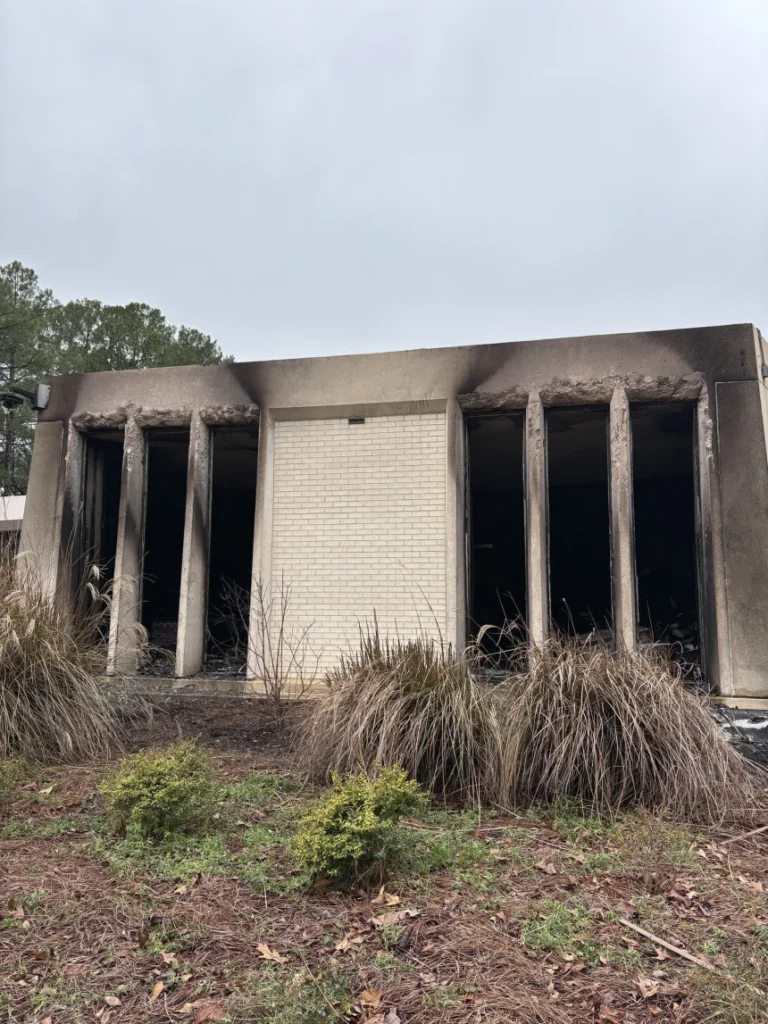
The library at Beth Israel Congregation is where investigators believe the arsonist started the fire that destroyed large portions of the building. (Courtesy: Beth Israel Congregation)
Listen to the audio version of this article (generated by AI).
- The congregation at Beth Israel must rebuild after an arsonist’s fire damaged large portions of the largest Jewish synagogue in Mississippi.
Jackson, Mississippi — Before the sun rose on Saturday, January 10, 2026, fire and billowing smoke spread through the Beth Israel synagogue. Fire crews responded to an emergency call after 3 a.m. After extinguishing the blaze, they determined it had been set by an arsonist.
Founded in 1860, Beth Israel is the capital city’s only synagogue. It is the largest Jewish house of worship in Mississippi.
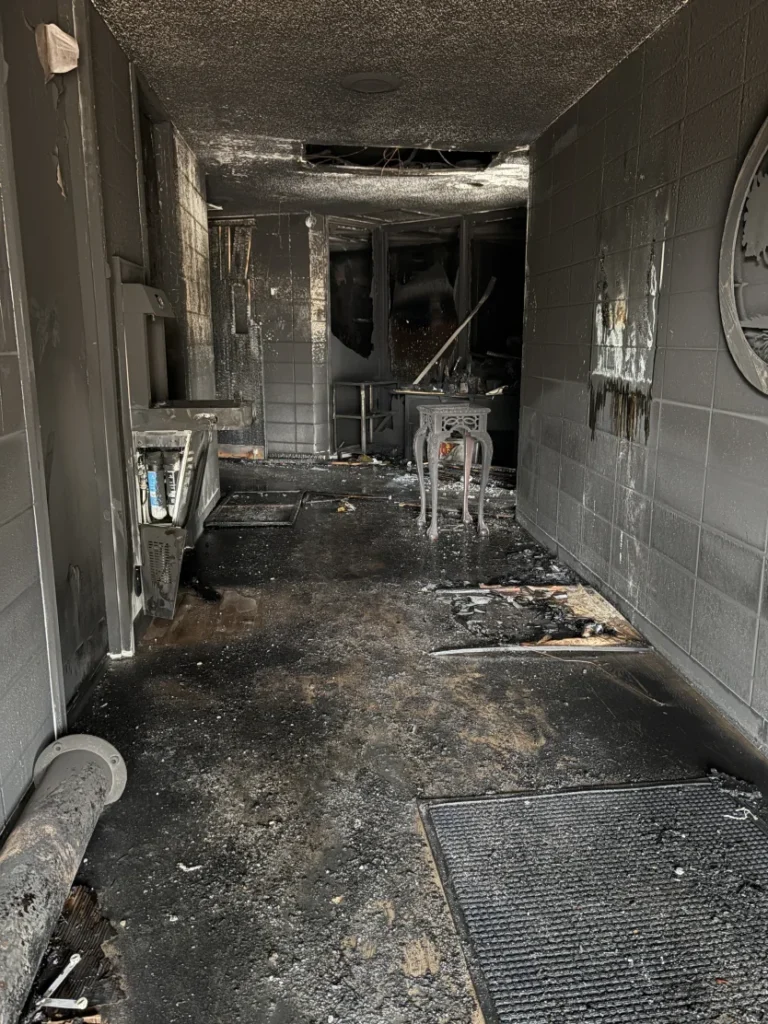
Flames tore through the synagogue’s library, where investigators believe the fire started, and into the administration building, charring and structurally damaging both. Soot and smoke permeated the rest of the building, including the main sanctuary, covering floors, walls and ceilings.
Two Torah scrolls — handwritten scriptural texts central to Jewish worship — were destroyed. Five others were damaged. A Torah on display at Beth Israel that survived the Holocaust survived unscathed.
Fortunately, no one was in the building at the time, meaning no one was injured, save the arsonist himself. The alleged perpetrator was identified at a Jackson area hospital later Saturday as he sought treatment for burn wounds suffered at the time of lighting the blaze.
The suspect’s identity has not yet been made public, but city officials told Magnolia Tribune Saturday night that he was motivated by anti-Jewish sentiment and the attack on Beth Israel was ‘deliberate’ and ‘targeted.’
The investigation remains active with cooperation between the Jackson Fire Department’s Arson Division, the Jackson Police Department, the FBI, the ATF and the Joint Terrorism Task Force.
In the wake of the attack, Beth Israel has suspended in-building services indefinitely while assessing damage and planning repair. Congregational leaders have accepted offers from nearby churches to host worship services and community programs as the synagogue begins what is likely to be a long rebuilding process.
One long-planned community celebration — an adult bat mitzvah — is still expected to proceed this coming Shabbat, albeit in a borrowed space and with a borrowed Torah if necessary.
Reactions Pour in from Jewish Community, City, State and National Leaders
Jackson Mayor John Horhn issued a statement condemning the act, not only as an attack on the Jewish community, but on the entire city’s safety and freedom to worship.
“Acts of antisemitism, racism, and religious hatred are attacks on Jackson as a whole and will be treated as acts of terror against residents’ safety and freedom to worship,” he said, adding that targeting people because of their faith is “morally wrong, un-American, and completely incompatible with the values of this city.”
Beth Israel Congregation President Zach Shemper expressed devastation at the damage, but gratitude that no one was hurt. In an official statement, he thanked first responders and members of the wider interfaith community who reached out:
“As Jackson’s only synagogue, Beth Israel is a beloved institution, and it is the fellowship of our neighbors and extended community that will see us through. We are a resilient people. With support from our community, we will rebuild.”
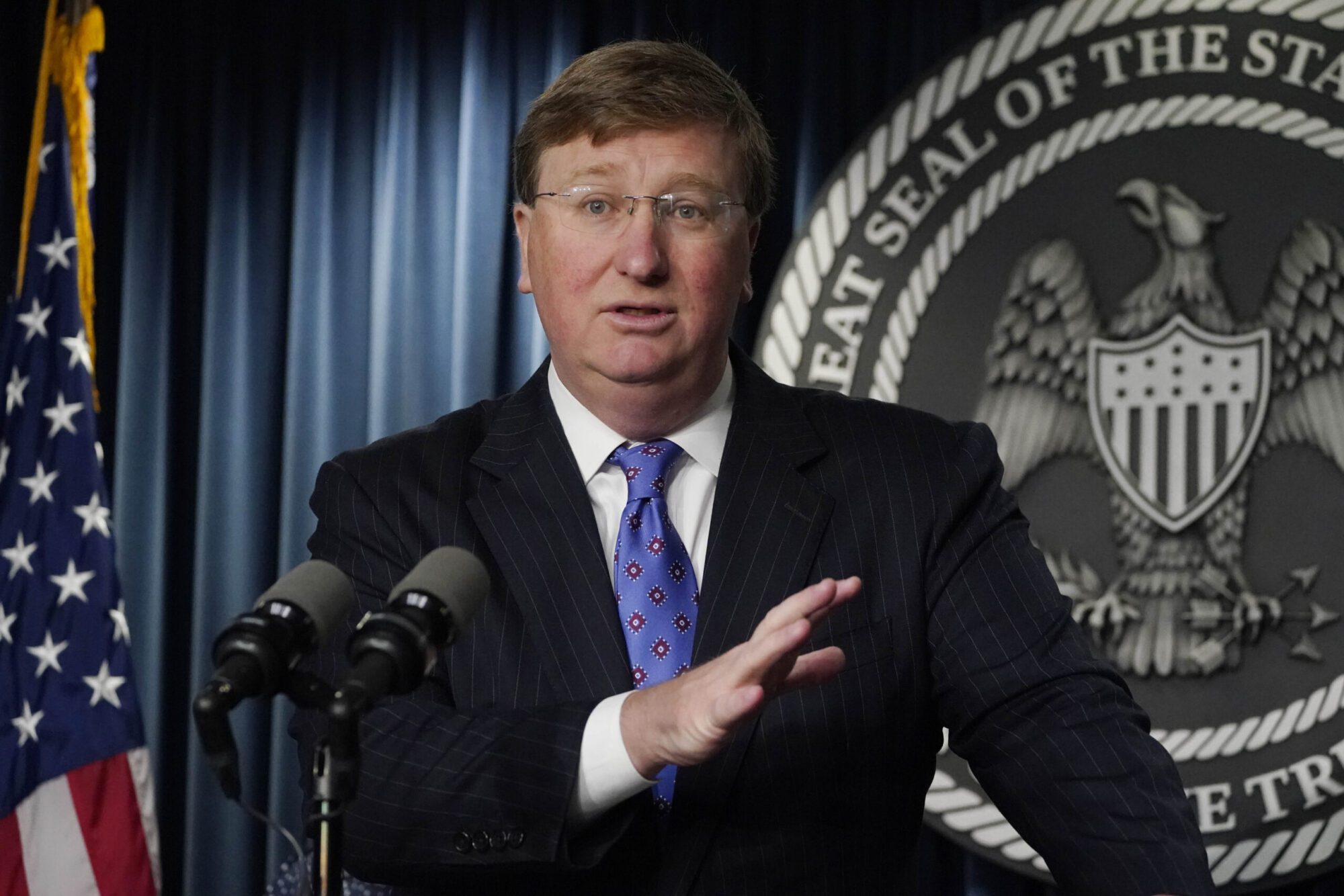
National Jewish advocacy groups weighed in as well. Amy Spitalnick, CEO of the Jewish Council for Public Affairs, said the attack “comes alongside a dramatic increase in hate and violence targeting Jewish communities and institutions around the globe, compounding our fear and vulnerability at this already challenging moment.”
Jonathan Greenblatt, CEO of the Anti-Defamation League (ADL), declared, “An attack on any synagogue is an attack on all Jews. We will not be intimidated. We will not be silent.” reflecting longstanding concerns from civil rights advocates about rising antisemitic acts in recent years.
Politicians throughout Mississippi and across the nation expressed outrage at the attack and solidarity with the Jewish community.
A History of Resilience
Over 160 years, the Beth Israel synagogue has weathered rebuildings, relocations and demographic shifts. It built the first synagogue in Mississippi, and its storied history is interwoven with both Jewish life and the broader struggles for civil rights in the South.
Several outlets were quick to associate Saturday’s violence with a 1967 attack. That year, members of the Ku Klux Klan bombed the synagogue — damaging offices and the library — because of its rabbi’s civil rights advocacy. The race of the arsonist and his exact ideological motivation are unknown at this point.
In more recent decades, the synagogue has also faced lesser acts of vandalism, including windows broken and antisemitic graffiti scratched onto doors.

This attack did not occur in isolation. For years, data from civil liberties and hate-crime organizations have illustrated an upward trajectory in antisemitic acts both in the U.S. and globally, with a particularly pronounced spike following Hamas’ October 7, 2023 attack on Israel and the ensuing war in Gaza.
According to the ADL’s annual audit, more than 9,300 antisemitic incidents were reported in the U.S. in 2024 — including harassment, vandalism and assaults — marking the highest total since the organization began tracking data in 1979. In the months immediately after October 7th, antisemitic incidents spiked around 360% compared with the same period a year earlier.
Far Left and Far Right Voices Promoting Anti-Semitism
In the wake of October 7th, large pro-Palestinian protests across the U.S. and globally have sometimes featured rhetoric that crosses into antisemitic territory. Chants such as “From the river to the sea,” and slogans interpreted as denying Israel’s right to exist, have been seen by many observers as antisemitic when they target Jews collectively rather than specific policies or leaders.
Critics argue that some protest movements have failed to adequately separate legitimate criticism of Israeli governmental policy from broader hostility toward Jews. There have been more overt instances of anti-Jewish rhetoric present in the protests. For example, at George Washington University, during a pro-Palestinian protest in April 2024, a demonstrator was photographed holding a sign that read “final solution”, a phrase historically used by Adolph Hitler’s Nazis to refer to their plan to exterminate European Jews in the Holocaust.

On the far right, conspiracy theories that recycle age-old antisemitic tropes have found new audience through high-profile media figures and extremist influencers. Figures like Tucker Carlson and internet provocateur Nick Fuentes have been criticized for spreading narratives that echo classic antisemitic stereotypes — for example, asserting disproportionate Jewish influence over finance, media, politics, or cultural institutions. These narratives mirror prejudiced ideas that have fueled antisemitic violence historically.
Such rhetoric can give cover to individuals who see Jews not just as political actors in a foreign policy dispute, but as monolithic, powerful villains — an idea at the core of antisemitic ideology. These tropes, when amplified through millions of followers on social media contribute to a cultural environment where Jew-hatred could become normalized or excused.
Fuentes denies the Holocaust and has at various time praised Hitler with statements like “Hitler was awesome.”

Russ Latino