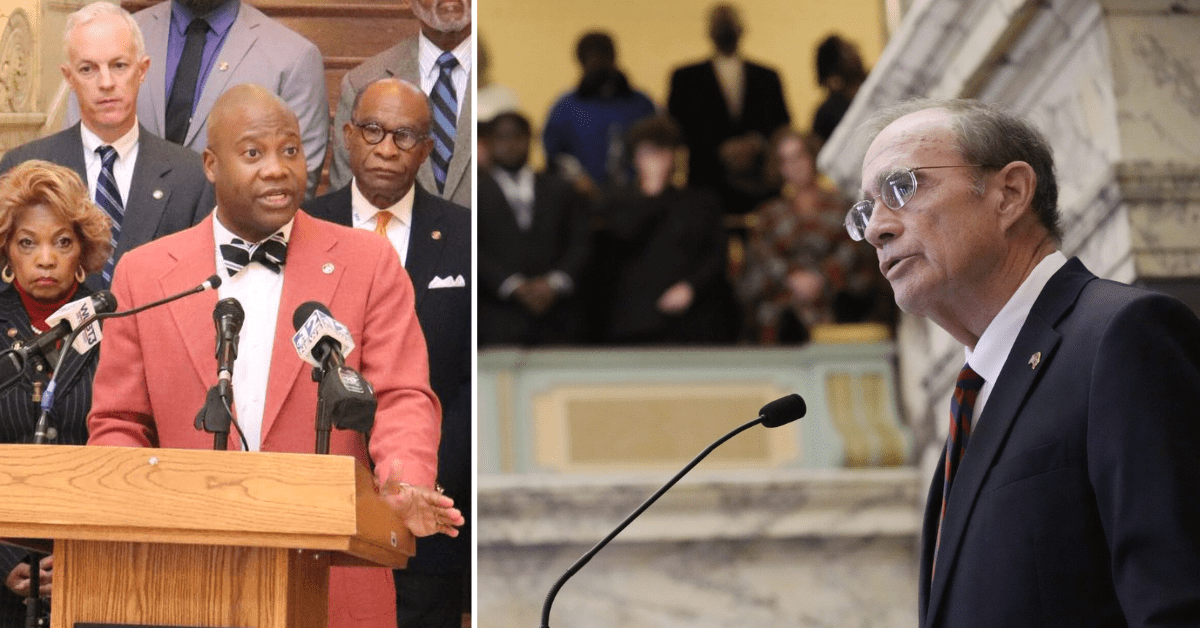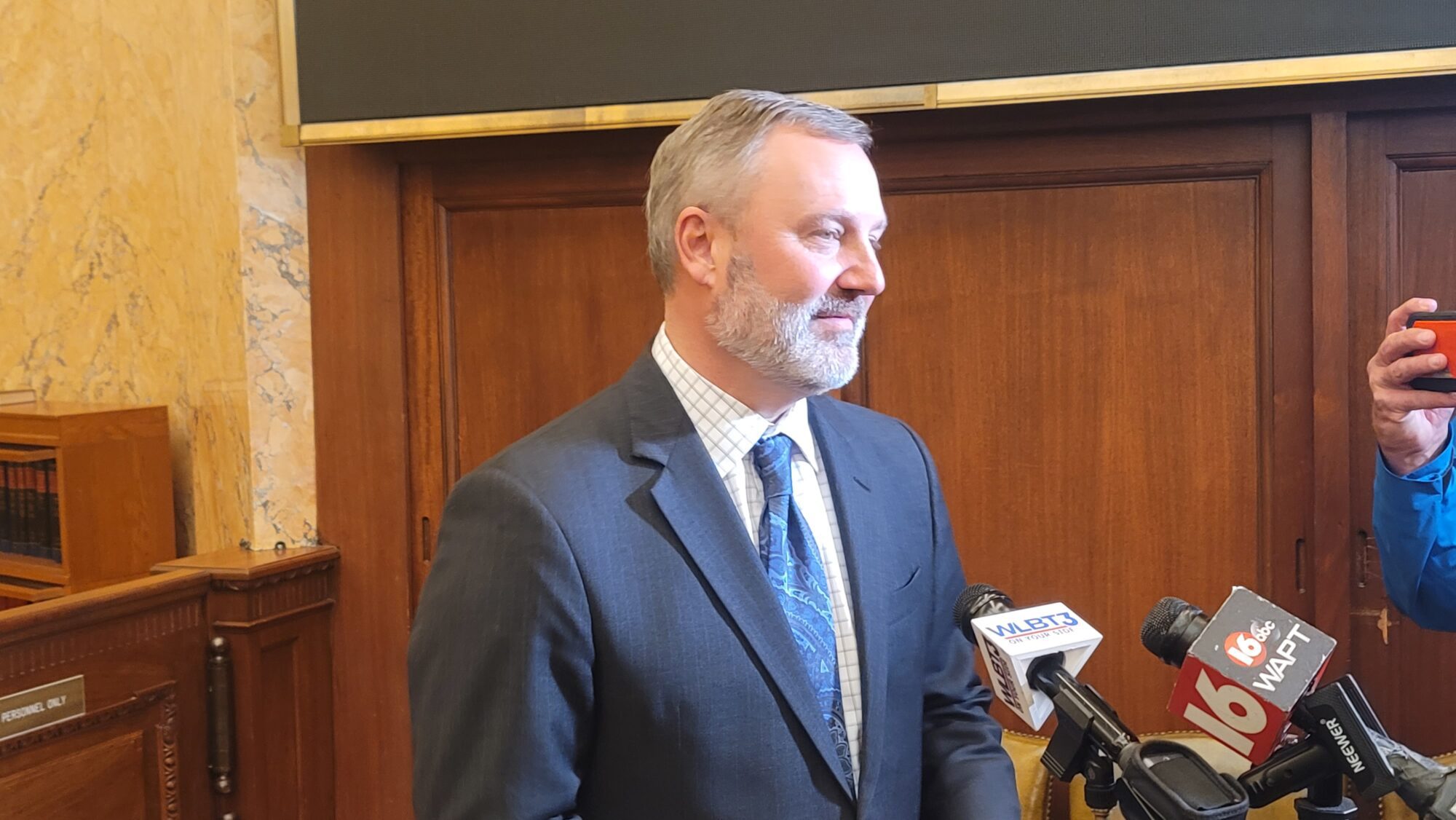
Speaker of the House Jason White addresses the media on Wednesday after Lt. Gov. Delbert Hosemann announced the Senate's new tax plan. He also discussed the expected death of a school choice bill in the House. Photo by Jeremy Pittari | Magnolia Tribune
Listen to the audio version of this article (generated by AI).
- Speaker Jason White and House Republican education leaders dropped the Education Freedom Act on Wednesday, offering a path to universal school choice.
The kitchen sink. It’s arguably the only thing missing from the Mississippi House of Representatives long awaited school choice proposal. Among the proposals contained in the omnibus bill, HB2, are:
- An Education Savings Account that would allow a first year limit of 12,500 students to access their state allotted funds for private school tuition;
- The loosening of restrictions and aid to support transfers between public schools;
- A lottery-based support structure for homeschool families and the inclusion of the Tim Tebow Act to allow homeschool students to participate in public school extracurriculars;
- An expansion of eligibility and support for Mississippi’s existing ESA for children with special needs and its dyslexia scholarship;
- A rework of the authorization framework for new charter schools;
- An expansion of Mississippi’s literacy and math support through MDE aimed at sustaining current 4th grade gains through the 8th grade; and
- A pay raise for teachers’ assistants, among other provisions.
Education Savings Accounts
In “school choice circles” Education Savings Accounts or ESAs are seen as the holy grail. ESAs are a priority of the Trump administration to advance his stated goal of ensuring every child in America has access to education choice. Under the leadership of Republican governors, surrounding states, including Arkansas, Florida, Texas, Tennessee, Alabama and Louisiana have all implemented ESA programs.
ESAs offer flexibility to families to use not just on private school tuition, but on associated education costs. Because they are based on a state’s existing per student funding model, they also afford the greatest potential to scale and for more students to participate.
By contrast, and as an example, tax credit scholarship programs typically offer greater constraints on participation because they are limited by the extent of corporate donations.
The House proposal calls for the creation of two pools of eligible students. The first pool of 6,250 scholarships is available only to students in the existing K-12 system. This comprises roughly 1.5 percent of Mississippi’s total student population. The second pool of 6,250 scholarships is available to all Mississippi students eligible to enroll in a public school.
Both pools prioritize low income students before making any remaining slots eligible through lottery. The amount of the scholarship for students from participating schools is the base student cost under the state’s current funding formula. Eligibility for the program will increase by 2,500 annually — divided between the two pools — provided the previous year’s allotment of scholarships have all been claimed.
This current school year the base student cost was $6,695.34. The new cost associated with the ESA program in Year 1 is, accordingly, estimated at just under $42 million.
Public-to-Public Transfers
Where ESAs allow a student to use his or her allotted per pupil expenditure on private school tuition, among other qualified expenses, public-to-public school choice allows a student to leave the public school where he lives to attend another neighboring public school.
This form of school choice is sometimes referred to as “open enrollment” or “portability.”
Mississippi already has law in place that allows for public-to-public transfers. It currently requires that both the school the child is leaving and the school the child wants to attend agree to the transfer. This effectively means that the school the child wants to leave can veto the transfer even if the other school has space for and wants the child.
Both SB2002, which passed the Senate Wednesday, and HB2 remove the sending school’s veto power, but keep in place the receiving school’s authority to accept or reject the student. Neither bill requires a school without capacity or resources to accept a student.
HB2 requires districts to publish their criteria for determining whether to accept students. Under current Mississippi law, a student’s state funding follows him when he transfers between districts, but the local property taxes collected by the district do not. This is the source of some critique and has yielded situations where some districts accepting out-of-district students charge tuition to cover the difference.
HB2 creates a $5 million dollar fund to cover the amount a district receiving a public transfer student misses out on because local property taxes are not transferable between districts.
Under both current law and the proposed law, families availing themselves of public-to-public transfer must provide their own transportation. In practice, even states with extremely permissive portability laws see limited participation. For that reason, the scale of this proposal is much smaller than ESAs.
MDE Support/Teacher Assistants
HB2 establishes additional support to expand Mississippi’s literacy and math programs that have been widely and nationally credited with gains experienced by fourth grade students. The aim of this support is to sustain those gains past the fourth grade to eighth grade NAEP testing. Lt. Governor Delbert Hosemann has also made this a stated goal.
The Senate has proposed a new teacher pay raise on top of the pay raises passed in 2022 — which themselves included annual step ups based on experience and higher starting point resets every five years. By contrast, HB2 leaves in place the existing automatic raise structure for teachers and instead focuses on raising the minimum salary for teachers’ assistants to $20,000.
Charter School Authorization
Charter schools are public schools designed to offer an innovative alternative to existing public schools within a district. At the turn of the 21st Century, charter schools became a popular outlet in urban areas with failing schools across the U.S.
Mississippi’s existing charter school law places significant limitations on where they can be opened and provides a single point of authorization. The result has been very few authorized charter schools.
HB2 seeks to rework the authorization process and to expand where high schools can open to include on the campuses of Mississippi’s colleges and universities.
Special Needs, Speech Therapy and Dyslexia
Mississippi has in place an ESA for which only children with special needs are eligible. It also has scholarship programs for dyslexia and speech therapy.
HB2 removes the cap on the number of students eligible for the Special Needs ESA and sets the ESA amount at the base student cost, plus $2,000. Similarly, the speech therapy scholarship is set at base student cost, plus $2,000. Finally the dyslexia scholarship is set at base student cost, plus $1,000.
Homeschool Support
HB2 creates a $5 million fund with support capped at $1000 per homeschool family for qualified educational resources. Where demand exceeds the fund’s cap, awards will be determined by lottery.
Additionally, HB2 includes the provisions of the Tim Tebow Act, enacted in over 30 states, that permits homeschool students to participate in extracurricular activities within the local school district in which they live. A standalone version of the Tim Tebow Act passed the Mississippi House last year, but did not receive a vote in the Senate.
Other Provisions
Other provisions include reforms to Tier 5 of PERS, that reduce years of service for eligibility from 35 to 30, a financial literacy course requirement, a restructuring of the school districts within Copiah County, creation of NJROTC programs within each congressional district with $10 million in funding, and allowing schools to hold silent prayers at the beginning of each school day.