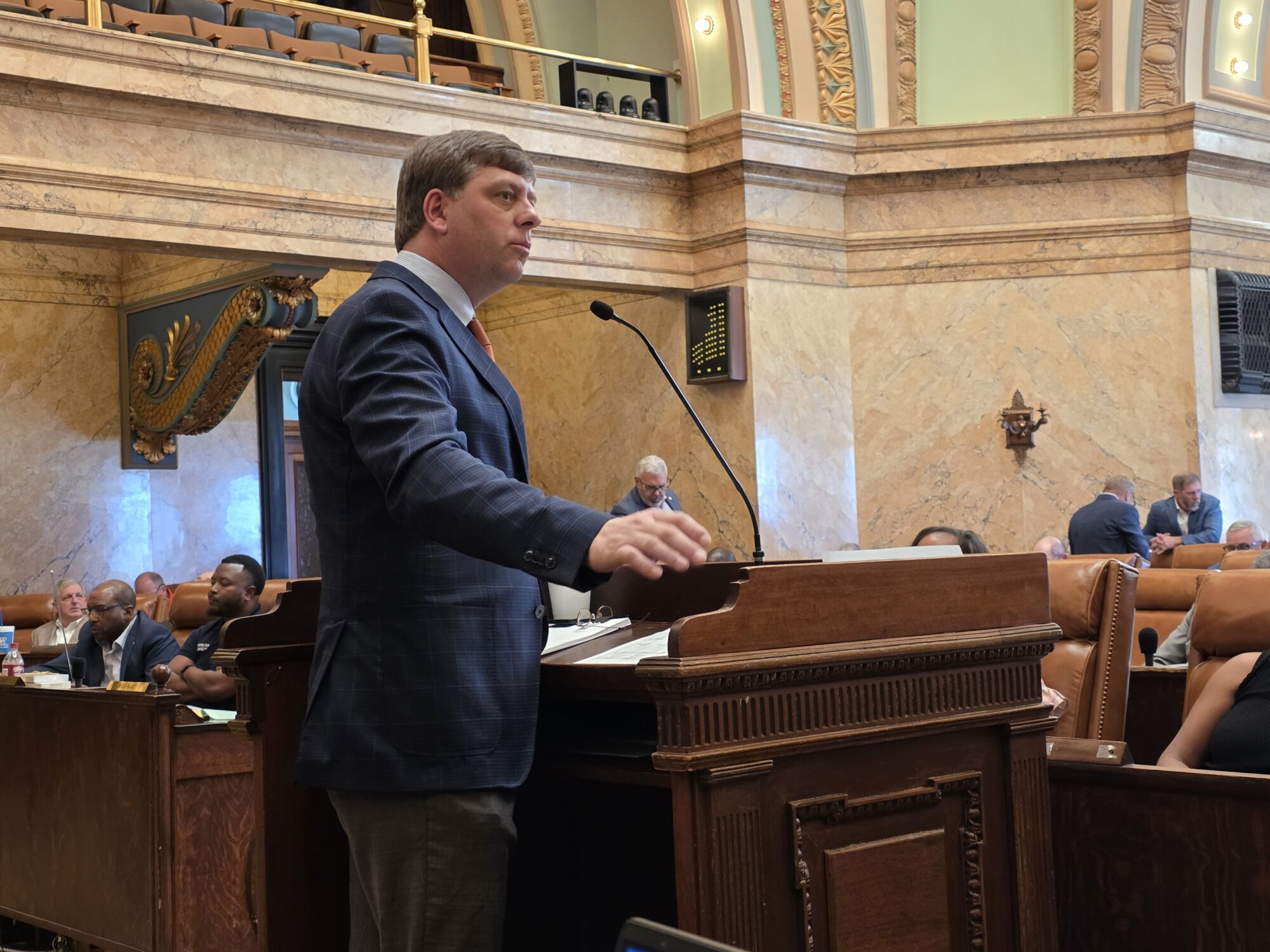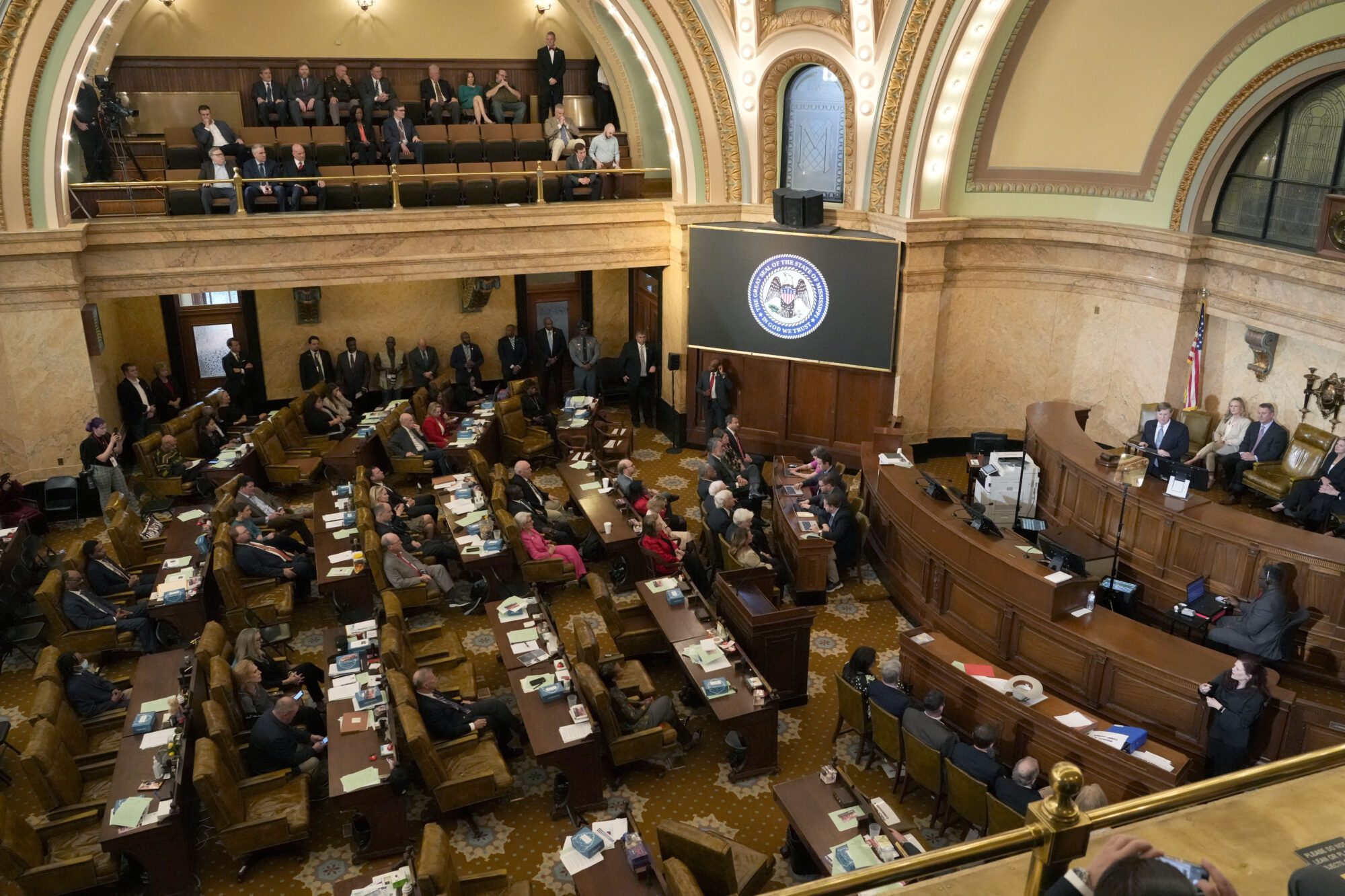
Mississippi House of Representatives chamber, Monday, Feb. 26, 2024, at the state Capitol in Jackson, Miss. (AP Photo/Rogelio V. Solis)
- Learn more about what to expect over the next three months and what is on the horizon as the Mississippi Legislature gets down to business.
Lt. Governor Delbert Hosemann (R) and Speaker Jason White (R) are set to gavel in the Mississippi Senate and House of Representatives, respectively, Tuesday at noon at the state Capitol.
The annual legislative session will run three months, with sine die, or the end of the session, tentatively set for Sunday, April 5.
Makeup of the Mississippi Legislature
The Mississippi Legislature is comprised of the state Senate and the House of Representatives. Lt. Governor Hosemann presides over the Senate while Speaker White presides over the House. The presiding officers appoint committee chairmen and make committee assignments. The pro-tempore for each chamber is elected by its members.
Republicans hold a supermajority in the 122-member House and the majority in the 52-member Senate, after losing the supermajority by two seats during the 2025 special redistricting elections.
Key leadership positions in each chamber, other than the presiding officers, include those that handle money or appropriations bills. In the Senate, that includes Senator Josh Harkins (R), chairman of the Senate Finance Committee, and Senator Briggs Hopson (R), chairman of the Senate Appropriations Committee. In the House, State Rep. John Read (R) chairs the House Appropriations A Committee while State Rep. Trey Lamar (R) chairs the House Ways and Means Committee.
Other powerful committee chairs include those that handle high-profile legislation, such measures dealing with education, healthcare, and elections.
The Process
All legislation filed by members is assigned to a certain committee – or two – to consider its merits.
The chairman of the assigned committee has the responsibility to work with the chamber’s leadership and his/her committee members to determine what legislation is brought up in the committee for action and what is allowed to die.
Once a measure is passed out of committee, it is then up to the presiding officer and the committee chairman to determine if and when a measure is brought to the chamber’s full body for a debate and a vote. Members can offer amendments to bills in committee or on the floor.
When a measure receives a positive vote in one chamber, it is then transmitted to the other chamber for similar action.
If a bill makes it out of the other chamber’s committee without an amendment, the full chamber essentially then has the option to concur, advancing the measure to the governor for his signature.
However, if changes or amendments are made to the bill in committee or on the floor, the measure would then be sent back to the originating chamber for consideration.
Once a bill has worked its way through the full process, it then goes to the governor, who can choose to sign the measure into law, allow it to become law without his signature, or veto it.
To become law, a general bill only requires a simple majority vote of approval while a three-fifths majority is required to pass revenue bills, and a two-thirds majority is needed to pass constitutional amendments or resolutions.
A two-thirds majority vote by lawmakers is required to override a governor’s veto.
Dates to Keep in Mind
The timetable for processing legislation during the 2026 session includes various deadline dates to ensure the chambers do not get bogged down by the thousands of bills expected to be filed.
Here are a few important dates to keep in mind:
- January 19 – Deadline for introduction of general bills and constitutional amendments
- February 3 – Deadline for committees to report general bills and constitutional amendments originating in their chamber
- February 12 – Deadline for floor action on general bills and constitutional amendments originating in their chamber
- February 23 – Deadline to make requests for appropriation and revenue bills to be drafted
- February 25 – Deadline for floor action for appropriation and revenue bills in their chamber
- March 3 – Deadline for committees to report general bills and constitutional amendments originating in the other chamber
- March 11 – Deadline for floor action on general bills and constitutional amendments originating in the other chamber
- March 17 – Deadline for floor action for appropriation and revenue bills in the other chamber
- March 20 – Deadline for introduction of local and private bills that are revenue bills
- March 27 – Deadline for introduction of local and private bills that are non-revenue bills
- March 28 – Deadline for conference reports to be filed for appropriations and revenue bills
- March 30 – Deadline for final adoption of conference reports on appropriation and revenue bills; and deadline for conference reports on general bills and constitutional amendments to be filed
Key Topics Heading into the 2026 Session
Education freedom will lead the House’s early work, with action on a package expected in the opening days of the 2026 session.
Teacher pay raises and efforts to address chronic absenteeism in K-12 public schools, as well as considering ways to update how the state’s public colleges and universities are funded appear to be high on the Senate’s education priority list.
Lawmakers could readdress the new Tier 5 created in the Public Employees Retirement System, or PERS, during the 2025 session while also considering ways to financially stabilize the system through the use of one-time funds and a dedicated stream of revenue.
Early voting and restoration of a ballot initiative process could also be back on the table for consideration this session, both of which have repeatedly failed to gain approval in both chambers.
Economic and workforce development efforts continue to be front and center as Mississippi strives to train up its citizens for the high tech and industrial jobs coming into the state.
Also at issue is whether the Mississippi State Board of Election Commissioners, made up of Governor Tate Reeves (R), Attorney General Lynn Fitch (R) and Secretary of State Michael Watson (R), will challenge a federal court order to redraw the state’s Supreme Court districts over the want for greater black voting strength. Hosemann has said the Board should challenge the order given the U.S. Supreme Court’s review of provisions in the Voting Rights Act. Lawmakers will be asked to work up a redistricting plan for these new Supreme Court districts.
On the Horizon
The 2026 session is sure to be one to watch as more than a few lawmakers are rumored to be considering runs for higher office in the 2027 statewide election cycle.
Governor Tate Reeves (R) and Lt. Governor Hosemann are both term limited, meaning they cannot seek re-election, leaving open seat elections in 2027. These two top seats are expected to draw significant interest from other statewide officials which would then open at least a few of the other six statewide seats in 2027.
So far, Agriculture Commissioner Andy Gipson (R) has announced a run for governor while State Auditor Shad White (R) and Attorney General Lynn Fitch (R) are also mentioned among those considering a run for the state’s chief executive. Secretary of State Michael Watson (R) appears to be heading toward a run for Lt. Governor.
Campaigning for 2027 will be on full display in the state Senate and House as certain members as well as their political party leaders jockey for position, power, and public good will.

Frank Corder