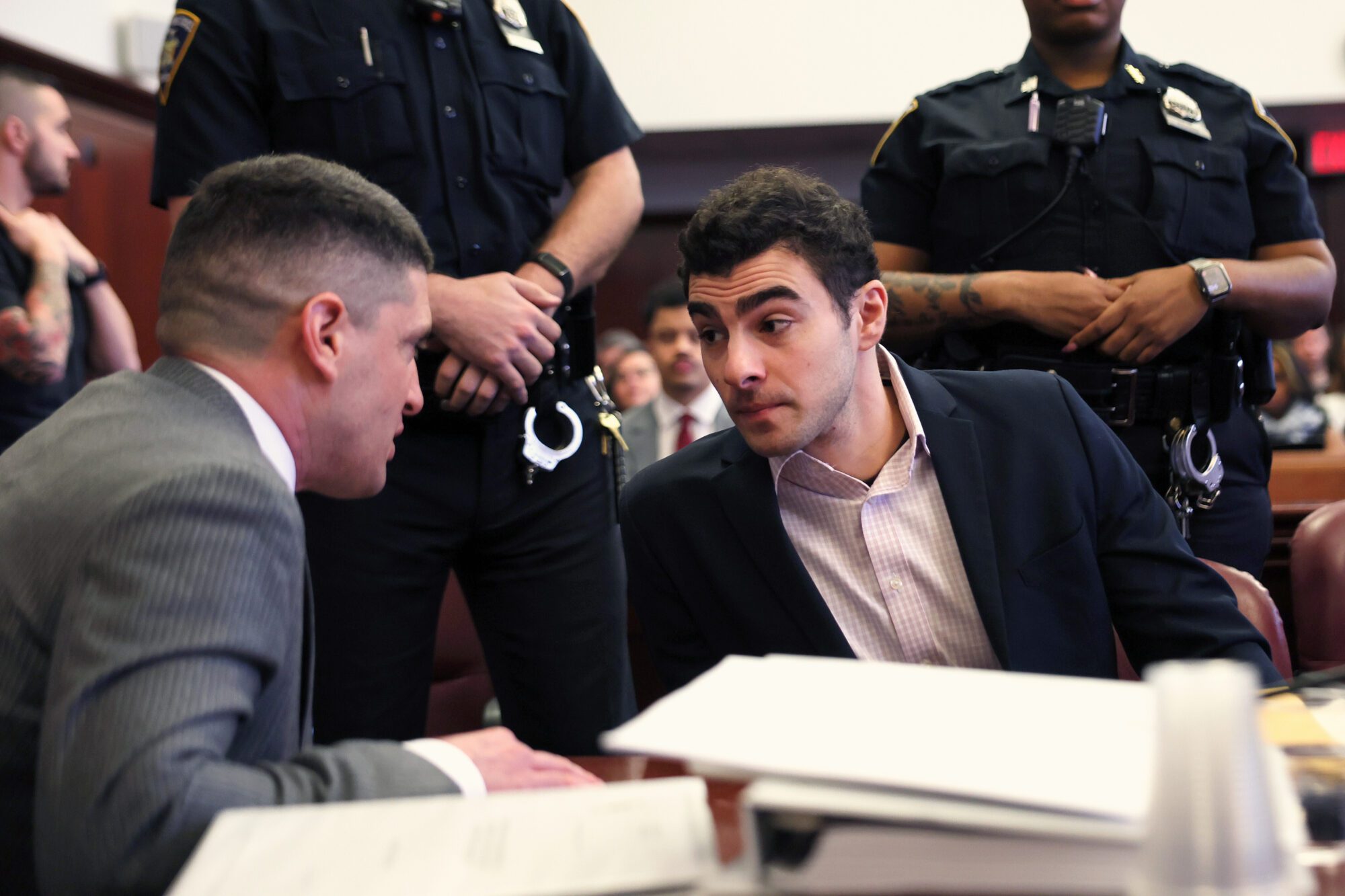
Luigi Mangione appears in Manhattan Criminal Court for an evidence hearing, Tuesday, Dec. 2, 2025, in New York.(Michael M. Santiago/Pool Photo via AP)
- The normalization of violence against those one simply does not like continues apace. It is high-profile and deeply political. The solution is not easy because the disease has metastasized.
Approximately one year ago on December 4, 2024, United Healthcare CEO Brian Thompson was shot in the back while walking along a NYC sidewalk. He was headed to a business meeting. Unbeknownst to him, his killer was waiting, all too eager to shoot dead a man who worked for a broken industry. Five days later, alleged murderer Luigi Mangione was arrested for the crime.
Not long after his arrest, a fandom began to grow around him. Men and women alike view him as a sort of Robin Hood character standing up to a bad guy who deserved what he got. Some women have taken it further and have grown infatuated with Mangione’s youth and good looks.
In the year since, there have been more high-profile assassinations and attempts. In April, Pennsylvania Governor Josh Shapiro and his family escaped a fire set in the executive mansion set by an arsonist who was intent on harming him. In June, Melissa Hortman and her husband were shot dead by a man who broke into their home. And in September, Charlie Kirk was killed in Utah at a college event. (All of this following a July 2024 assassination attempt on President Donald Trump, which he narrowly avoided, as he was campaigning.) Even before these horrific incidents, the murder of Brian Thompson was a standalone atrocity. One in which the horror of the moment itself was almost matched by the shock at witnessing the absolute glee of the alleged shooter’s fanbase. It boggles the mind that there would be a sizable crowd who love Mangione, want him to be free, and either campaign for that or give money to his legal fund.
Time has not diminished the interest in Mangione, the things that led to his alleged actions, the killing itself, and the celebrity around him. In fact, he’s more popular than ever ahead of summer’s scheduled trial. Given the events in the past year related to assassinations, one might think the fervor would die down. The very obvious fact that it hasn’t is deeply concerning. It is just one of many factors indicating our cultural health is at an all-time low. We are experiencing a serious, invasive societal sickness. Days, weeks, and months have only hardened the hearts that look at a cold-blood, premeditated murder with feelings of joy.
How can we combat this rot? Is it even possible?
It’s hard to know whether the temperature can be turned down in this age of social media. The camaraderie found online only exacerbates the violent tendencies of those who assemble in the darkest corners of the internet. When the black and white of good and evil is muddied to this degree, one wonders if we’ll ever collectively recover.
An early December pre-trial hearing for Mangione is a stark example of just what we’re facing. Outside the Manhattan courtroom, women assembled in a fangirl support sort of way for the 27-year-old.
The “Mangionistas” prepared homemade wristbands and beaded bracelets that read “Free Him”, along with a number to denote their place in the line for seats in the public gallery of Mangione’s pretrial hearing on Monday.
There are “Cougars for Luigi” and “Latinas for Mangione”. Then there are the criminal-justice advocates who see Mangione, who is facing the death penalty, as a victim of a politicised justice system.
But worse than the already grotesque displays of starry-eyed, estrogen-fueled lunacy are the apparent justifications for the shooting.
“I guess most Americans have experience of the healthcare system screwing them over,” said Drew Robinson, 36, who was among those at the barricades on Monday morning. “I was born with a birth defect. I’m on Medicaid, but it doesn’t cover a lot of doctors. The one who did my surgery suddenly went out of network before the healing process was over.
“I couldn’t afford to pay out of pocket so I just dealt with it on my own. My foot is worse now than before the surgery,” said Robinson. “Pretty much everyone I know has a story like this.”
Millions of American have some sort of healthcare horror story whether it be the actual care, a delay in care, or the price of services. Yes, some are worse than others. And yes, healthcare costs can and do cause great financial burden, including bankruptcy. But is this a license to murder? And not even someone directly responsible for wrongdoing? To the killer, Brian Thompson was the representation of an entire industry. And to his supporters, alleged killer Luigi Mangione is nothing but a good force who “bravely” combatted evil.
I can’t imagine believing that because I or a family member received bad care or delayed care, that someone else should die as a result. There are many conversations to be had about health insurance and the medical system as a whole. No one is saying it’s perfect. It certainly needs to change. But those who work in the insurance or medical fields should not be sitting targets for the disgruntled. Furthermore, the killing of a healthcare CEO was never going to move the needle in the direction of improvement.
Suffice it to say, Luigi Mangione’s summer 2026 trial will be a veritable circus. The fans will be there and so will the excuses for his alleged actions. Don’t expect most media types to express horror at what occurred on a cold December day in 2024. Brian Thompson is seen as the villain by too many. Meanwhile, the real villain and alleged murderer has throngs of supporters who think he should be released. This all combines into a toxic mix that permeates society and the current discourse.
The normalization of violence against those one simply does not like continues apace. It is high-profile and deeply political. The solution is not easy because the disease has metastasized.
There is certainly a widespread brokenness in society. But unlike what Mangionistas and others like them think, it has nothing to do with people like Brian Thompson.

Kimberly Ross