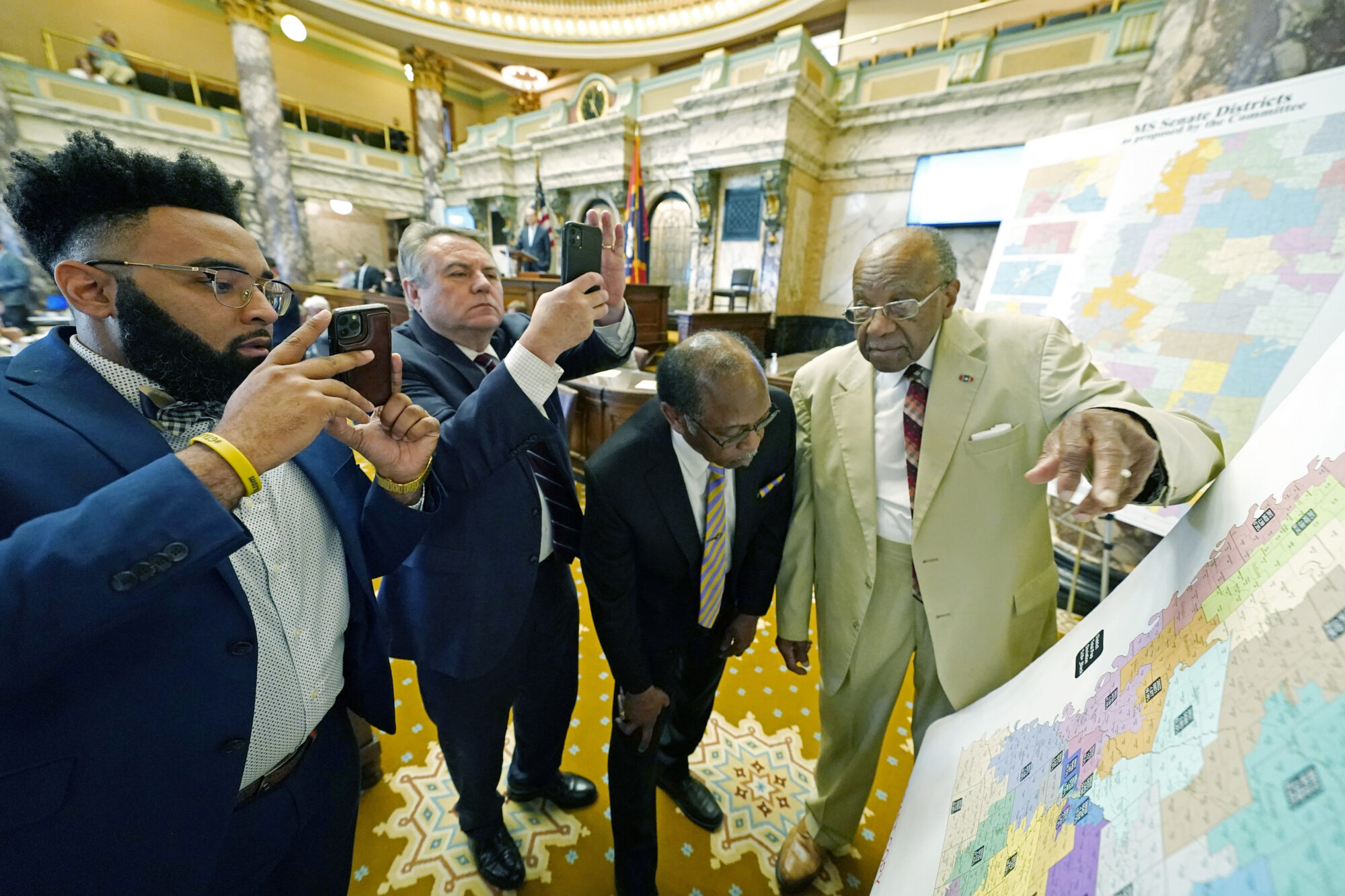
FILE - Mississippi state Sens. Rod Hickman, D-Macon, left, Michael McLendon, R-Hernando, second from left, Albert Butler, D-Port Gibson, and David Jordan, D-Greenwood, review an alternate Senate redistricting map at the Mississippi Capitol in Jackson, Miss., March 29, 2022. Three federal judges ruled Tuesday, July 2, 2024, that Mississippi legislators must redraw some state House and Senate districts because the districts adopted in 2022 dilute Black voting power. (AP Photo/Rogelio V. Solis, File)
- The need to redraw the districts came after the Mississippi NAACP filed a lawsuit challenging the 2022 legislative redistricting plan adopted by lawmakers.
Each chamber has now adopted the other’s legislative redistricting plans setting up special elections for House and Senate seats later this year.
On Wednesday, the House adopted the Senate’s plan – JR 202 – by a vote of 68 to 49 while the Senate approved the House’s plan – JR 1 – by a vote of 30 to 12. However, passage of the measures did not come without voiced opposition.
As previously reported, a federal three-judge panel ordered the supermajority Republican Mississippi Legislature to draw and adopt new state legislative district maps during the 2025 session and subsequently hold special elections to fill the seats. The new maps are to reflect new majority-minority districts in both chambers.
That order came after the Mississippi NAACP filed a lawsuit challenging the 2022 legislative redistricting plan adopted by lawmakers.
How it unfolded in the House
In the House, Apportionment and Elections Chairman Noah Sanford (R) presented the Senate resolution to the body, expressing his own discontent with the measure.
“I’m fixing to vote no on this bill, and I want you to know why,” Sanford told the House.
He said his county of Covington has been “whole” for about 10 years, yet Sanford said the Senate redistricting plan splits the county and his hometown of Collins “right down the middle.”
“I contacted the leadership at the other end of the building, and I said, ‘Look, I’m hearing y’all are going to split my county, split my city in half, and I have a problem with that and I’m the one expected to carry this across the finish line on the other end of the building,” Sanford said. “They had no interest in talking to me. They had no interest in hearing my concerns about my county whatsoever and I’m the one expected to present it.”
Sanford said he viewed that as a lack of professional courtesy.
“There’s a reason we call each other gentlemen and they don’t,” Sanford said, referring to the Senate.
Under the Senate redistricting plan, a new majority-minority district is being created in both DeSoto and Forrest counties which will also require other district boundaries to shift. The change pairs Senators Reginald Jackson (D-SD 11) and Michael McClendon (R-SD 1) and Senators Chris Johnson (R-SD 45) and John Polk (R-SD 44). As a result, 10 special elections for Senate will be necessary later this year.
READ MORE: Senate passes its legislative redistricting plan, setting up special elections later this year
The most vocal opposition to the Senate plan has come from those in DeSoto County. On Tuesday, the DeSoto County Board of Supervisors announced that they had retained outside legal counsel “to explore all legal remedies available to it in order to contest the Senate plan on behalf of the voters of DeSoto County.”
READ MORE: DeSoto County supervisors contesting Senate redistricting plan
State Senator Michael McLendon (R) has repeatedly expressed his extreme displeasure with the change in the area, questioning the process by which the districts were drawn. He offered an amendment to change the North Mississippi districts, his main contention being that Hernando should not be split into two Senate districts, but it overwhelmingly failed on a voice vote.
In the House Tuesday, State Rep. Dan Eubanks (R) rose to speak on the Senate plan, saying the reason the Legislature is in this position of having to redraw district lines “is because of race” but the concerns being raised in DeSoto County are not.
“We all represent a diverse set of standards and issues and needs and problems across this state,” Eubanks said, adding that the Senate plan takes “the heart of DeSoto County, our county seat and drops into a district that goes four counties into the Delta.”
Eubanks said there is a big difference between a Hernando and a Crowder.
Other members of the House DeSoto County delegation also voiced their concerns with the Senate plan prior to its passage.

Over in the Senate
Meanwhile, over in the Senate, the House redistricting plan was brought to the floor for consideration.
Rules Chairman State Senator Dean Kirby (R) handled the item.
Under the House plan, House District 22, currently represented by State Rep. Jonathan Lancaster (R), would be a new majority-minority district. Four other districts would be affected by the change – House Districts 16, 36, 39 and 41. No incumbents would be paired in the redistricting plan for the area. This will require 5 special elections later this year.
READ MORE: House passes legislative redistricting plan that makes HD 22 a majority-minority district
State Senator Daniel Sparks (R) noted that the Senate had previously backed the redistricting plans with strong support. He said the State Election Commission’s failure to appeal the federal court order resulted in lawmakers having to redraw these boundaries this session.
Senator McLendon again raised the concern that the same experts or consultants that vetted the previous maps for compliance that were struck down by the federal court also vetted these new district maps.
“I have some real concerns over the same group vetting it last time that said, ‘Don’t worry about a thing, this is going to be good,’ that we voted for,” McLendon said.
Kirby said he thought the first maps were good as well but complying with the court order must now be done.
“They [the House] feel very confident that the court will approve what they’ve done,” Kirby added.
What’s next?
The special election schedule for the affected House and Senate districts would be a primary election in August and a general election in November of this year.
Notice of those elections in the affected districts will be forthcoming.
Should the legal challenge by DeSoto County’s Board of Supervisors or another individual or group move forward, the redistricting plans could stall and the federal court could take up drawing the new maps.
However, as it stands now, both legislative redistricting plans have been adopted in compliance with the court order, as represented by Senator Kirby and Rep. Sanford.
You can review the new district maps for the House and Senate here.