(Photo from Shutterstock)
- The Department of Mental Health says Mississippi’s overdose deaths rose sharply, peaked, and have fallen faster than the nation’s, but the burden is not shared evenly across the state. See where troubled areas persist.
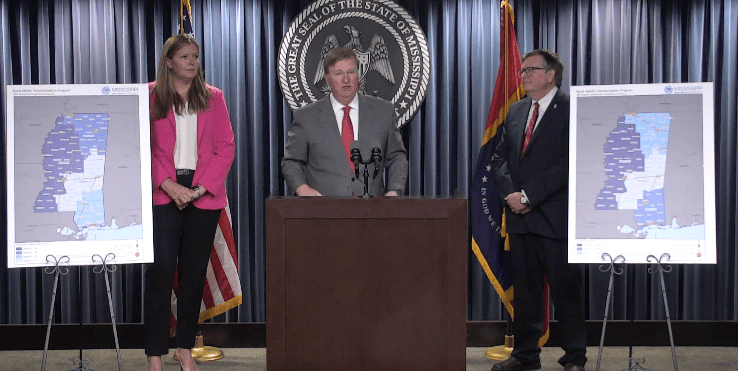
Overdose deaths in Mississippi have been on the decline in the past four years. To highlight the need to keep the focus on reducing addiction and continue that trend, the Department of Mental Health and state leaders are preparing to gather on Monday to recognize International Overdose Awareness Day.
Earlier this week, Governor Tate Reeves (R) issued a proclamation declaring August 31 as Overdose Awareness Day in Mississippi.
A press conference is now set to take place at the Jackson Medical Mall on Monday at 1:30 p.m. It will bring state leaders and overdose survivors together to continue the discussion on prevention.
Four speakers will be featured at the event. They are slated to share their personal experiences with addiction.
Included among the speakers is a former star high school athlete who fell into addiction and was subsequently incarcerated as well as a former military service member who became addicted to opioids after a car collision. A parent who lost a son to overdose and a former gang leader who found sobriety and redemption through God are also on the speakers’ list. Three of the speakers are currently serving their communities as certified peer support specialists.
The event will also spotlight the state’s efforts to prevent overdose deaths, which includes the availability of Narcan through vending machines and other free methods, DMH’s substance use awareness and recovery platform Stand Up MS, and the DMH Helpline that connects people with addiction assistance.
“Governor Reeves’ proclamation and the resources we’re highlighting today, from distribution of naloxone to Stand Up MS to highlighting the real voices of recovery, reflect our unwavering commitment to making sure every Mississippian struggling with substance use knows that hope and recovery are within reach,” said Wendy Bailey, Executive Director of DMH, in a statement.
Monday’s event comes as overdose deaths in the state, and nation, are on the decline.
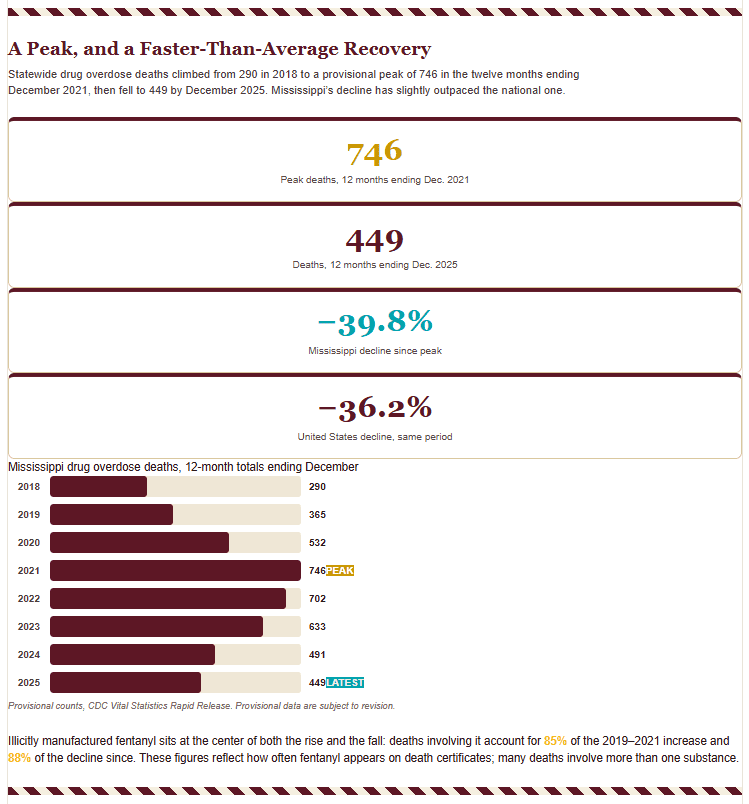
According to a recent behavioral health needs assessment conducted by DMH and Mississippi State University, there were 449 reported overdose deaths in the Magnolia State during 2025, representing a 39.8% drop since a peak recorded in 2021. In 2021, that number reached 746 reported overdose deaths, a sharp increase to the 290 deaths recorded in 2018. Nationally, overdose deaths have declined by 36.2%, the assessment outlined.
“Every number in our overdose data represents a Mississippian — a family member, a friend, a neighbor. The decline we’re seeing is proof that prevention, treatment and access to naloxone save lives, but our work isn’t finished,” Bailey said.
The assessment also found that overdoses involving fentanyl have declined. Fentanyl attributed to “85 percent of the 2019-2021 increase (in overdose deaths) and 88 percent of the decline since,” the assessment states.
As the instances of fentanyl-related deaths decrease, the assessment showed methamphetamine use remains an issue for addicts, reflecting the need to shift focus as stimulants take the place of synthetic opioids.
Even though statewide data indicates an overall decrease in overdose deaths, the assessment determined cases in some counties continue to rise, particularly within the six-county Gulf Coast region. In the southern part of Mississippi, 26.4 overdose deaths per 100,000 people were reported over the past 12 months. The rest of Mississippi recorded 11.6 overdose deaths per 100,0000 residents on average in that same period.
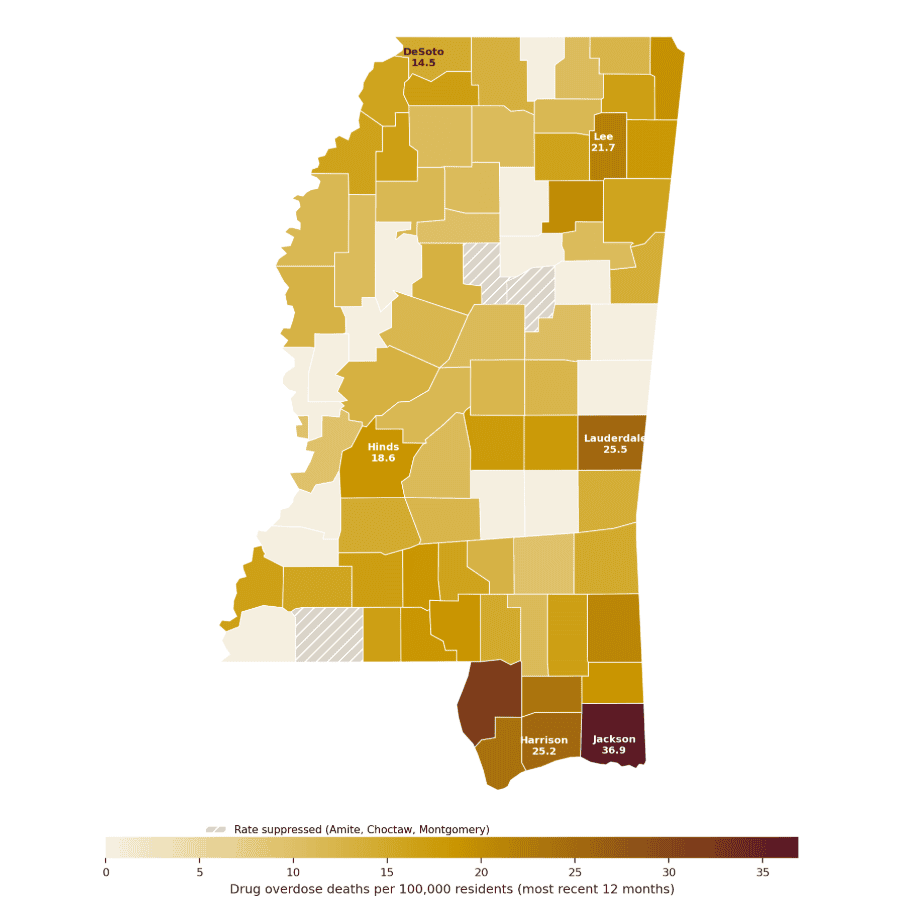
Jackson County reported the highest rate at 36.9 per 100,000 residents, an increase from its 2019 rate of 20.9.
Lauderdale County reflected the largest jump in that time, going from a rate of 5.9 in 2019 to the most recent rate of 25.5 overdose deaths per 100,000 people.
Addiction impacts the entire family, particularly when a parent is being incarcerated or otherwise removed from the life of their child. The assessment noted 36,700 grandparents in Mississippi were serving as the primary caregiver to a grandchild. Counties affected by this trend are not the same as the ones seeing an increase in overdose deaths. Instead, counties where grandparents serve as the primary caregiver are concentrated to the Delta, the assessment showed.