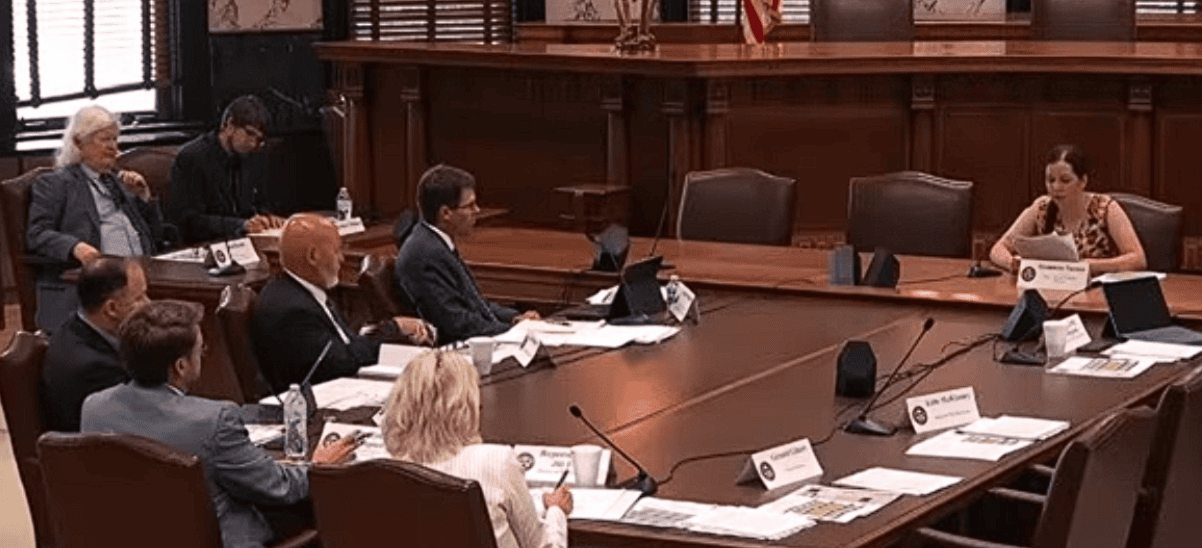
AI Task Force hearing, July 2026 (From livestream)
- Two days of hearings by a legislatively created task force delved into the concerns and the benefits data centers have brought to Mississippi. The group will use the data and testimony to consider what recommendations to make to lawmakers regarding these developments.
A two-day hearing by the Legislature’s AI Task Force was held this week as Mississippi lawmakers gathered information about the state’s growing number of data centers.
Day one of the hearings focused on the concerns some have with data centers, such as excessive noise levels caused by generators, the particulates that are released by the diesel generators, and fears of excessive water usage. Another complaint shared dealt with how negotiations between local leaders and data center companies include little to no public input.
Shannon Samsa, director of Safe and Sound Coalition which focuses on the Southaven and surrounding areas, said she has heard from community members who are dealing with the excessive noise levels due to the operation of dozens of diesel generators used at the xAI data center in North Mississippi.
Currently, there are reportedly 59 diesel generators operating on the site to provide the power necessary to operate the facility, with another 49 planned, she told the task force. Samsa said the complainants say the generators create a humming sound that disrupts sleep. She personally lives two miles away from the center and can hear the noise, she added. Samsa further said operation of the diesel generators releases particulate matter into the air that can negatively affect human health due to its inflammatory properties.
She went on to say that those issues are compounded by the public not being adequately informed of the center’s construction until it was too late. Samsa told the panel that she is not opposed to AI, or data centers, but she is opposed to projects without public input or notification that pose potential harms to the community.
“I’m opposed to a project approved without a regular vote of the Board of Aldermen or for that matter, before the public even knows they exist,” Samsa explained. “xAI was not mentioned in any city or county agenda or meeting minutes until after the project had already been approved, so we were denied any meaningful opportunity to raise concerns before decisions were made.”
Samsa also questioned reported increases to water usage from a major aquifer in the area, estimated to be about 77 million gallons over 12 days, even though there were promises the water that would be used for cooling would be recycled.
She said the presence of the facility has caused her to reconsider residing in Mississippi.
When asked by committee Co-Chair State Rep. Jill Ford (R) if she felt the presence of the data center is affecting property values, Samsa said the noise is not a selling point.
“I personally, if I went to go tour a home that I was buying, and I heard that noise happening constantly while I was there looking at the home, I wouldn’t want to purchase that home and I would assume most people would not want to either,” Samsa said.
Power, water and environmental impacts were also a cause of concern lodged by Jim Walsh, Policy Director at Food and Water Watch. He cited concerns that the communities where the data center facilities are located could be left to foot the bill for not only the infrastructure needed to attract the companies, but also potential rate increases in power and water due to their operation.
Walsh contends that even in instances where the facility generates its own power through generators, rates will still be affected due to the competition for fuel to run the machines. Additionally, demand for the components to run the facilities will increase costs.
He was also critical of the reported job increases and the tax incentives offered to entice data centers to a particular area.
“We shouldn’t be asking rural communities to trade away water pollution and air quality, local control, potentially millions and billions of dollars in tax dollars for what might be a very modest and moderate increase in construction jobs over a very short period of time,” Walsh said.
Across the nation, states are putting moratoriums on the establishment of new data centers, Walsh told the group. Besides the noise, electricity and water concerns, Walsh noted a lack of transparency in the projects. He fears if too many resources in the form of water and electricity are provided to data centers, the capacity for future economic development will be lacking.
The second day of testimony provided rebuttals to the first day’s complaints. Representatives of local governments and data centers appeared before the task force.
Chris Wells, executive director of the Mississippi Department of Environmental Quality, said the agency has no authority in noise levels but does regulate other aspects of data center construction, such as habitat protections, air pollution and water consumption. There is one concern to keep in mind for the future, he said.
“Down the road, e-waste and decommissioning of these types of facilities can and will be an issue,” Wells told the task force.
MDEQ’s aim is to ensure water usage is not excessive or unreasonable, and that the resource is managed to ensure future access. Currently, for industrial uses, there is the option to use alternative sources such as grey water or surface water and there are limits on the use of ground water.
“Use of large volumes of groundwater for once-through non-contact cooling purposes is not considered a beneficial use,” Wells described. “You’ll notice there’s a 20,000 gallon per day limit.”
Over 90% of the state’s drinking water comes from groundwater, or water pumped from aquifers.
In terms of electricity usage and the potential for rates increasing due to the presence of data centers, Entergy Vice President of Business Operations and Strategy Jeremy Vanderloo said the presence of data centers are not only assisting in building out the state’s electricity infrastructure, but helping to keep rates down.
Data centers operated by Amazon Web Services are connected to the grid, and they are paying their fair share of not just the cost to add capacity, but in rates as well, Vanderloo said.
To ensure that continues to be the case, sufficient contract terms, minimum bill requirements and collateral are being employed. Vanderloo estimates the presence of data centers will help keep the cost of electricity for Entergy customers 30% lower by 2030 than if the centers were not there.
Not all of the data centers in the state are drawing cooling water from groundwater sources. Grey water from nearby wastewater plants will be used for cooling at the AWS centers, task force member Gerard Gibert stated.
There are also areas of the state where closed loop cooling systems were put in place as the data centers are built out. Clinton Mayor Will Purdie said the Amazon data center being built in his area will be required to not only use a closed loop cooling system to reduce water usage but also be connected to the power grid to eliminate noise pollution. It is being built in an industrial zoned area and Amazon has to acquire a bond to financially protect the city.
Ridgeland Mayor Gene McGee said his city has implemented similar code requirements, such as locating the data center in an industrial area and requiring a power grid connection.
Both mayors asked for the Legislature to leave those controls at the local level and to avoid setting statewide regulations pertaining to data center developments.
A facility owned by Compass in Lauderdale County, that will be leased to Meta, will cover the full cost of making the necessary substation and line upgrades to the system as it connects the facility to the grid, said Mississippi Power General Manager of Transmission Stephen Schruff. Those upgrades will bolster the entire system in that area and make it more reliable during storms, he said.
As for jobs, Andrea Hutchins with Amazon’s Economic Development team said the $10 billion investment made so far in Mississippi has led to 7,000 additional jobs, including long-term jobs within the data centers such as technicians, network specialists and maintenance. To fill those and other job openings, Amazon is setting up training sessions with assistance of AccelerateMS. She confirmed the company is paying 100% of grid upgrade costs and not passing it on to the ratepayers.
From credit card transactions to healthcare and the geolocation services that get people to their destinations, much of today’s society relies on technology. Senior Manager of State Policy and Partnerships for the Data Center Coalition Heather Coil said those services are run by data centers.
“Without data centers these things would not be possible in our current economy,” Coil said, adding that only one third of the global population is not online.
Brent Collard, Senior Vice President of Land Development for Compass Datacenters, noted that his company has paid its way, investing $300 million in grid transmission, substation and infrastructure improvements in Meridian. In terms of cooling, the Compass data center sites use closed loop systems.
“Our closed loop systems recycle the same water indefinitely,” Collard explained. “The water we use annually for everyday office needs is roughly equivalent to two average households.”
To help the job market, Collard said Compass’ data center has resulted in the creation of 6,400 long-term jobs, with more anticipated.
The task force will use these testimonies to consider what legislation, if any, should be recommended to lawmakers in the 2027 session.

Jeremy Pittari