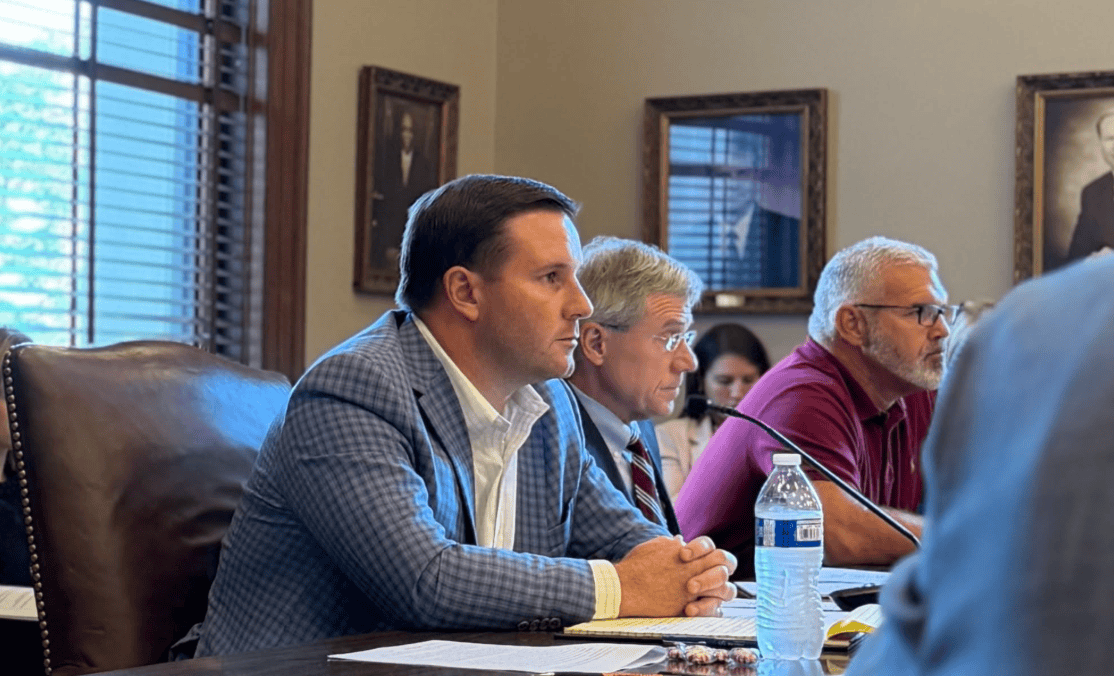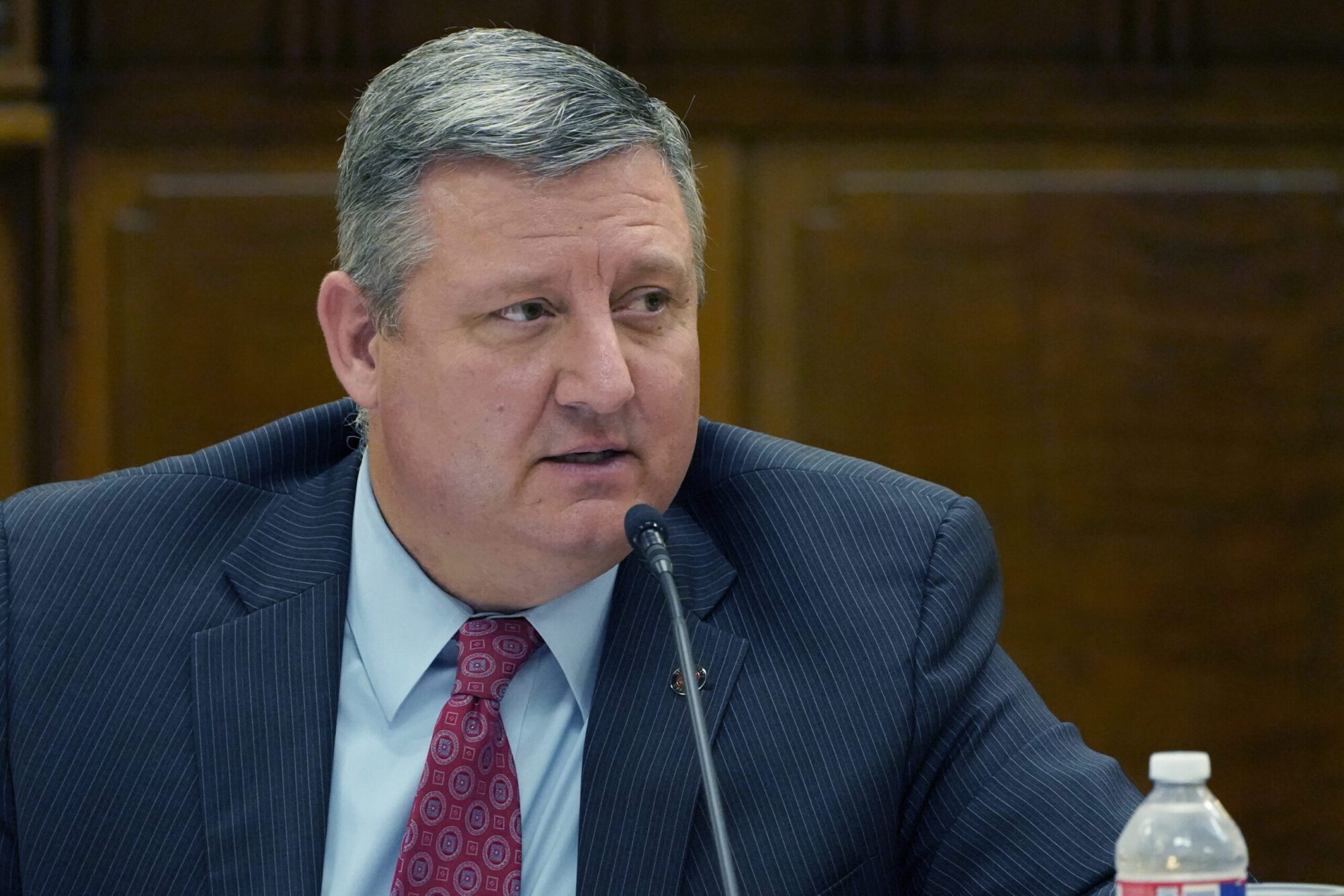
Senate Education Committee chairman Dennis DeBar Jr., R-Leakesville, addresses committee members during a teacher pay hearing at the Capitol in Jackson, Miss., Wednesday, Sept. 15, 2021. (AP Photo/Rogelio V. Solis)
- The Mississippi Democratic Party took a victory lap late Tuesday, following the Senate Education Committee’s vote to killing the Mississippi Education Freedom Act, a proposal that had the support of President Donald Trump, Governor Tate Reeves, House Speaker Jason White and the Mississippi Republican Party.
Speaker Jason White’s signature education freedom package died at the hands of the Senate Education Committee on Tuesday, as Republicans joined Democrats in unanimously killing the measure.
Senate Education Committee Chair State Senator Dennis DeBar (R) said that the voice vote on HB 2 was unanimously against the bill. The committee consists of ten Republicans and five Democrats.
Speaker White (R) wasted little time in responding to the Senate action.
“Today, the Senate chose to be premature of legislative deadlines and performative in their 2-minute Education Committee meeting to kill HB 2,” White told Magnolia Tribune. “The self-proclaimed deliberative body did not deliberate. Instead of engaging in meaningful work to build on Mississippi’s education gains, the Senate has chosen the route to shut down any productive pathway to put students before systems. To avoid conversation, debate, or thorough evaluation is a disservice to parents, students, and future generations of Mississippians.”
Speaker White said Senate leadership “has aligned themselves with the ACLU, Southern Poverty Law Center, the Mississippi Democratic Party, and the status quo.” He praised his House members “who were brave and courageous in their vote for HB 2, unlike the impulsive and rash action shown today by the Senate.”
“Given the way major legislation has been championed by the House over the previous two years, we have seen this move from the ‘deliberative body’ and know the playbook. We are not deterred,” White said.
Senators surveyed by Magnolia Tribune said the driving force for voting against the bill was the fact that it included “vouchers” for private schools, there was no additional accountability for private schools receiving state funds, and there was no clear cost to the state.
HB 2 did not include “vouchers,” a term of art that applies to coupons paid directly to a private school. In recent years, the term has been co-opted by national teachers’ unions as a slight against school choice.
HB 2 included Education Savings Accounts, a legally distinct concept, controlled by families on qualified expenses. It also included a requirement for students participating to take national norm reference testing that had to be reported to the state to measure the efficacy of the program. The scholarship portion was estimated to add approximately $43 million in new expenses in year one.
DeBar said the Senate has passed its own bills that address much of what the House bill sought to address, such as public-to-public school choice.
“I’ve made my opposition to ‘vouchers’ known and for the reasons why. And today the committee spoke loud and clear that they are opposed to vouchers as well,” DeBar told Magnolia Tribune. “We do have portability, we do have the Math Act, we have literacy.”
State Senator David Blount (D) was one of the five Democratic members of the committee to vote against the bill.
“Personally, I think it’s a bad policy. It’s going to be very expensive and to give taxpayer money to schools that are not subject to any academic standards and any financial oversight is a mistake in my opinion,” Senator Blount said.
He also said the positive aspects of HB 2 are being covered by bills the Senate has introduced and passed.
State Senator Brice Wiggins (R) added that the vote from the originating body indicates there are issues with the bill. HB 2 passed off the House floor with a narrow vote of 62-59 last month.
“The other side of it is that, I think as the vote revealed in the House, people have significant issues on the ‘voucher,’” Senator Wiggins described. “The House calls it ESA but there are a lot of people who see that as a ‘voucher.’ But there’s a lot of different ways to skin a cat. The Senate has stood up and sent over conservative school choice legislation.”
One other issue cited was the lack of transparency on the cost HB 2 would impose. State Senator Nicole Boyd (R) said her reasoning for voting against the bill was due to that lack of a true cost estimate and opposition within her constituency.
“Based on the fact that it was an omnibus bill, it was all or nothing and we have no fiscal note for the total impact of the budget as written for HB 2.” Boyd described. “There was portions in there that I didn’t know the financial impact and the future implications of the budget for the state.”
Boyd also said she received a tremendous amount of emails and phone calls from her constituents who opposed HB 2.
The Mississippi Democratic Party rushed to celebrate the demise of HB 2, couching it as a victory for their organizing efforts.
“This victory belongs to the teachers, parents, and students who made their voices heard and refused to be drowned out by outsiders with deep pockets,” said Mississippi Democratic Party Executive Director Mikel Bolden. “When Democrats organize and fight for our home, we win—even against millions in outside money. This is proof that principled leadership and grassroots advocacy can protect what matters most to Mississippi families.”
Despite the setback, Speaker White said this issue will not go away.
“The Senate has anchored their support to the status quo,” White said. “We are comfortable where we stand in our support from The White House, the Governor, most of our statewide elected officials, faith-based organizations, business leaders, the Mississippi Federation of Republican Women, and the majority of Mississippians. The House has proven we will stand up for what is best for Mississippi, and especially our state’s greatest asset – our children.”
Governor Tate Reeves (R) had urged lawmakers to support the House bill authored by Speaker White and supported by the House Republican caucus. It was an omnibus education package that would, among other things, loosen restrictions and aid to support transfers between public schools, allow a first year limit of 12,500 students to access their state allotted funds for private school tuition, and rework of the authorization framework for new charter schools.
Reeves’ backing came as U.S. Secretary of Education Linda McMahon issued the White House’s endorsement of the plan to create Education Savings Accounts that permit money already allocated by the state of Mississippi on a per student basis to follow the child to the school of their choice, including private schools.
President Donald Trump (R) has also repeatedly spoken in favor of providing school choice to every child in America, and the issue has been placed in the Republican Party’s platform as well.

Jeremy Pittari