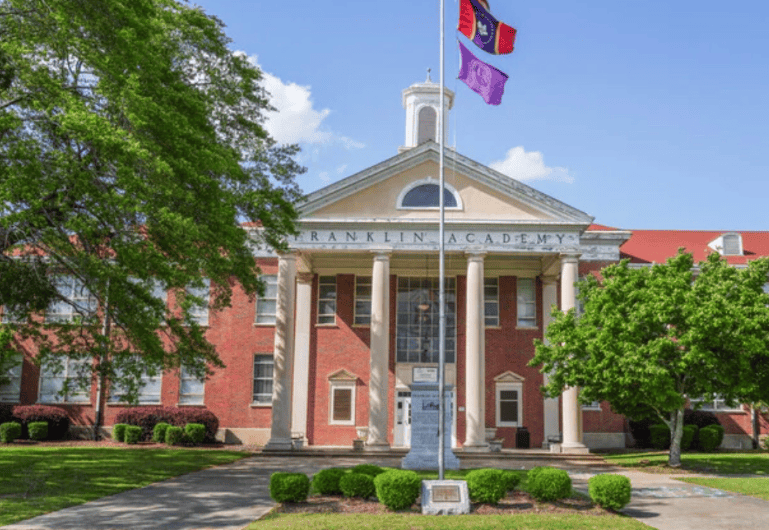
(Photo from Homes.com)
- On February 10, 1821, the Mississippi Legislature officially chartered the town of Columbus. Tucked into that same act was a provision establishing a school to be known as Franklin Academy, funded in part by leasing designated town lots.
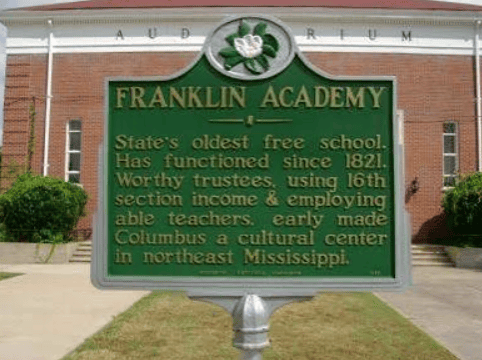
For more than 200 years, generations of children in Columbus started school at a place that holds a distinction no other Mississippi school can claim. Franklin Academy, established in 1821, was the first free public school in the state. This fall, for the first time in its long history, it will no longer operate as a school.
And 200 years? That is a lot of history.
Mississippi had only been a state for four years when people in Columbus were already working out how to provide children with an education, whether their families could afford tuition or not.
On February 10, 1821, the Mississippi Legislature officially chartered the town of Columbus. Tucked into that same act was a provision establishing a school to be known as Franklin Academy, funded in part by leasing designated town lots.
Eight commissioners charged with surveying the new town and leasing those lots also became Franklin Academy’s first trustees. They held their first meeting that June and elected William Cocke as president. By August, plans for a schoolhouse were being discussed, and an advertisement had been placed in a Tuscaloosa newspaper seeking a qualified teacher.
The first Franklin Academy wasn’t exactly grand.
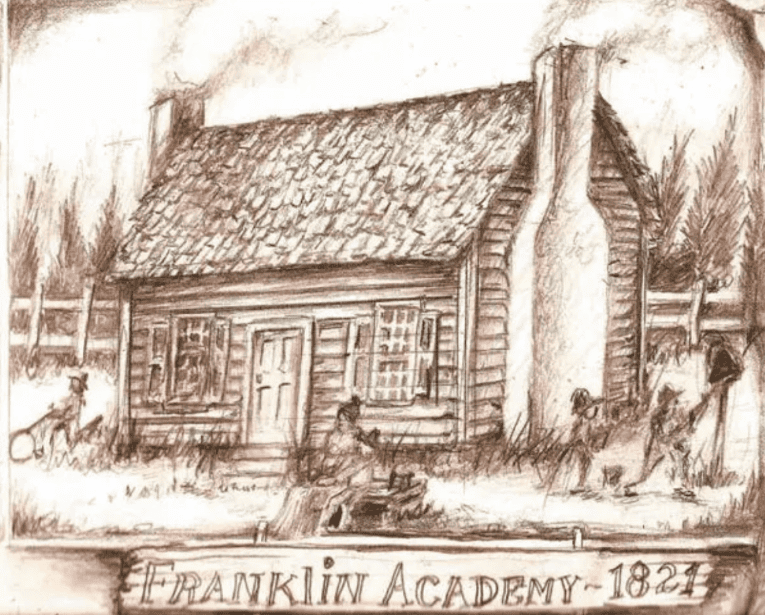
It was a 30-by-40-foot wooden frame building with unfinished walls and ceilings. There were no stately columns, sprawling hallways, or architectural details to admire. It was simply a schoolhouse.
But something pretty remarkable was happening inside.
Among Franklin’s earliest students were children from the local Choctaw population as well as white children living in Columbus. By 1825, the school had grown to more than 60 students.
That same year, Cocke reached all the way to Virginia for educational advice, corresponding with an old acquaintance named Thomas Jefferson. Yes, that Thomas Jefferson.
Jefferson was nearing the end of his life by then, but education had become one of his great interests. He had spent years advocating for broader access to learning and had helped establish the University of Virginia. The fact that Franklin Academy’s president was exchanging ideas about education with one of the country’s Founding Fathers gives this little Mississippi school a pretty remarkable connection to early American history.
The buildings changed as the years passed.
In 1835, the original wooden schoolhouse was replaced by two brick buildings, one for boys and another for girls. Each stood two stories tall, with a large room downstairs and two rooms on the second floor.
Then Columbus grew, enrollment grew, and Franklin needed more room again.
A much larger school was constructed in 1886. This time, Franklin Academy was a three-story brick building with 14 rooms and a central chapel—a long way from that unfinished wooden schoolhouse of 1821.
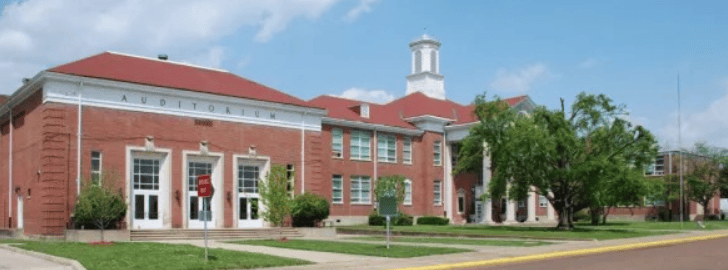
The Franklin Academy building familiar to Columbus today came along in 1938-39.
Constructed with assistance from the federal Public Works Administration during the New Deal era, the Colonial Revival-style school has the balanced, traditional appearance common to public buildings of the period. Its red-brick exterior, symmetrical design, and prominent entrance gave Franklin a sense of permanence that its first trustees could probably never have imagined.
By the time that building went up, Franklin Academy had already been educating children for well over a century.
And some of the most important chapters were still ahead.
Following the Civil War, Union Academy, a school established for African American children, became a branch of Franklin Academy in 1877. Then, in September 1965, six young Black students from the Jamison and Doughty families integrated the previously all-white school.
Just imagine what this one piece of ground has witnessed.
Children attended Franklin before the Civil War. They came during Reconstruction, through two world wars and the Great Depression. They witnessed segregation and integration. They learned in simple schoolrooms in one century and eventually used computers in another.
In 2021, Franklin Academy celebrated its 200th anniversary.
Five years later, another chapter ended.
Franklin closed as an active school at the end of the 2025-26 school year as part of restructuring within the Columbus Municipal School District. Beginning this fall, its students have been reassigned to other district schools. Declining enrollment, staffing challenges, and the need to better use available resources were among the reasons behind the change.
There has been discussion about finding a new use for the historic property, and hopefully, whatever comes next will give this old school another chapter.
There is something almost impossible to grasp about more than 200 years of children coming to this same place to learn. The schoolhouses changed. Columbus changed. Mississippi certainly changed.
But every August, another group of children showed up.
Until this year.
Still, Franklin Academy has already earned a permanent place in Mississippi history.
Long before free public school was simply part of growing up, a community in a newly chartered Mississippi town decided education should be available to children regardless of whether their families could afford tuition.
More than 200 years later, that’s a story worth remembering.
After all, somebody had to be first.

Meredith Biesinger