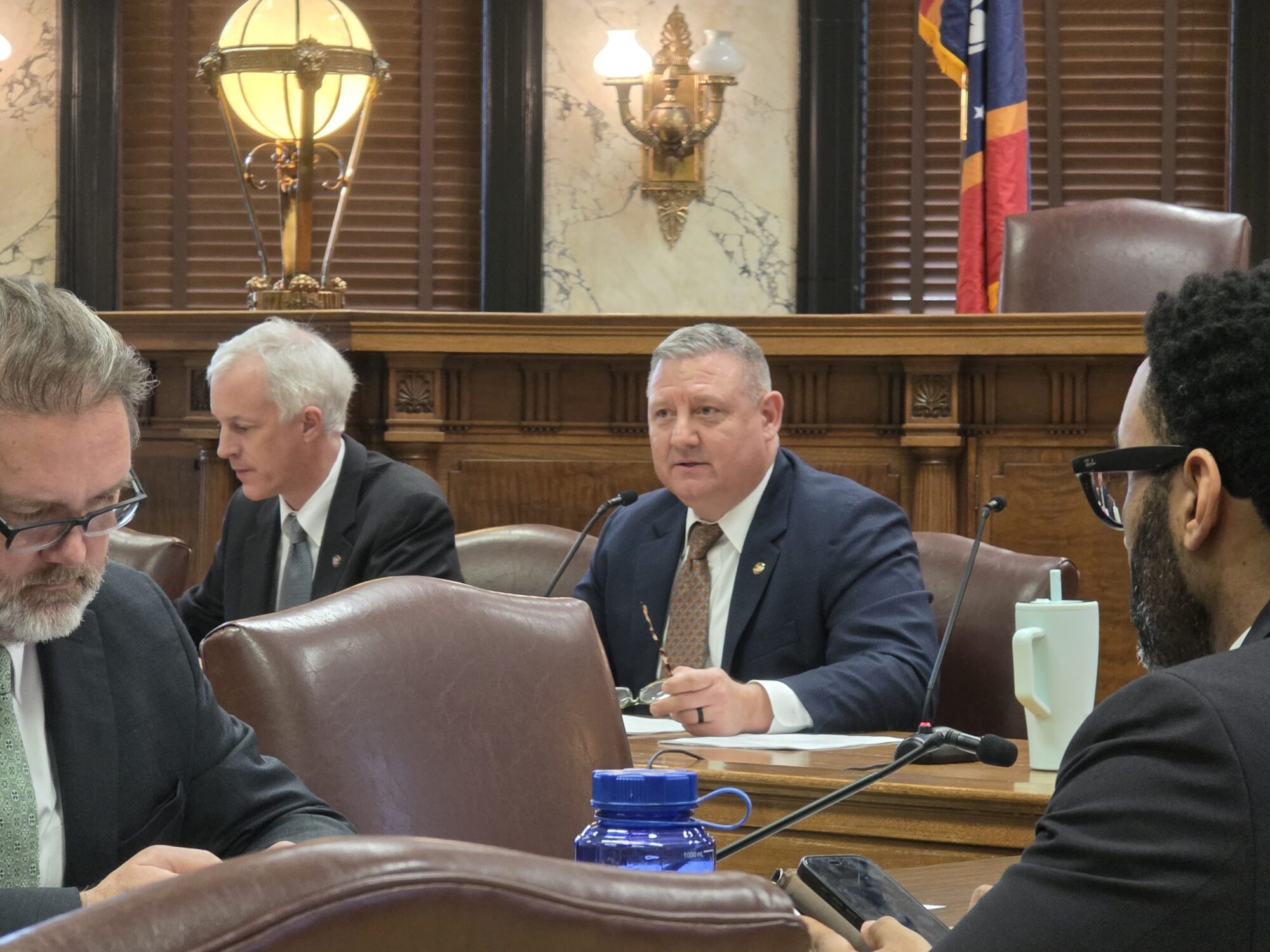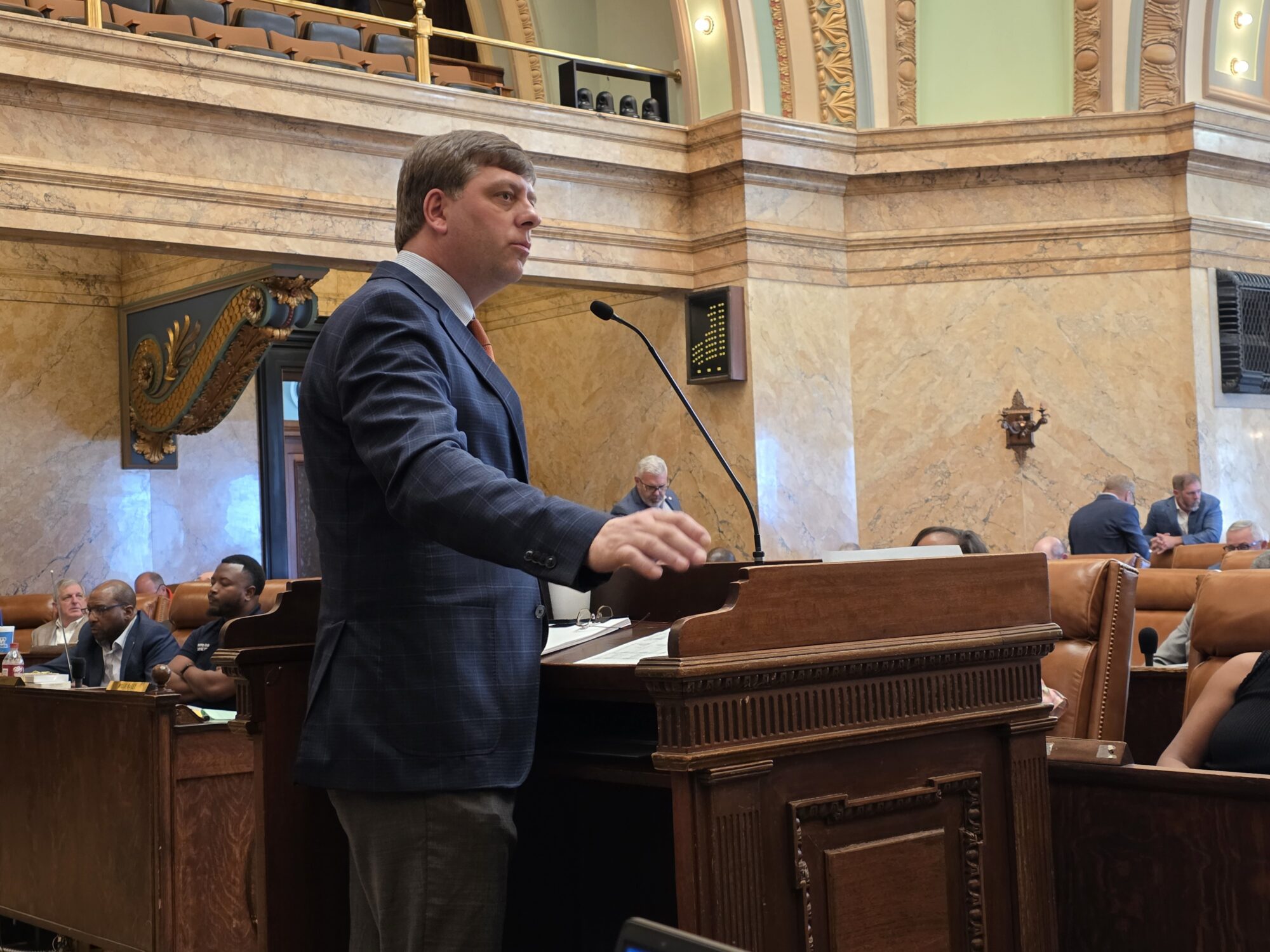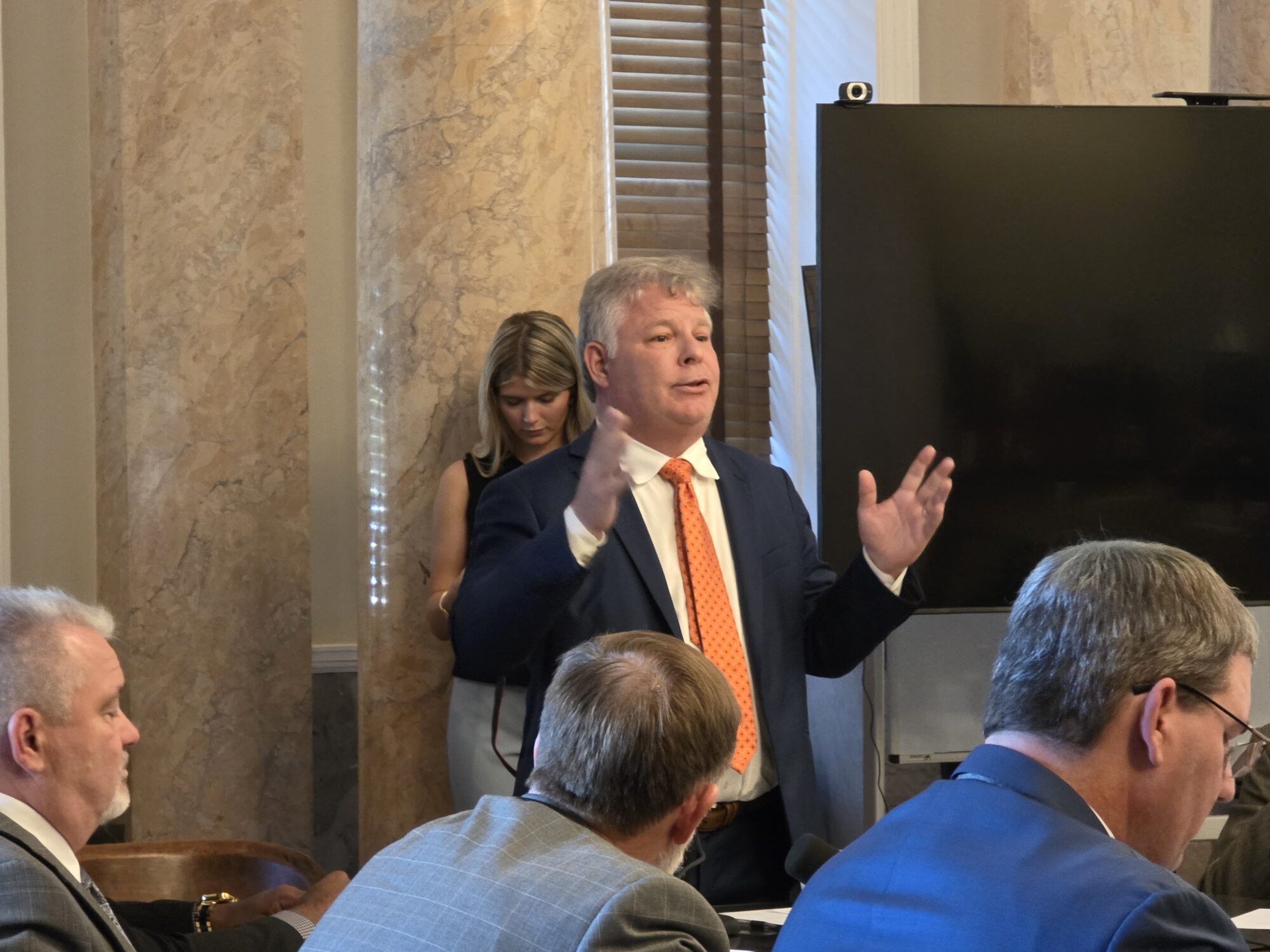
House Education Committee Chair Rob Roberson (R) kicks off a hearing held Wednesday where parents and others could share their experiences and thoughts on school choice. (Photo by Jeremy Pittari | Magnolia Tribune)
- “Options are extremely limited for families who want something better or simply different for their children,” New Hebron Mayor Cindy Bryan told lawmakers. “We now have fewer students, more funding per student and lower performance.”
Members of the Mississippi House Education Committee heard testimony from parents and others invested in education about the potential impacts school choice may have on the state during a hearing held Wednesday afternoon.
The committee hearing came just hours after Speaker Jason White (R) unveiled his education freedom reform package.
READ MORE: Mississippi House proposes ambitious package of school choice reforms
The comments during the committee hearing ranged from success stories of students finding the help they needed to be successful to concerns that school choice may worsen educational outcomes.
Contina Jones sends her child to MidTown Public Charter School, a decision she made after public schools in Jackson failed to meet her son’s educational needs.
“He was going to a traditional public school here in Jackson. The school did not serve him. He went to school every day with panic attacks, teachers in and out, staff members that were overwhelmed and they just did not serve him,” Jones described.
After transferring to MidTown for his fifth through eighth grade years, the young man found meaningful interactions with other students and began to thrive. Jones said his grades also rose “through the roof,” as he joined the band and ran for “Mr. Midtown.”
Another parent, Brittany Thrash, described how she had to leave a career in nursing to take a job as an assistant teacher at a school that better benefitted her child’s educational future because public school services are not universal across the state.
While attending kindergarten in public school, her son did not test well. Thrash suspected her child may suffer from dyslexia, and a subsequent diagnosis confirmed her suspicion. She found that getting her child the education he needs involved far too much red tape.
For a time, they moved to the Rankin County School District while renovations to their home were being completed. There she was able to enroll the child in a school that was better suited to her child’s needs. However, once those renovations were complete and they moved back to the family home, which was outside of the Rankin County School District, they lost access to those services.
“So, we had to move back to our county school where they do not offer the classes my child needs,” Thrash explained.
Even though she got approval from their local district to transfer their child back to Rankin County, the Rankin County School District did not even look at the request, she said.
“I don’t know if you know, they don’t accept transfers, only military and if you work at the school,” Thrash told lawmakers.
In response, she took a job as an assistant teacher in the Rankin County School District so her child could get a proper education.
“I never would have thought that it would be this hard to get my child the proper education that he needs,” Thrash said.
An elected official also addressed the need to reduce restrictions on public-to-public school transfers. New Hebron Mayor Cindy Bryan told the committee that “geography matters, because it exposes how rigid county boundaries can limit real education opportunities for families.”
She described how Lawrence County has a limited number of schools, which are also seeing declines in performance. Over the past seven years, about 500 children have left that school system and taxpayers are seeing increases to the district’s millage rate.
“Options are extremely limited for families who want something better or simply different for their children,” Bryan explained. “We now have fewer students, more funding per student and lower performance.”
To fix the issue, she suggested the Legislature lift restrictions that prevent students from attending schools across county lines.
Under HB 2 as proposed by Speaker White, school districts would be required to publish their criteria for determining whether to accept students. Under current Mississippi law, a student’s state funding follows when the student transfers between districts, but the local property taxes collected by the district do not. To assist with that gap, HB 2 creates a $5 million dollar fund to cover the amount a district receiving a public transfer student misses out on because local property taxes are not transferable between districts.
“Open the public school system so parents can freely choose which public school their children attend without having to navigate all the red tape of yearly school board waivers,” Bryan said.
Homeschooling is an option some families choose in lieu of public or private school because it better meets their child’s educational needs. Yet making those changes come with downfalls as well.
Je’Tua Amos told of how her family’s decision to homeschool her children meant a reduction in household income due to her leaving the teaching profession.
“I’ve been a great educator to other’s kids, why not our own?” Amos said.
While homeschooling provided better outcomes for her children, she estimates her family spent about $3,000 to $5,000 annually per child to homeschool the children. She hopes the Legislature can find a way to provide some state funding that would help cover those expenses.
Under Speaker White’s HB 2, a $5 million fund would provide support capped at $1000 per homeschool family for qualified educational resources. Where demand exceeds the fund’s cap, awards will be determined by lottery.
Additionally, HB2 includes the provisions of the Tim Tebow Act, which has been enacted in over 30 states, that permits homeschool students to participate in extracurricular activities within the local school district where they live.
Speaking in favor of public schools as opposed to expanding school choice, Florance Bass presented a case pointing out that private schools typically do not place children with disabilities in the same classrooms as the rest of their peers. That fact means children with and without disabilities are not mixed socially, which is a missed opportunity.
“They are contributing members of society,” Bass described. “And there’s a groundswell of effort to provide job training for these individuals while in schools… Our public schools are not glorified babysitting services for these students as a particular founding member of the school choice law organization declared.”
She did not put a name to her reference.
Bass also argued that school choice will only help those who are already enrolled in private schools, which are not always able to address the needs of disabled students like public schools. She is the mother of a child with intellectual disabilities.
“Students like mine that private schools will not take,” Bass said. “If anything, it’s created financial strains on the public schools, thereby it impacts public school students and especially, most especially students with disabilities.”
Mississippi has in place an ESA for which only children with special needs are eligible. It also has scholarship programs for dyslexia and speech therapy.
White’s HB 2 removes the cap on the number of students eligible for the Special Needs ESA and sets the ESA amount at the base student cost, plus $2,000.
Similarly, the speech therapy scholarship is set at base student cost, plus $2,000, while the dyslexia scholarship is set at base student cost, plus $1,000.

Jeremy Pittari