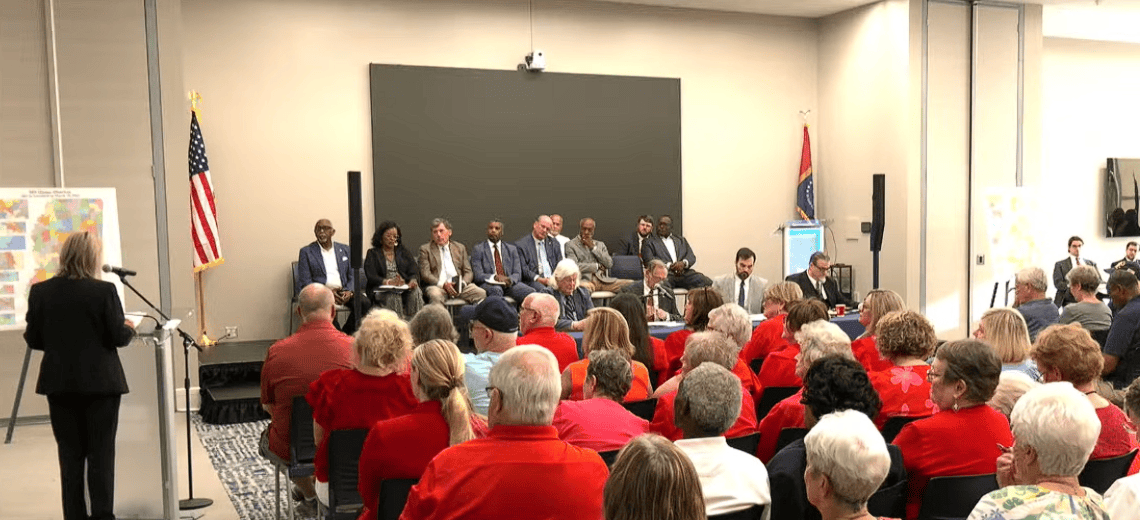
DeSoto County redistricting hearing, August 27, 2026 (Photo from livestream)
- Majority of respondents at the Northwest Mississippi Community College hearing support lawmakers redistricting legislative and congressional districts in wake of Callais.
Roughly 50 people provided their opinion during the second of several hearings taking place across Mississippi to gather public input on the potential for mid-decade legislative and congressional redistricting in the wake of the Callais decision.
The series of meetings comes after the Republican majority Legislature and Governor Tate Reeves have indicated that lawmakers would seek to redraw district lines after the U.S. Supreme Court decision earlier this summer. The Callais ruling determined racial gerrymandering to be unconstitutional as it had been practiced under Section 2 of the Voting Rights Act. The decision raised the evidentiary bar for proving a violation of the Voting Rights Act, requiring proof of actual discriminatory intent in drawing voting districts.
In response, the Joint Committee on Redistricting and Reapportionment has been tasked with gathering public input before a clear path is set in motion, the first step of which could come in a special session later this year before legislative qualifying begins on January 2.
“We’re going around all over the state listening to everyone trying to figure out exactly what the people want before we do anything,” said committee chair State Senator Dean Kirby (R).
Kirby made it clear that the committee “has the responsibility of drawing redistricting plans for both the State Senate and the House as well as Congress.”
While his committee is not tasked with redistricting the state supreme court districts, the committee did accept any comments on the topic. Kirby said the Senate Judiciary A Committee and the Judiciary B Committee in the House have been tasked with judicial redistricting. He also reminded those in attendance that districts for locally elected officials such as boards of supervisors, city councils, and boards of aldermen are not in the committee’s purview.
A majority of respondents in attendance who gave a clear opinion on the matter, about 56%, indicated they support a “race neutral” approach to setting voting district boundaries, while about 44% provided arguments why the maps do not need to be changed just yet. Some respondents did not take a clear stance either way.
In Support
The second meeting was held on August 27 at Northwest Mississippi Community College. People who supported making changes to the maps called for a “race neutral” effort to redraw district lines.
State Representative Kimberly Remak (R) spoke to the committee about issues created with the passage of HB 1544 and SB 2768 that resulted in racially segregated voting precincts in DeSoto County. Those bills added two new judgeships that will have jurisdiction in the entire county, but only 14% of the county’s population will vote on who will fill the two seats.
“That creates two classes of voters in the same county,” Remak described. “Approximately 86% of DeSoto County voters are effectively shutout of selecting a Place 4 Circuit judge and a Place 3 Chancellor, even though those judges preside over the same county.”
Mark Gardner, who currently serves as the District 2 Supervisor in DeSoto County, said he supports a race-neutral approach to redistricting. He recalled a lawsuit filed against the county after a request for a minority-majority district was denied by the DeSoto Board of Supervisors.
“Millions of taxpayer dollars later, federal Judge Glenn Davidson agreed with us that that request was in fact unconstitutional,” Gardner said.
Another supporter of redistricting suggested starting with a blank piece of paper and use race-neutral methods to determine the new map.
“We do not correct discrimination by creating another system that sorts citizens according to race,” John Sullivan said. “We correct it by establishing rules that treat every citizen equally.”
Several supporters of redistricting said their reasoning focused on removing race from the electoral process all together.
“Our goal should not be to divide Mississippians into competing racial groups,” said DeSoto County resident Matthew Kelso. “It should be to draw districts that respect county boundaries, neighborhoods and genuine communities of interest and ensure that every citizen has an equal voice.”
The Opposition
The 44% of respondents in attendance opposed to redistricting cited past issues with race in Mississippi that prevented fair representation. There were also questions as to why there is a rush to change the maps when the next Census is not set to take place until 2030. Congressional maps are historically adjusted to reflect shifts in populations every 10 years.
“Any diminishment of black political power is discriminatory,” Tunica County resident Melvin Young said. “Unless there is a clear and compelling legal requirement to change a particular district, Mississippi should preserve its existing districts and conduct the next regular statewide redistricting process following the 2030 United States Census.”
State Representative John Faulkner (D) argued that it is not the citizens asking for new lines, but rather those in power pushing for the change.
“So I ask the question, what problem are we solving and why are the taxpayers being asked to solve a problem they never asked us to address in the first place?” Faulkner asked. “If we move district lines in a state where nearly 40% of the population is black, then we cannot ignore the consequences or the negative impact that it could have on black vote strength and black representation in this state.”
Other commenters tasked lawmakers with remembering the storied history of Mississippi, which includes slavery, Jim Crow laws, and the denial of black voting rights prior to 1965.
“I must have missed it. I don’t know when Mississippi became a race neutral state. I must have slept through that,” Robert Tipton Jr. quipped during his time at the podium.
Mike Minor, a pastor in Hernando, described Mississippi’s diversity as a strong suit.
“It doesn’t make us weaker, it makes us stronger,” Minor told the lawmakers. “It makes us a better DeSoto County, makes us a better Mississippi.”
Jennifer Morris, an Olive Branch resident who is a retired police officer currently working as a history teacher, agrees the history of the state does not indicate “race neutral.”
“Black Mississippians deserve meaningful representation,” Morris said. “Considering whether a map dilutes the voting power of black communities is not giving those voters special treatment.”
A couple of people diverged from the direct topic at hand. One woman even claimed the effort to redistrict the state prior to 2030 is part of a larger plot.
“It’s about bending the knee to the President to help him cheat his way through the midterms at great expense to Mississippians,” Kelly Jacobs exclaimed to the committee.
Austin Bachelder suggested the state needs to focus on more important things other than spending money on redistricting, such as children who are abused, neglected and left unfed.
Next Round of Meetings
Another hearing was held on Tuesday at Delta State University. Five more are planned as part of the committee’s statewide listening tour.
All meetings in the remaining schedule will start at 6 p.m. and be live streamed for public viewing. The dates and locations are listed below:
- September 8 – Alcorn State University
- September 10 – Meridian Community College
- September 17 – University of Southern Mississippi
- September 22 – Mississippi Gulf Coast Community College Hospitality and Resort Management Center
- October 1 – Mississippi State Capitol